
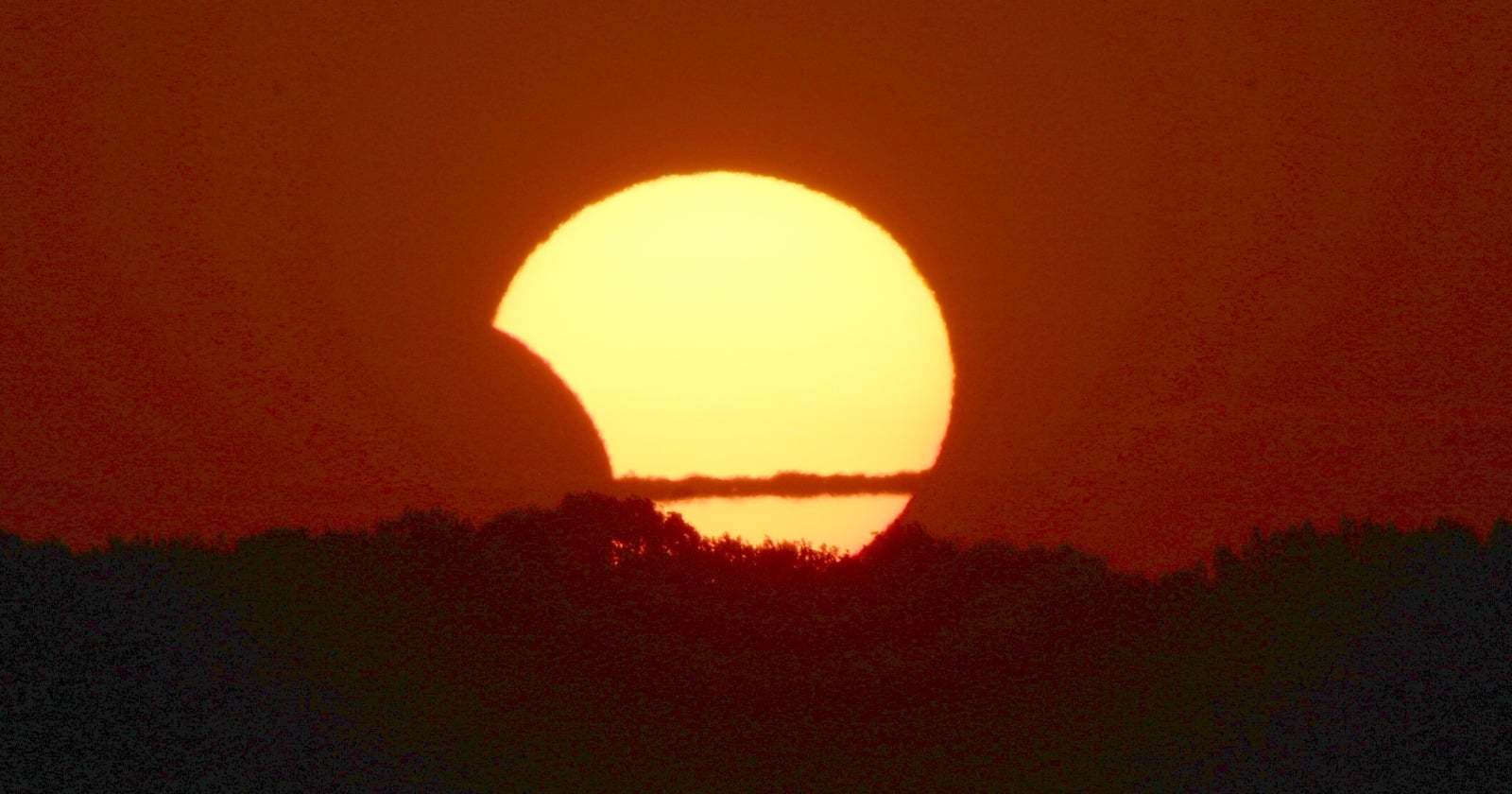
Detroit will see 3 percent of the Sun covered. Fairbanks will see 37 percent. Between those two numbers sits every other American city on NASA’s list, and much of the country sees none of it.
Then, after midnight, the compensation. A solar eclipse can only happen at new moon, so the sky over North America on the night of August 12 holds no moonlight at all, and that is the night the Perseids reach their predicted maximum.
What reaches the United States
The path of totality crosses Greenland, Iceland, northern Russia, the Atlantic, Spain and a small corner of Portugal, according to NASA’s figures for August 12. None of it touches North America. What arrives here is the partial eclipse, across parts of the northern states only, from Alaska to North Carolina, and it comes in the morning for Alaska, around midday for the northern contiguous states, and into midafternoon farther east.
Maximum coverage for a selection of American cities, with local times of greatest eclipse:
- Fairbanks, Alaska: 37 percent at 8:27 a.m.
- Anchorage, Alaska: 28 percent at 8:21 a.m.
- Bangor, Maine: 24 percent at 1:53 p.m.
- Boston: 16 percent at 1:55 p.m.
- New York: 9 percent at 1:54 p.m.
- Washington, D.C.: 4 percent at 1:53 p.m.
- Detroit: 3 percent at 1:36 p.m.
NASA’s own description is a small bite taken out of the solar disk, as though the Moon has just clipped the edge of the Sun. At the bottom of that range nobody will notice. Removing 3 percent of the Sun’s area does not visibly change the daylight, and the whole event can pass over Detroit unremarked by anyone who is not holding a filter.
A small bite is not a safe bite. NASA’s rule is that nobody looks at a partially eclipsed Sun without protection, at any coverage and through every partial phase, which means eclipse glasses or a handheld viewer meeting the ISO 12312-2 standard rather than sunglasses of any tint, and never a camera, binoculars or a telescope unless a purpose-built filter is fitted over the front. Our earlier eclipse preview sets out the rest of NASA’s guidance.
Or skip looking up altogether. A pinhole projector, or the shadow cast through the leaves of a tree, puts the notched disk on the ground at your feet.
Better American views are a long way off. NASA’s schedule of future eclipses puts the next total solar eclipse on August 2, 2027, crossing southern Spain, North Africa, Saudi Arabia and Yemen. The United States gets a partial view of that one too, from northern Maine only.
The eclipse hands over a moonless night
A solar eclipse requires the Moon to pass between Earth and the Sun, which is the definition of new moon. The eclipse is its own proof that the Moon will be absent after dark.
Lunar glare is what usually ruins a meteor shower. The Southern Delta Aquariids peak on the night of July 30 to 31 under a Moon 98 percent full, which the American Meteor Society expects to compromise that shower severely. The Perseids two weeks later draw the opposite luck: peak night August 12 to 13, Moon zero percent illuminated, conditions the AMS calls optimum.
Their debris comes from comet 109P/Swift-Tuttle, which takes about 130 years to circle the Sun by the reckoning of the IMO’s 2026 meteor shower calendar, or 133 years by NASA’s, and last came through the inner solar system in 1992. The grains arrive at 59 kilometres per second, or 37 miles per second, fast enough to leave the glowing wakes the shower is known for. The Perseids are known for fireballs too, meaning meteors brighter than magnitude -3.
When to go outside depends on where you are. The IMO places the predicted maximum between 02:00 and 04:00 UT on August 13, which is 10 p.m. to midnight Eastern on August 12, or 7 to 9 p.m. Pacific.
Eastern observers come out of that well. The IMO notes that from mid-northern sites the radiant, the point the meteors appear to fan out from, has climbed to a reasonable elevation from 22:00 to 23:00 local time onwards, so the forecast window opens at roughly the hour the sky becomes worth watching, and the radiant keeps rising for hours after that.
The Pacific zone draws the worse hand. At 7 p.m. local the sky is still bright and the radiant sits well below the elevation the IMO calls reasonable, so the forecast peak passes before anyone on the West Coast can act on it.
Alaska does worst, which is the day’s real irony. Fairbanks and Anchorage lead the American eclipse table at 37 and 28 percent, and both lie north of 60 degrees latitude, which the IMO gives as roughly the limit beyond which the shower cannot be properly viewed. The peak window is no kinder: 02:00 UT on August 13 falls in the early evening there, hours before the sky goes dark. Juneau, at 17 percent coverage, sits south of that line and keeps both halves of the day.
None of which narrows the target as much as a two-hour forecast implies. Historical observations place the broad maximum anywhere between 21:00 UT on August 12 and 09:00 UT on August 13, which covers the whole of the night in the Eastern zone and most of it farther west. NASA’s Perseids viewing tips say what they say every year, that the pre-dawn hours are best with some meteors possible as early as 10 p.m., and the AMS is blunter still, noting that these showers are all best seen after midnight. Wherever you stand, the hours after local midnight do the most work, and what they ask for is a site well away from town lights, a wide view of the sky, and enough patience to let your eyes adapt.
A stream that may run below par
A moonless sky is only half of what determines how many meteors anyone sees. The other half looks weaker than usual this year.
The IMO’s calendar gives the Perseids a zenithal hourly rate of 100, then spends a paragraph taking it apart. Modelling by Maslov, the calendar notes, indicates that the background activity of the stream is expected to be notably lower than the usually quoted ZHR of 100 until 2026. Only in 2027 will Earth again cross sections of the stream stirred up by Jupiter’s gravity, which may then push general rates back up. On the IMO’s own reading, 2026 sits at the end of a lean stretch.
Two possible bonuses are on the table, both hedged, neither timed for American skies. Vaubaillon’s calculations put Earth near a branch of the 1079 dust trail at 16:53 UT on August 12, just before 1 p.m. Eastern and in broad daylight, and the calendar declines to give any activity estimate because the trail is so old. A weak filament of Swift-Tuttle catalogued by Jenniskens in 2006 is predicted for around 01:00 UT on August 13, with an uncertainty of five hours either way and an expected ZHR of 43 or below. The calendar’s judgment is that the trail and the filament may become detectable if the background rate is low, which is a forecast about whether a signal could be picked out, not a promise of a busy sky.
The 100 figure is a ceiling in any case, assuming a radiant straight overhead and a sky no observer gets. Published expectations for a real count vary widely. The AMS puts normal rates from rural locations at 30 to 50 meteors per hour at maximum, while NASA’s Perseids page carries both a fast-fact figure of about 25 meteors per hour under dark skies and a body-text range of 50 to 100, which is a fair illustration of how loosely the number travels even in careful hands.
In the early afternoon of August 12, the light under a tree in Michigan will carry a field of small discs, each one faintly notched where the Moon has clipped the Sun.
