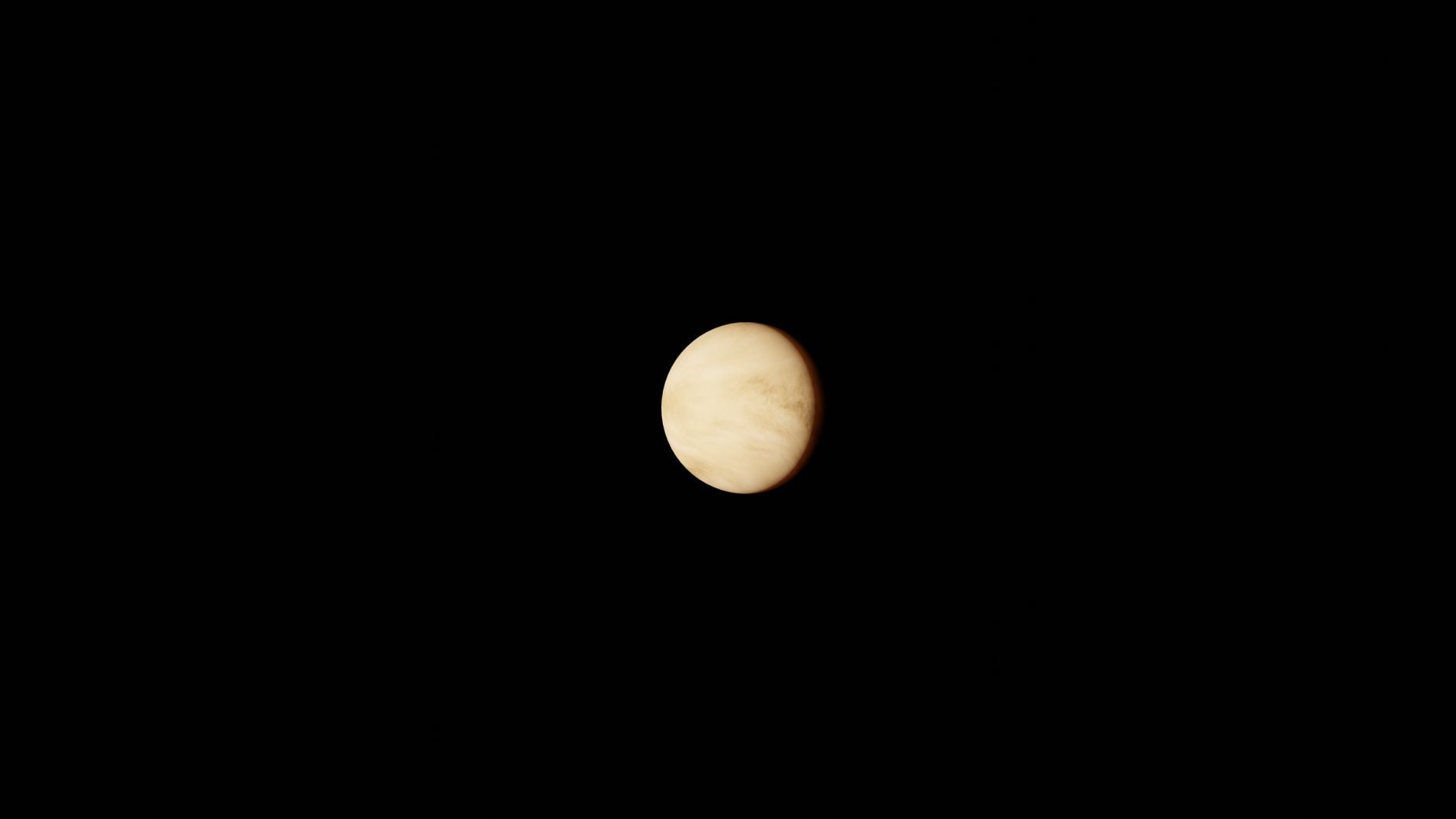
Venus appears to keep two incompatible clocks. Its solid surface takes about 243 Earth days to rotate once relative to the distant stars, while the planet completes an orbit around the Sun in about 224.7 Earth days. On that definition, one Venusian day is longer than one Venusian year.
Yet clouds near the top of its atmosphere circle the planet in roughly four Earth days. They stream westward at speeds approaching 360 kilometres per hour while the ground at the equator turns at only about 6.5 kilometres per hour.
The figures are not contradictory. They describe four different motions: the spin of the solid planet, its orbit, the Sun’s apparent passage through its sky, and air moving with far greater angular speed than the surface directly beneath it.
The famous day is measured against the stars
A day can be measured against the stars or against the Sun. A sidereal day is the time a planet needs to complete one rotation relative to distant space. A solar day is the interval between two successive local noons, or two other equivalent positions of the Sun in the sky.
NASA lists Venus’s rotation period at 243 Earth days and its year at 225 days. Venus also rotates retrograde, opposite to the direction in which it orbits. The Sun would therefore appear to rise in the west and set in the east.
That backward rotation changes the solar clock. Venus’s orbital motion and its rotation work together rather than against each other, bringing the Sun back to the same position in the sky after about 116.75 Earth days. A place near the equator would have roughly 58 Earth days of daylight followed by a similarly long night, although the planet’s opaque clouds would hide a sharp solar disc.
The familiar “day longer than a year” comparison is therefore correct only when day means a rotation measured against the stars. Someone living on the surface and counting local noons would experience nearly two solar days during each Venusian year.
This removes the first apparent contradiction. The four-day circuit does not describe either kind of ground-level day. It describes material moving through the atmosphere.
The clouds are not fixed to the surface
On Earth, weather generally moves much more slowly than the planet rotates. Venus reverses that relationship. At altitudes near 65 to 70 kilometres, ESA’s Venus Express observations tracked clouds sweeping around Venus once every four days. The atmosphere at that level rotates about 60 times faster than the solid planet.
Planetary scientists call this atmospheric super-rotation. The term does not mean the atmosphere is detached from Venus. Gravity holds the gas to the planet, pressure links each layer to the layers above and below, and friction couples the lowest air to the ground. But an atmosphere can still circulate around a planet much faster than the rock turns.
There is a useful terrestrial analogy, provided it is not pushed too far. Earth’s jet streams move around the globe independently of the soil below them. Venus has taken that separation to an extreme: its upper clouds move in the same westward direction as the planet’s retrograde spin, but at vastly greater speed.
The height qualification is essential. Winds near the surface are slow, partly because the dense lower atmosphere encounters drag from the ground. Speeds increase with altitude, becoming strongest around the upper cloud deck. Saying that “Venus’s atmosphere circles in four days” is convenient shorthand for the high, fast cloud-bearing layers, not every parcel of gas from the surface upwards.
This vertical separation also appeared in my earlier look at why the Venus cloud layer remains part of the habitability discussion. Conditions roughly 50 kilometres up differ sharply from the crushing pressure and 465-degree heat below. On Venus, altitude is not a minor detail.
Thermal tides move angular momentum
A fast atmosphere cannot maintain itself merely because the planet rotates. Venus hardly rotates at all by planetary standards, and surface friction should gradually remove energy and angular momentum from the winds. The circulation therefore needs ways to transfer angular momentum, the rotational equivalent of linear momentum, through the atmosphere.
Sunlight supplies energy unevenly. Venus’s clouds absorb solar radiation, heating the dayside and creating large-scale variations in pressure and temperature. This slowly repeating heating pattern produces strong atmospheric thermal tides. These are global waves in air pressure and temperature, not tides in an ocean.
In 2020, Takeshi Horinouchi and colleagues used images and temperature measurements from Japan’s Akatsuki orbiter to map how several processes transport angular momentum near the cloud tops. Their Science paper found that thermal tides carry angular momentum towards low latitudes, helping maintain the strongest westward flow around the equator.
The result did not reduce the circulation to one cause. A slower north-south and vertical circulation tends to weaken the equatorial super-rotation by moving angular momentum away from low latitudes. Other waves and turbulence contribute differently at middle and high latitudes. As JAXA’s account of the Akatsuki analysis explains, the observed circulation depends on these processes acting together.
The atmosphere also transports heat. Its fast westward flow moves warm air away from the long-lit dayside while slower circulation carries energy towards the poles and between altitudes. This helps explain why Venus’s surface temperature varies far less between day and night than its slow solar cycle might suggest. The dense atmosphere is constantly redistributing energy while the ground creeps beneath it.
Mountains can reach into the cloud deck
Akatsuki supplied a particularly clear example of coupling between the surface and the atmosphere. In 2015, the spacecraft observed a bow-shaped feature about 10,000 kilometres long. It remained nearly fixed above the slowly rotating surface for several days even as the background clouds streamed past.
A 2017 paper in Nature Geoscience interpreted the feature as a gravity wave generated as lower-atmosphere flow crossed the high terrain of Aphrodite Terra and propagated upwards. Gravity waves form when buoyancy restores vertically displaced air, rather as ripples form when water is disturbed. They are different from gravitational waves in spacetime.
The observation showed that the slow ground and fast clouds are not independent systems. Surface topography can leave a detectable structure tens of kilometres above it. A later Nature Astronomy analysis found numerous stationary or slowly moving features in the night-side upper clouds, many concentrated over elevated terrain.
Mountain-generated waves are not a complete explanation for super-rotation. The 2017 modelling offered preliminary support for the interpretation while acknowledging that propagation through the near-surface conditions remained difficult to reproduce. Their significance is that angular momentum can move vertically as well as north, south, east and west. Any complete model has to account for this exchange across a cloud layer more than 20 kilometres thick.
Why the solid planet turns backwards
The slow retrograde spin of the solid planet is a separate, older problem. A large collision early in Venus’s history has often been proposed, but the modern rotation is not simply a fossil of one impact. Over billions of years, the Sun has exerted gravitational tides on the solid body, while solar heating has raised thermal tides in Venus’s dense atmosphere. Those torques can act in opposing directions.
Models show that their balance can support a slow retrograde state. They do not give us a unique reconstruction of Venus’s early spin, atmosphere and possible oceans. The important distinction is between explaining why the atmosphere currently super-rotates and explaining how the entire planet reached its present rotation. The two questions interact, but they are not interchangeable.
Even the modern spin rate is not perfectly constant. Earth-based radar observations obtained from 2006 to 2020 produced an average sidereal period of 243.0226 Earth days, with variations of roughly 20 minutes in the instantaneous length of day. The published spin-state analysis identified exchanges of momentum between the atmosphere and solid planet as one plausible contributor.
Twenty minutes is tiny beside a 243-day rotation, but it is measurable. It is also a reminder that the atmosphere racing overhead and the rock below are continually coupled, even when their apparent speeds differ by a factor of about 60.
Four clocks, one planet
I have come across the same interpretive trap in other planetary stories. In my earlier article on ice surviving in Mercury’s permanently shadowed craters, the planet closest to the Sun still contained places sunlight never reached. My piece on Titan’s methane rain, rivers and lakes dealt with familiar weather words describing an unfamiliar liquid.
Venus’s timing puzzle turns on the same need for precision. The 243-day rotation belongs to the rock and is measured against the stars. The 224.7-day year belongs to the orbit. The 116.75-day solar day belongs to the apparent Sun. The four-day circuit belongs to high clouds driven around the planet by a super-rotating atmosphere.
Akatsuki has shown how thermal tides, slower meridional circulation, waves and turbulence divide the work of transporting angular momentum near the cloud tops. It has not made every part of Venusian circulation predictable, nor has it supplied a complete history of the planet’s retrograde spin. Those remain separate problems for observations and models to constrain.
The four clocks can run together because none is measuring quite the same motion.