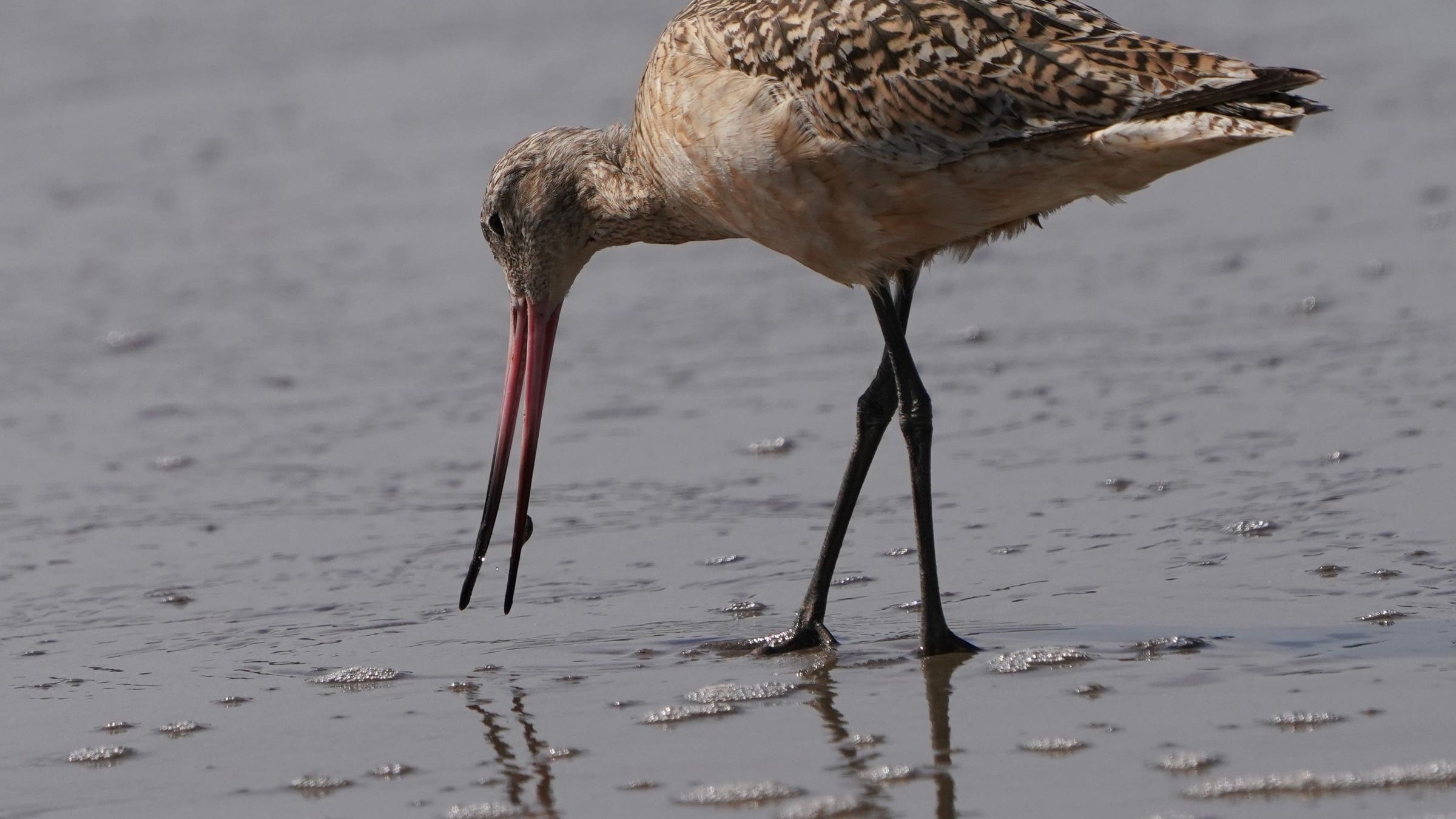
On 13 October 2022, a juvenile bar-tailed godwit left western Alaska and pointed itself south across the Pacific. Eleven days and one hour later, it reached Ansons Bay in north-eastern Tasmania.
The track covered about 13,560 kilometres. There was no island stop, no meal and no quiet night on a beach. The bird stayed airborne through daylight and darkness, crossing an ocean larger than many continents while carrying a solar-powered transmitter weighing five grams.
The first surprise is that the record holder was only about four months old. The second is that this was not a freak performance by an otherwise ordinary bird. Bar-tailed godwits have evolved around journeys that turn their bodies into temporary flying machines.
But two parts of the question need a little care. Chocolate bars come in wildly different sizes, and reports of the record did not publish the exact mass of the bird, known as B6. Juvenile godwits sampled at the start of migration averaged about 367 grams, so the comparison works with a large family-sized block, not a standard 100-gram bar.
And although the transmitter showed that B6 did not land, it did not record the bird’s brain. We know it flew continuously. We do not yet know whether it went entirely without sleep.
The track that turned an astonishing migration into a measurement
Scientists had suspected for years that Alaska-breeding bar-tailed godwits flew directly to New Zealand and eastern Australia. The birds vanished from coastal Alaska and appeared thousands of kilometres away, carrying fat stores that seemed designed for a transoceanic crossing.
In 2005, researchers assembled weather records, field observations and flight models into a detailed case for an 11,000-kilometre nonstop route. Satellite transmitters later changed the question from whether godwits could make the flight to exactly how they did it.
An adult female called E7 provided one of the first complete tracks in 2007, flying roughly 11,680 kilometres from Alaska to New Zealand in just over eight days. Space Daily has previously examined that landmark journey.
B6 went farther. After fattening on Alaska’s Kuskokwim Delta, the juvenile departed on 13 October and reached Tasmania on 24 October. The USGS described its 8,425-mile route as the longest documented nonstop flight by any animal.
The transmitter proves continuity by recording an unbroken moving track across the ocean. It does not produce a video of every wingbeat, but a landing long enough to rest or feed would have created a stationary location pattern. None appeared.
Before takeoff, the bird rebuilds itself
A godwit does not simply eat a large breakfast and leave. It changes the allocation of tissue inside its body.
In a study of juvenile Alaska godwits, birds sampled while feeding averaged 379 grams. Birds sampled at the beginning of migratory flight averaged a similar 367 grams. The similarity concealed a remarkable transformation.
Fat accounted for about 17 percent of the feeding birds’ mass. In the migrating birds, it made up almost 55 percent. At the same time, the mass of water and fat-free tissue had fallen sharply.
The changes were not distributed evenly. The liver, kidneys, stomach and intestines were all smaller in birds entering flight. A 2021 reanalysis documented the transformation in detail. Earlier work memorably summarised the strategy as “guts don’t fly”: once a bird has loaded the fuel it needs, carrying a full digestive system across the Pacific becomes expensive dead weight.
The godwit is effectively swapping digestive capacity for range. It will not need a large gut over open water because there is nothing it can eat there. On arrival, it can rebuild digestive tissue as it resumes probing mudflats for worms, molluscs and other invertebrates.
This is more sophisticated than treating fat as fuel in an aircraft tank. The airframe itself is changing before and during the journey.
Fat carries more than energy
Fat is exceptionally useful for long-distance flight because it stores more energy per gram than carbohydrate or protein. It also produces metabolic water when oxidised, helping an animal that cannot stop for a drink.
Even so, the bird is not powered by fat alone. Long endurance flights also consume some protein, and shrinking tissues can contribute both mass and amino acids. The exact balance between stored fat, protein use, water production and tissue repair remains an active research problem.
A review of extreme endurance migration noted that the biochemical adaptations allowing a shorebird to budget energy, water and nutrients for more than a week are still not fully understood. Even detailed flight models depend on assumptions about muscle efficiency, metabolic costs and how much protein the bird consumes along the way.
That gap matters. Saying the godwit “burns fat” is true in the same way that saying a spacecraft “uses fuel” is true. It names the energy source without explaining the engineering that makes such extreme economy possible.
The Pacific wind is part of the machine
The bird’s body is only half of the system. The atmosphere supplies the other half.
Godwits do not leave Alaska on an arbitrary date. They wait for weather that can give them favourable winds at the beginning of the route and improve their chances farther south. A poor departure decision can add hours of effort, push the bird away from land or exhaust its reserves before it reaches a usable shore.
Researchers who analysed satellite tracks from 24 godwits found that the birds selected winds across several legs of their annual migration. Their 29,000-kilometre circuit around the Pacific passes through changing pressure systems, storm tracks and seasonal wind fields.
This does not mean the birds receive a perfect tailwind for 11 days. They encounter crosswinds and conditions that force route corrections. The point is that departure timing and the shape of the route can reduce the energetic bill.
For a bird carrying only a finite load of fat, wind is not background scenery. It is part of the fuel calculation.
A four-month-old bird must also know where to go
B6’s age makes the journey stranger still. This was not an experienced adult following a route memorised over many seasons. It was a juvenile on its first southbound migration.
Young godwits may travel with other birds, but adults often depart before juveniles because they have had more time to refuel. That raises a difficult question: how much of the route is inherited, how much is learned from a flock, and how much is corrected in flight?
Bird navigation can draw on several signals, including the Sun, stars, Earth’s magnetic field, wind and large-scale visual or olfactory cues. Over the central Pacific, familiar landmarks disappear. A bird also has to compensate for drift, because holding a compass direction while the air mass moves sideways will not necessarily deliver it to the intended coast.
The track tells us that B6 solved the problem. It does not reveal which cue the bird was using at each moment. In that sense, the five-gram tag gave scientists a line across a map while leaving much of the computation inside the animal hidden.
Did it really fly without sleeping?
This is the least settled part of the story.
Continuous flight does not automatically mean continuous wakefulness. In 2016, researchers fitted great frigatebirds with devices that recorded electrical activity from both brain hemispheres. They showed that the birds could sleep in flight with one hemisphere or both hemispheres at once.
Yet even the frigatebirds slept surprisingly little while airborne, averaging about 42 minutes a day, roughly seven percent of the sleep they obtained on land. Their sleep came in short, shallow episodes, often while circling in rising air.
A godwit presents a different aerodynamic challenge. Frigatebirds are expert soarers. Bar-tailed godwits cross the Pacific mainly through sustained flapping flight, so we cannot simply transfer the frigatebird result from one species to another.
It is plausible that godwits take microsleeps or allow one hemisphere to enter a sleep-like state while the other maintains control. It is also possible that they suppress most sleep for the duration and recover after landing. Without brain recordings from a migrating godwit, both ideas remain hypotheses.
So the strongest scientifically defensible version of the claim is this: B6 flew for 11 days without landing or feeding, and it did so without any conventional period of sleep on the ground. Whether tiny episodes of sleep occurred in the air is unknown.
The answer is not one adaptation but a chain of them
How does an animal the mass of a large chocolate block cross the Pacific?
It stores an extraordinary fraction of its body as fat. It reduces organs that will not be useful over open ocean. It spends some of its own tissues as the journey continues. It times departure around large-scale weather, adjusts its route through moving air and navigates toward a coast it may never have seen.
Most importantly, all of those pieces have to work together. More fuel makes the bird heavier. A larger flight muscle provides power but costs energy to carry. A smaller digestive system saves mass but leaves the bird dependent on finding rich mudflats after arrival. Waiting for better wind can save fuel, but waiting too long risks missing the seasonal window.
The record is therefore not simply a story about toughness. It is a story about precision and trade-offs.
There is one final consequence. A migration this finely balanced depends on healthy feeding grounds at both ends and at the stopovers used during the rest of the annual circuit. The USGS tracks these birds partly because shorelines and wetlands are being altered by development, sea-level rise and climate change.
B6 crossed an empty ocean under its own power. But before and after that flight, its survival depended on a chain of muddy, unglamorous places where a very small bird could eat enough to perform one of the largest journeys in the animal world.