
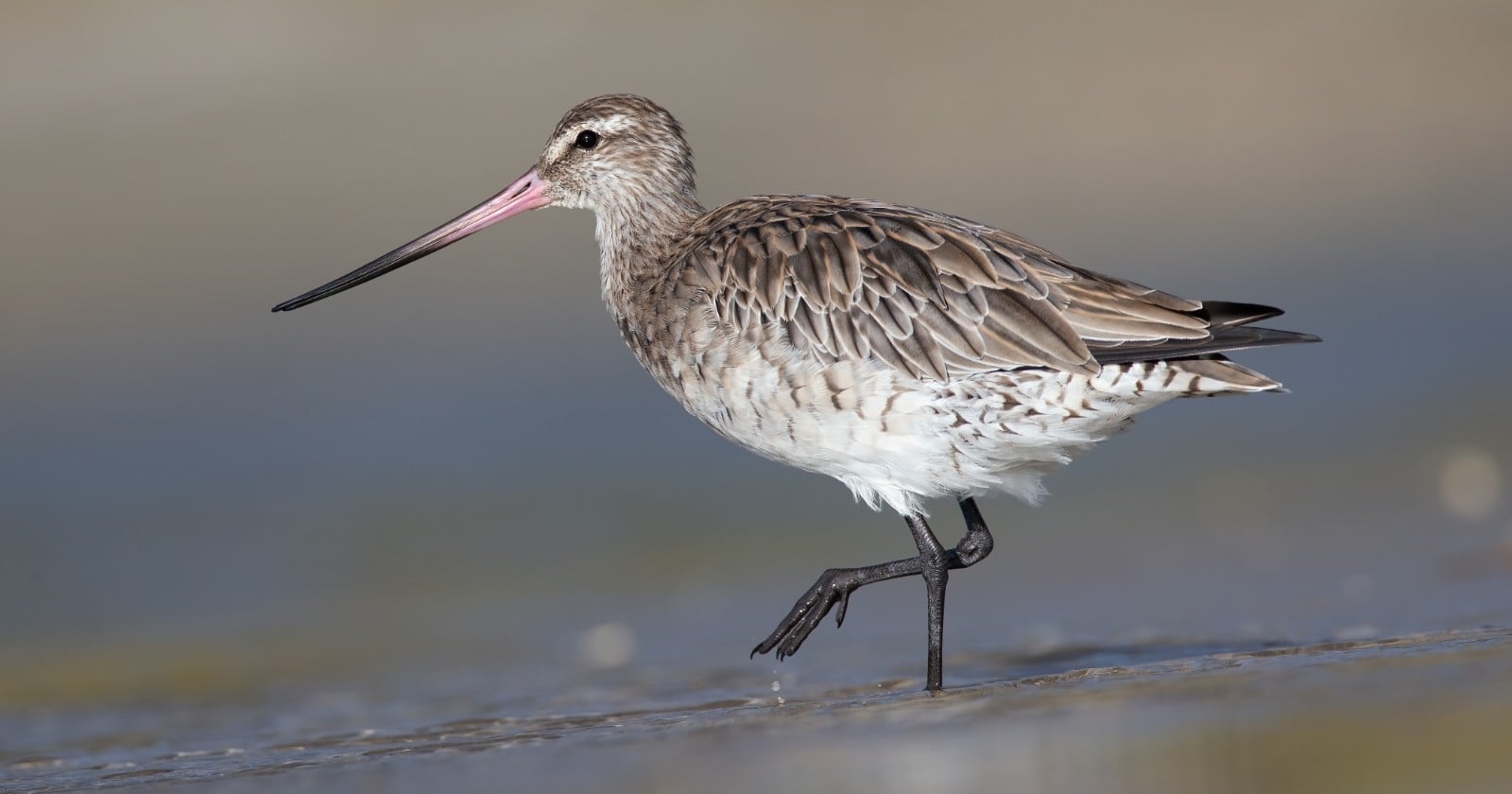
A female bar-tailed godwit fitted with a satellite transmitter left western Alaska and flew 11,680 kilometers, about 7,250 miles, straight across the Pacific Ocean to the North Island of New Zealand. She did it in one continuous flight lasting 8.1 days, never touching land, never feeding, never drinking. When researchers published the track in 2009, it was the longest nonstop flight ever recorded for any land bird.
She was not a fluke. In the same study, seven satellite-tagged female godwits flew nonstop between 8,117 and 11,680 kilometers across the open ocean, spending six to more than nine days in the air. The distances were so far beyond what anyone had documented that the researchers, led by U.S. Geological Survey biologist Robert Gill, described the flights as setting “new extremes for avian flight performance”. Until then, the record for a nonstop landbird crossing was a far eastern curlew that flew about 6,500 kilometers between Australia and China, with roughly 4,500 kilometers of that over open water. The godwits nearly doubled the distance, and did the whole of it over ocean.
The bird rebuilds itself before takeoff
A godwit cannot simply decide to fly for a week. It has to become a different animal first. In the weeks before departure, godwits gorge on the rich clams and worms of the Yukon-Kuskokwim Delta and pack on fat until, in juveniles departing Alaska, lipids make up about 55 percent of total body mass. A bird that is more than half fuel by weight is close to the physical limit of what can still get airborne.
Then it does something stranger. To make room and cut dead weight, a departing godwit reduces the size of the organs it will not need. Earlier research on these ocean crossings found that the birds’ digestive organs shrink substantially around the flight, while the flight muscles and heart stay powered up. The bird effectively trades much of its gut for fuel, because it will not eat again until it lands on the far side of the ocean.
Sustaining that flight burns energy at an estimated eight to ten times the bird’s resting rate, held for more than nine days at a stretch. In the animal energetics literature, the researchers noted, that combination of intensity and duration is essentially unmatched.
By the time it reaches New Zealand, the transformation runs in reverse. A bird that departed as more than half fuel arrives with almost none of it left, its fat spent and its shrunken gut still to be rebuilt before it can feed normally again. The godwit does not just fly the ocean; it remodels its own body twice to do it.
Timing the wind
Distance is only half the problem. The other half is choosing the day to leave. Godwits do not launch at random; they wait for weather systems that will push them south.
The birds time their departures from Alaska to coincide with the tailwinds thrown off by the Aleutian low-pressure systems that sweep into the Gulf of Alaska in autumn. In the study, the tagged godwits left almost exclusively on days when the pressure maps showed winds blowing hard to the south, and their departure headings lined up closely with the wind. A good launch buys them free distance and spares fuel they cannot spare.
After that, the corridor itself does some of the work. The central Pacific route the godwits follow is nearly empty of the predators and disease that crowd a coastal migration with its many refueling stops. A bird flying nonstop over open ocean is beyond the reach of falcons and picks up no parasites along the way. The flight is brutal, but the path is, in the researchers’ framing, less a barrier than a clean corridor.
The route is also remarkably straight. The tagged godwits left Alaska on a heading close to due south and held it across the whole central Pacific. They stayed inside a corridor only about 1,800 kilometers wide, a narrow lane down one of the emptiest stretches of ocean on Earth. Their tracked speed averaged around 16.7 meters per second, roughly 37 miles per hour, fastest just after departure when the tailwinds were strongest and slowest near the equator where the winds fall quiet.
Curiously, the godwits fly the ocean route only heading south. On the return trip to Alaska in spring, they hug the coast of Asia and break the journey into shorter legs. The researchers think the difference comes down to safety margins. On the southbound flight there are Pacific islands to fall back on if a bird’s fuel runs low, while the final stretch of a northbound ocean crossing would leave roughly 4,000 kilometers with no place to land at all.
The flight was reconstructed from satellite fixes
No one watched a godwit fly for eight days. The tracks come from transmitters that reported location in bursts, with long gaps between them, and the satellites fixed each position to within a kilometer or two at best. The team calculated distances as great-circle paths between fixes and estimated the exact departure and arrival moments by extrapolating from the first and last stretches of flight.
That method is strong enough to establish the nonstop crossings, and the researchers checked it carefully. For most birds there was simply no plausible way to reach land and return to the tracked path without a telltale slowdown that never appeared. For a few individuals near the start or end, they could not rule out a very brief pause of under an hour, but nothing that would count as a real stopover. The nonstop flights hold up.
What is genuinely unsettled is the biology underneath them. The flights, the authors wrote, “challenge current physiological paradigms” on sleep, dehydration and the body’s ability to remodel itself. Whether and how a godwit sleeps while flying over open ocean for a week is not established; it is one of the open questions the flights force, not a solved detail. The dramatic figures for fat load and organ shrinkage come from separate studies of the same population, not from the tagged birds themselves. The record, in other words, is solid; the full explanation for how the animal survives it is not.
The record has only grown
The 2009 tracks were not the last word. In 2022, the U.S. Geological Survey reported a four-month-old godwit, a juvenile tagged as B6, that flew from Alaska to Tasmania, a distance of 8,425 miles, roughly 13,560 kilometers. It stayed in the air 11 days without stopping, on a five-gram solar-powered tag, a flight the agency logged as a world record. That a bird making its very first migration, with no adult to follow, can cross an ocean this way only deepens the puzzle.
The godwit weighs less than a pound. It has no way to soar and rest like an albatross; it flaps the entire way. And somewhere over the middle of the Pacific, days from any land in any direction, it is navigating across the equator, where the magnetic cues many birds rely on grow unreliable, with no coastline and no landmark to steer by. How it holds its course, and whether it can afford to close even half its brain to sleep while it does, are questions the tracking has raised and not yet answered.
