
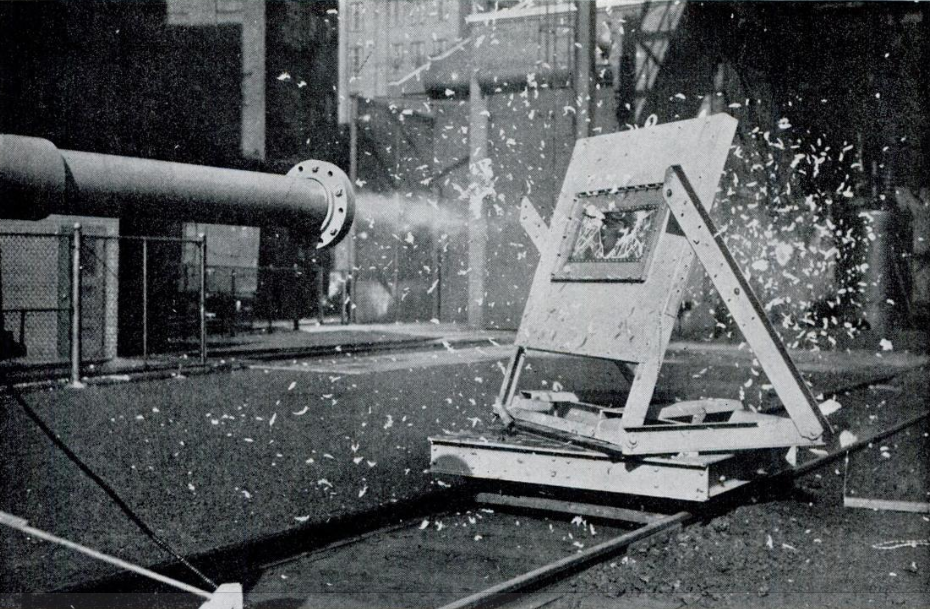
The practice is exactly what the name suggests, and it has been the standard method for demonstrating aircraft bird-strike resistance since 1942. A dead chicken, thawed, unfrozen, weighing approximately 1.8 kilograms, is loaded into a compressed-air cannon and fired at the windshield or engine intake of a test aircraft at speeds approaching 900 kilometres per hour. The impact is measured. The debris is examined. The results are submitted to the certification authority. And the aircraft is either certified or sent back to the design team.
The device is called, formally, a flight impact simulator. Every aerospace engineer working in structural certification calls it a chicken gun.
The practice is both older and stranger than most travellers assume. The specific set of engineering decisions that produced it are worth setting out plainly, because they explain why modern commercial aircraft can survive events that, on any first-principles physical analysis, would seem to guarantee their destruction.
How the tests are actually conducted
A modern chicken gun is a large-diameter smoothbore tube, typically several metres long, connected to a compressed-air reservoir at one end and a targeted test frame at the other. The bird carcass is placed in a lightweight foam sabot inside the barrel, oriented so it will strike the target in a specific attitude. The air behind the sabot is compressed to a working pressure of approximately 2.4 bar, or 35 pounds per square inch. When the operator opens the release valve, the compressed air expands into the barrel, accelerating the sabot and its contents along the length of the tube. At the muzzle, a stop ring catches the sabot and allows only the carcass to continue toward the target. The bird arrives at the specified velocity in a fraction of a second.
The tests are meticulously calibrated. High-speed cameras record the impact at hundreds of thousands of frames per second. Strain gauges attached to the target measure the deflection of the structure. Load cells record the total force transferred. Pressure sensors record the transient acoustic effects. The debris field is photographed and catalogued. The bird itself is examined, in what industry publications quietly refer to as “snarge analysis,” to determine whether it struck the target correctly.
The birds themselves are procured from ordinary poultry suppliers. They are usually purchased already slaughtered but not frozen, because frozen birds impart substantially different impact forces than fresh birds and produce non-representative test results. The specific chicken used is, on the accumulated evidence of eight decades of practice, a four-pound broiler.
If you find this article interesting, you’ll also enjoy our video on airplane radiation:
The 1942 origin
The chicken gun was invented by the United States Civil Aeronautics Administration, working in collaboration with the Westinghouse Electric and Manufacturing Company, at the latter’s High Power Laboratory in Pittsburgh in 1942. According to the historical documentation collected in the Wikipedia article on the device, the specific engineering problem it was designed to solve was the vulnerability of contemporary aircraft windshields to bird strikes at low altitudes.
The results of the first tests were, on the recorded evidence of the period, alarming. The windshields of the Douglas DC-3, the most common passenger aircraft in service at the time, were penetrated completely by a four-pound bird travelling at only 120 kilometres per hour, or approximately half the take-off speed of the aircraft it was mounted to. Subsequent testing established that laminated panels made of glass interleaved with polyvinyl chloride sheets were substantially more resistant to bird impact. The specific glass-plastic laminate construction still used in modern aircraft windshields, from Boeing widebodies down to general-aviation Cessnas, was developed in direct response to the Pittsburgh tests.
The original gun operated at the Westinghouse High Power Laboratory until November 1943, then moved to a Civil Aeronautics Administration facility in Indianapolis, then was retired at some point in 1947. A similar gun was independently developed by de Havilland in the United Kingdom in the mid-1950s. The Royal Aircraft Establishment in the UK built its own version in 1961. The Canadian National Research Council opened its Flight Impact Simulator Facility next to Ottawa airport in 1967. The United States Air Force built the AEDC Ballistic Range S-3 at Arnold Engineering Development Complex in 1972, initially to test the canopies of the F-4 Phantom, F-111 Aardvark, and A-10 Thunderbolt II. Every subsequent generation of commercial and military aircraft has been tested against a version of the same fundamental device.
What the tests are meant to demonstrate
Modern certification of a commercial jet engine requires the demonstration of several specific bird-ingestion scenarios. According to the Federal Aviation Administration’s Title 14 Code of Federal Regulations §33.76, which is the specific regulation governing bird ingestion for turbine aircraft engines, an engine must be tested against at least four separate threat categories.
Large single bird ingestion, using one bird of between 1.85 and 3.65 kilograms depending on the engine’s inlet throat area, fired at 200 knots true airspeed and aimed at the most critical location on the first-stage rotor blades. The engine must not experience an uncontained failure, meaning rotating parts must not be ejected from the engine casing.
Medium flocking bird ingestion, using between one and six birds of 0.35 to 1.15 kilograms, fired in rapid succession within one second of elapsed time. The engine must produce at least 75 per cent of takeoff thrust after the ingestion and must run continuously for a specified 20-minute post-ingestion demonstration.
Large flocking bird ingestion, using birds of 1.85 to 2.5 kilograms, fired at 200 knots and targeted at the first exposed rotating stage. The engine must maintain at least 50 per cent of maximum rated takeoff thrust during a 20-minute run-on demonstration.
Climb flocking bird ingestion, using one bird of the maximum medium-bird weight, fired at 261 knots true airspeed, aimed at whatever location on the fan will drive the maximum bird material into the engine core. The engine must not shut down and must sustain at least 50 per cent of maximum rated takeoff thrust.
The specific test schedules, laid out in FAA Advisory Circular AC 33.76-1B, issued 3 April 2023 as the current regulatory guidance, prescribe not only the ingestion event itself but the specific throttle movements, dwell times, and power settings the engine must sustain in the minutes following. The engine must not just survive the impact. It must continue producing enough thrust to keep the aircraft flying for long enough to reach a diversion airport and land.
What the Boeing 757 test revealed
The specific case that established the current stringency of the certification standards was the Boeing 757 airframe development programme of the late 1970s. During certification testing, a four-pound chicken was fired at the aircraft’s cockpit roof at 360 knots, approximately 670 kilometres per hour. The specific expectation of the Boeing engineers, on the strongest current reading of the surviving technical records, was that the roof would withstand the impact without visible deformation.
It did not. The chicken penetrated the aircraft skin. The Boeing 767, which shared the same fundamental fuselage design, had to be recalled from operators already flying it, for structural reinforcement of the specific area the test had shown to be vulnerable. A subsequent test on the cabin windows, requested by the UK Civil Aviation Authority under a more stringent test regime than the FAA of the period required, also failed. The metal frame around the windows required further re-engineering before the aircraft could be certified for European service.
Approximately 1,000 Boeing 757s and 767s were produced. Approximately 1,000 aircraft carry a specific structural reinforcement in the cockpit roof and window surrounds that traces its existence back to a single dead chicken fired at 360 knots in a Boeing test facility in Seattle.
What the tests do not demonstrate
The chicken gun has, on the accumulated evidence of eighty years of use, functioned as a broadly effective means of catching structural vulnerabilities before they enter service. It has also generated a substantial critical literature in the engineering and sociology-of-science communities.
Several specific limitations are widely acknowledged. Farm-raised broiler chickens have lower muscle density and softer bone structure than the wild birds that actually strike aircraft, meaning the test bird may impart less impact force than a comparable-mass wild specimen would. The bird’s specific orientation at the moment of impact is difficult to control precisely, and the test typically records the “correct” hits and discards results where the bird tumbles or strikes at an unrepresentative angle. Real bird strikes frequently involve multiple birds hitting different parts of the aircraft simultaneously, which the standard test protocols simulate only imperfectly. The artificial bird analogs sometimes proposed as ethical alternatives, typically gelatin blocks with fibre reinforcement, do not include the bird’s skeleton and produce measurably different impact signatures.
These limitations were catalogued in some detail in the 2009 study “Epistemological Chicken: What do we learn from aircraft bird-ingestion tests?” by the sociologist John Downer of the London School of Economics, which argued that the standardised bird strike test is, at bottom, a socially constructed proxy for an event that cannot be fully replicated in a controlled setting. The engineering community has generally accepted the argument, and generally proceeded with the tests anyway, on the grounds that a proxy that catches most structural failures before service is substantially better than no proxy at all.
What the practice actually shows
The chicken gun is, in the specific sense in which engineering practice is judged, a working solution to a problem that has no other tractable solution. Real bird strikes cannot be conducted on demand at controlled speeds against known target locations. Live birds cannot be sacrificed to the tests without both practical and ethical difficulties. Computer simulation is not yet accurate enough to certify aircraft on its own, though it now supplements the physical tests in every certification programme.
The specific event that most publicly demonstrated the value of the tests occurred on 15 January 2009, when US Airways Flight 1549 struck a flock of Canada geese approximately 90 seconds after takeoff from LaGuardia Airport. Both engines lost thrust. The aircraft, an Airbus A320, had been certified against the FAA’s bird ingestion standards before entering service, meaning its engines had been shown to survive impacts with single birds of up to approximately three kilograms and flocks of medium birds of up to approximately one kilogram each. The specific geese that hit Flight 1549 weighed between three and four kilograms each, and the engine ingested them in numbers exceeding the certification threshold.
The engines failed. But the aircraft did not disintegrate. The rotating parts did not exit the casings. Captain Chesley Sullenberger and First Officer Jeffrey Skiles retained sufficient control to glide the aircraft to a survivable ditching on the Hudson River. All 155 people on board survived.
The certification tests did not prevent the engine failure. They prevented the specific structural failure modes that would have made the ditching impossible.
The chicken gun did its job.
