
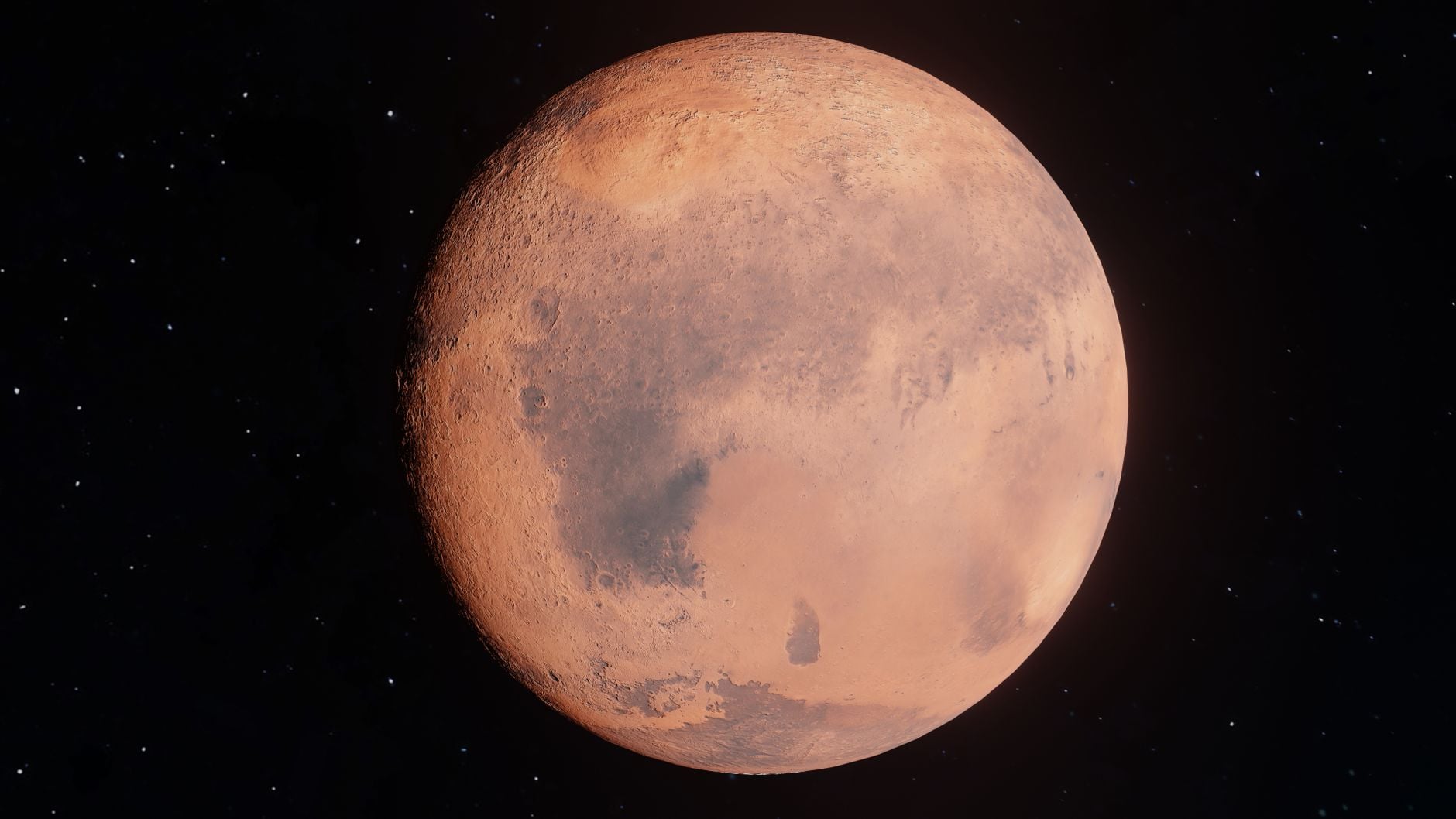
The history of Mars is often told as three planetary disasters in sequence. First the internal dynamo failed, taking the global magnetic field with it. Then the solar wind reached more directly into the upper atmosphere and carried gas away. Finally, with the air thin and the climate cold, the rivers stopped and the standing water disappeared.
There is evidence behind each act. There is also a risk in making the chain too clean. Mars did not lose its field on a known afternoon, its atmosphere in a single storm or all its water to one destination. Nor did those losses make the solid planet smaller. Mars was already small, and that fact may have shaped every stage that followed.
What looks like three catastrophes was a coupled transition extending across billions of years. The interior cooled, the Sun changed, the atmosphere leaked, water moved into space and rock, and a relatively low-mass planet became progressively less able to sustain liquid water at its surface.
Before the desert, rivers crossed Mars
The wet past is more than an artist’s reconstruction. Orbiters have mapped branching valley networks, deltas, channels and basins. On the ground, rovers have examined rounded stones transported by streams, minerals altered by water and fine sediments laid down in lakes.
Curiosity found both stream gravel and lake-floor mudstone inside Gale Crater. In 2015, the mission team described a succession of streams and lakes that existed between roughly 3.8 and 3.3 billion years ago. Perseverance later landed in Jezero Crater beside a fan of sediment built where a river once entered a lake.
That does not mean early Mars was a permanently mild version of Earth. The young Sun was fainter than it is now, and models have difficulty keeping the entire Martian surface warm for long periods with a carbon dioxide atmosphere alone. Water may have flowed during intermittent warmer episodes involving snowmelt, rainfall, volcanism, impacts or additional greenhouse gases. The geology establishes rivers and lakes. It does not settle every question about how long the warmth lasted or whether a northern ocean was stable.
First act: a dynamo faded
A planetary dynamo converts motion in an electrically conductive fluid core into a global magnetic field. Earth maintains such a field through its liquid outer core. Mars does not have one today, but old Martian rocks retain a strong magnetic imprint, especially across parts of the southern highlands.
That remanent magnetism is a record of an earlier field. Rocks cooled and solidified while the dynamo was operating, preserving its direction. Much of the younger crust and several large impact basins lack an equally strong signature, indicating that the global field weakened or stopped early in Martian history.
The chronology is not completely settled. Some younger magnetised surfaces have been interpreted as evidence for later activity or a more complicated sequence of shutdown and revival. A 2021 analysis by D. J. Hemingway in the Journal of Geophysical Research: Planets examined possible histories of the Martian core while treating the strongly magnetised ancient crust as evidence that an early dynamo once operated and later ceased.
Mars’s size matters here. A small world loses internal heat faster than a large one because it has more surface area relative to its volume. Changes in heat flow through the core and mantle could have removed the conditions needed to sustain the dynamo. The planet retained local magnetic fields frozen into its crust, and the solar wind still induces magnetic fields around its ionosphere, but the large internally generated shield was gone.
Second act: the upper atmosphere leaked into space
The solar wind is a thin flow of charged particles carrying magnetic fields outward from the Sun. At Mars, it transfers energy to the upper atmosphere. Electric fields accelerate atmospheric ions away from the planet. Extreme ultraviolet light heats the upper air and breaks molecules apart. In a process called sputtering, energetic ions strike neutral atoms and molecules, sometimes knocking them into space.
NASA’s Mars Atmosphere and Volatile Evolution mission, known as MAVEN, was built to measure these processes. The orbiter studied Mars from 2014 until NASA declared the mission ended in June 2026, after contact had been lost six months earlier. Its observations showed that gas escapes today and that the rate responds to solar activity. The young Sun produced stronger extreme ultraviolet radiation and was more active, so losses could have been much greater in the distant past.
MAVEN also read the history preserved in isotopes. Argon is useful because it is chemically inert and is not readily concealed in Martian rocks. Lighter argon escapes more easily than heavier argon. In 2017, Bruce Jakosky and colleagues reported in Science that the imbalance indicated about 65 percent of the argon once present had been lost. Argon is not the gas that warmed ancient Mars, but it is a tracer showing that physical escape removed a large fraction of the atmosphere.
In 2025, a team led by Shannon Curry reported in Science Advances the first direct observation of sputtering at Mars. Simultaneous measurements from three MAVEN instruments placed high-altitude argon where incoming energetic particles were striking the atmosphere. The observed rate was four times higher than previous predictions and increased during solar storms, according to NASA’s report on the paper.
The lost dynamo is an important part of this history, but a global magnetic field is not an absolute seal. Venus has no Earth-like intrinsic field and retains a massive atmosphere. Earth has a strong field and still loses some ions. Mars’s low gravity, atmospheric composition, ultraviolet exposure and the supply of particles to the upper atmosphere all affected the outcome. The shield story describes a change in solar interaction, not a single sufficient cause.
Third act: the water divided among several destinations
As greenhouse gases diminished, pressure fell and Mars cooled, stable liquid water became harder to maintain. Surface water could evaporate. In colder conditions it could freeze, then sublimate directly from ice into vapour. Ultraviolet light could split water molecules in the upper atmosphere, allowing light hydrogen to escape much more easily than oxygen.
Yet the phrase “the oceans evaporated” leaves two matters unresolved. First, the evidence for rivers and long-lived lakes is stronger than the case for a single extensive northern ocean. Proposed shorelines and ocean volumes remain debated. Second, evaporation is a change of state, not a final destination.
Some Martian water did escape to space. Some remains as polar and subsurface ice. Some reacted with crustal rocks and became fixed in hydrated minerals, with no plate-tectonic recycling system to return it efficiently to the atmosphere and surface.
A 2024 analysis by Bruce Jakosky in the Journal of Geophysical Research: Planets attempted to count these sinks. It estimated that water equivalent to a planet-wide layer 110 to 570 metres deep had been lost to space, while 130 to 260 metres had been incorporated into minerals. Another 20 to 30 metres was assigned to present-day exchangeable water in the polar caps, mapped near-surface ice and adsorbed water. Possible buried ice and deeper crustal water make the total inventory more uncertain still.
These are model-assisted ranges assembled from several kinds of observation, not a direct measurement of a vanished sea. They nevertheless rule out the simplest image of an ocean merely steaming away and vanishing. Mars redistributed water as well as losing it.
The planet was not reduced to half size
Mars is approximately half Earth’s diameter and about 10.7 percent of its mass. The atmospheric and water losses did not remove half of a rocky planet. The words “half the size it was supposed to be” point instead to the small-Mars problem in models of Solar System formation.
If rocky planets are allowed to grow from a smoothly distributed disk of material in many classical simulations, the body near Mars’s orbit often becomes far too massive. The real Mars appears to have stopped growing early. Isotopes in Martian meteorites support rapid formation, and a 2011 paper by Nicolas Dauphas and Ali Pourmand in Nature argued that Mars may be a stranded planetary embryo that avoided the later giant collisions through which Earth and Venus accumulated more mass.
There is no literal size Mars was “supposed” to reach. The phrase describes a mismatch between models and the planet we observe. Proposed solutions include an early migration of Jupiter that truncated the inner disk, a narrow initial ring of rocky building material, uneven movement of pebbles through the disk and an early instability among the giant planets. A successful model must explain not only Mars’s mass, but also its rapid growth, composition and orbit without ruining the rest of the inner Solar System.
The smallness is not the fourth catastrophe. It is the starting condition. Lower gravity made atmospheric escape easier. Faster cooling may have shortened the dynamo’s active life. A planet that failed to grow into another Earth or Venus was less able to hold internal heat, air and accessible surface water over geological time.
One history, not three clean endings
The transformation of Mars had feedbacks rather than sharp boundaries. Interior cooling affected magnetism and volcanism. Atmospheric loss weakened greenhouse warming. Cooling moved water into ice and minerals. A thinner atmosphere made stable surface water still more difficult, while the young Sun continued to energise escape from above.
Calling these changes catastrophes captures their accumulated consequence, not their pace. For most of Mars’s history, the losses were measured not as an explosion but atom by atom and season by season. The riverbeds survived because stone keeps a record longer than air does.
Mars did not die three separate deaths. A small planet followed one connected physical history from rapid formation to early rivers and onward to the frozen desert now observed. The magnetic field, atmosphere and surface water are chapters in that history, but the first fact was the planet’s limited mass, set before any of those chapters began.
