

Mercury is the planet that seems least entitled to keep ice.
It circles closest to the Sun. Its daytime surface can become hot enough to melt lead. It has no thick atmosphere to soften the thermal swing between day and night. NASA’s Mercury facts page gives the blunt range: daytime temperatures can reach 800 degrees Fahrenheit, or about 430 degrees Celsius, while nights can fall to about minus 180 degrees Celsius.
Yet that same planet appears to store water ice in some of the coldest natural vaults in the inner solar system.
The reason is not that Mercury is secretly gentle. It is that sunlight does not reach everywhere. Near Mercury’s poles, some crater floors and walls sit in permanent shadow because the planet’s rotational axis is barely tilted. A crater rim can block the Sun for billions of years. Inside those shadows, the usual mental picture of Mercury breaks down.
The result is one of the better planetary science reversals: on a world whose sunlit ground reaches 430 degrees Celsius, there are places that may never have been warmed by direct sunlight at all.
The coldest places are not the farthest from the Sun
It is tempting to think planetary temperature is mostly a matter of distance. Mercury is close to the Sun, so Mercury should be hot. Neptune is far away, so Neptune should be cold. That is useful as a first sketch, but it misses the local geometry that matters at crater scale.
Mercury’s axis is almost upright relative to its orbit. At the poles, the Sun skims low along the horizon rather than climbing high overhead. If an impact crater is deep enough, its floor can remain permanently shadowed even while nearby slopes bake under intense sunlight.
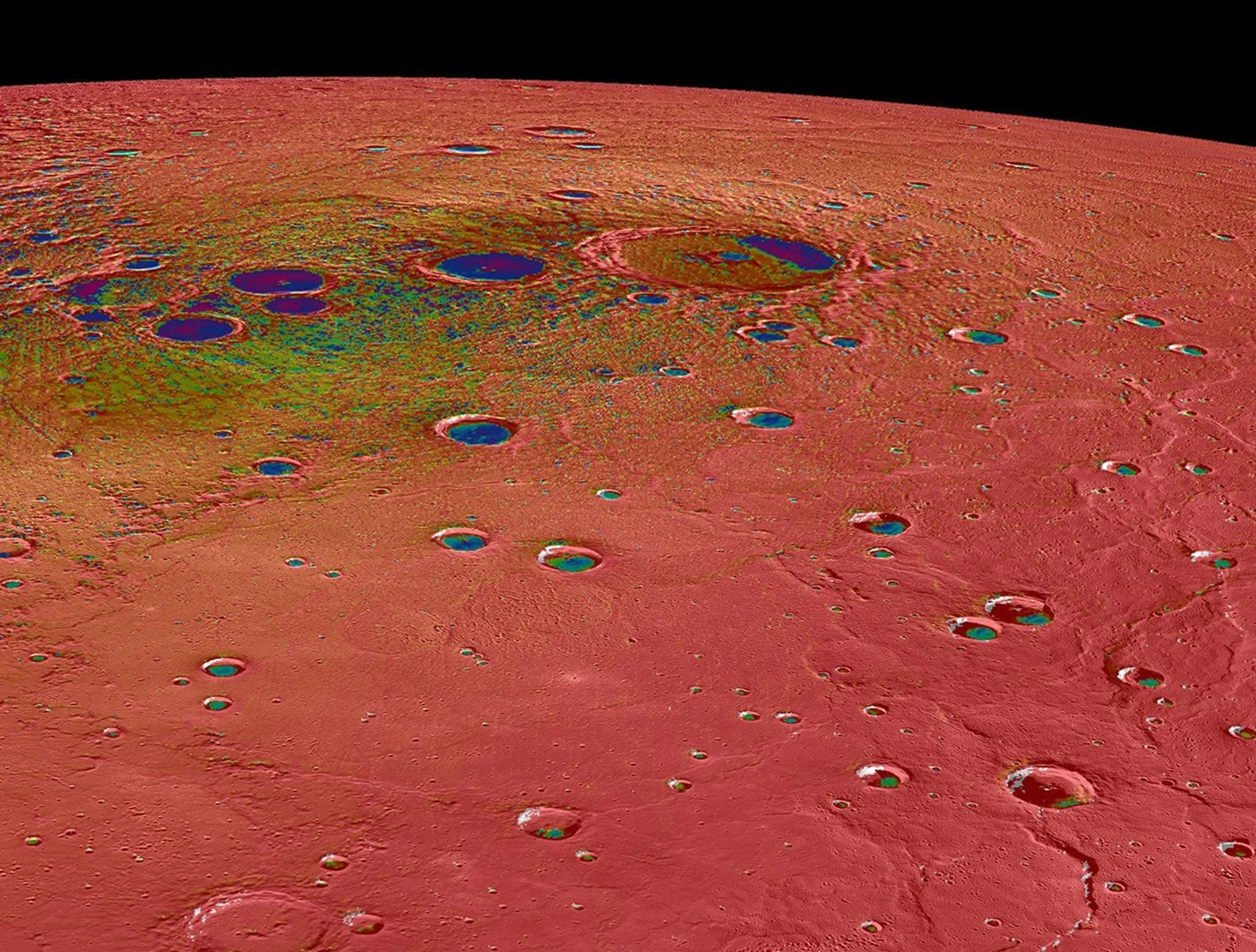
NASA’s “Hot and Cold” MESSENGER image shows this contrast visually. The view of Mercury’s north polar region is coloured by maximum surface temperature, with sunlit areas hot and polar shadow traps extremely cold. NASA notes that evidence from MESSENGER and Earth-based observations indicates water ice deposits are present in these cold craters.
Some of the coldest polar crater interiors can stay below 100 kelvin, or about minus 173 degrees Celsius. That is cold enough for water ice to remain stable at the surface over very long periods. In slightly warmer shadowed craters, the ice may survive only if it is buried under a thin layer of darker material.
So Mercury is not one temperature. It is a patchwork of extremes: red-hot plains, freezing nights, and polar hollows where the Sun’s heat is almost irrelevant.
The evidence began before MESSENGER
The idea of ice on Mercury did not begin with a spacecraft landing in a crater and digging it up. It began as a remote-sensing problem.
In 1991, radar observations from Earth detected bright patches near Mercury’s poles. Those radar-bright areas behaved in ways that were consistent with ice, but early observations could not settle the question. The puzzle was partly geometric. NASA’s Mariner 10 had flown past Mercury in the 1970s but mapped less than half the planet, leaving the polar terrain poorly constrained.
MESSENGER changed that. The spacecraft entered orbit around Mercury in 2011 and spent more than four years mapping the planet before its planned impact in 2015. NASA’s mission summary says MESSENGER verified that Mercury’s polar deposits are dominantly water ice, after also revealing details about the planet’s composition, geology and magnetic field.
In 2012, NASA announced that MESSENGER had supplied new support for the water-ice hypothesis. Instruments aboard the spacecraft found that radar-bright features at Mercury’s north and south poles lay within permanently shadowed regions, and that the neutron and reflectance measurements were consistent with abundant water ice and other frozen volatile materials. The NASA/JPL announcement described the findings as compelling support for water ice in Mercury’s permanently shadowed polar craters.
This is important because the result did not depend on one instrument alone. Radar, imaging, neutron data and thermal modelling all pointed in the same direction. Each line of evidence had limits, but together they made the ice interpretation much harder to dismiss.
Why the ice can survive
Mercury has no real atmosphere in the Earth-like sense. It has a very thin exosphere, made of atoms knocked from the surface by solar wind and micrometeorite impacts. That means heat is not spread efficiently around the planet.
On Earth, air and oceans move energy around. On Mercury, a shadow can remain a shadow in a more absolute way. A polar crater floor that never sees the Sun is not warmed by thick air, clouds or weather. It sits in darkness, exposed to space, with only weak heat leaking in from its surroundings.
That is why the ice is not a contradiction. The sunlit surface can be brutally hot while a nearby shadowed floor is cold enough to trap volatiles for geological time.
The word “ancient” should be handled carefully. The ice deposits are ancient in the sense that they may have persisted for very long periods and may preserve material delivered by comets or volatile-rich asteroids over the planet’s history. But the deposits are not dated like a tree ring or a crater count. They are inferred from where the ice can remain stable and from the long-lived nature of Mercury’s polar cold traps.
Some of the material may also be mixed with darker compounds. NASA’s 2012 report noted that in places where ice appears buried, the overlying dark material may be a mix of complex organic compounds delivered by impacts. That does not make Mercury habitable. It makes the polar deposits chemically interesting, because they may preserve a record of volatile delivery to the inner solar system.
A planet of extremes
Mercury often gets reduced to a simple fact: closest planet to the Sun. That fact is true, but it makes the world seem less strange than it is.
MESSENGER showed a planet with a large iron core, a magnetic field, volcanic plains, contracting cliffs, unusual surface chemistry and polar ice. BepiColombo, the joint European-Japanese mission now travelling toward Mercury, is expected to add another layer of detail when it enters orbit in the coming years.
The polar ice matters because it turns Mercury from a heat statistic into a geography problem. The planet is not uniformly scorched. It has places where sunlight is overwhelming and places where sunlight has never arrived. The same world can host both conditions because orbit, tilt, topography and time combine in ways that intuition does not always predict.
That is the quiet lesson in Mercury’s ice. Distance from the Sun is not the whole story. Sometimes the difference between fire and frozen water is the height of a crater wall, the angle of a pole, and a shadow that does not move.