

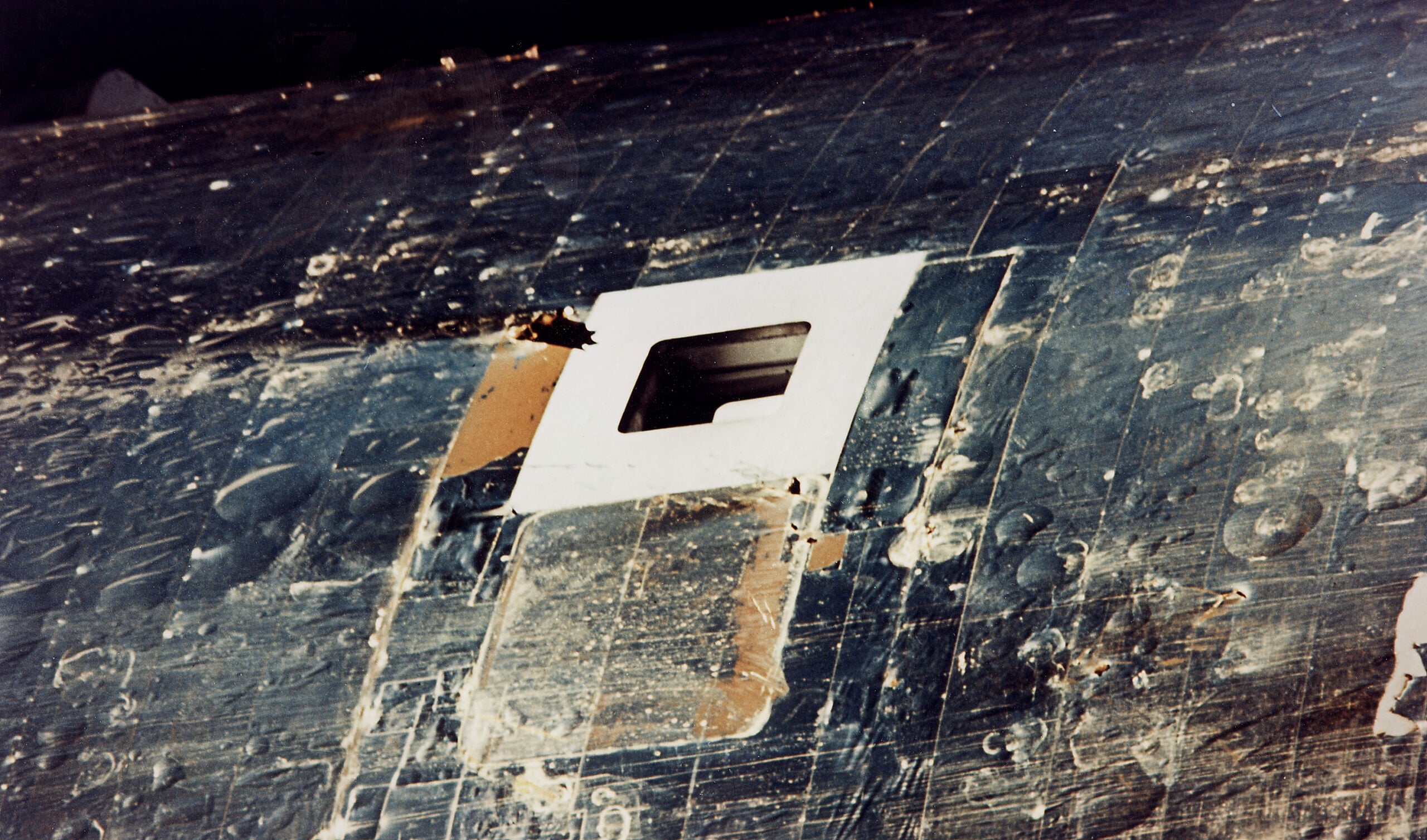
Skylab reached orbit on 14 May 1973, but the achievement almost ended before anyone could live aboard it. During launch, the shield wrapped around the orbital workshop tore away. One of the station’s two main solar wings disappeared with it, while debris trapped the other against the hull. Direct sunlight began heating the exposed laboratory towards temperatures no crew could safely tolerate.
NASA had planned to launch the first astronauts one day later. Instead, the agency postponed them for ten days while teams worked out how to cool an underpowered station they could not reach from the ground. Their answer was a folding parasol, designed and built in days, carried into orbit in an Apollo command module and pushed outside through a small scientific airlock.
The failure began 63 seconds after launch
Skylab was America’s first space station, built around a converted Saturn V rocket stage and launched without a crew aboard the final Saturn V on 14 May. According to NASA’s history of the station, telemetry showed trouble about 63 seconds into flight.
The micrometeoroid shield had begun to deploy while the vehicle was still climbing through the atmosphere. Aerodynamic forces tore it away. The shield also served as Skylab’s thermal blanket, so the loss exposed the workshop directly to the Sun. One main solar wing was lost, and wreckage from the shield pinned the second wing partly closed.
Smaller arrays on the station’s telescope mount opened normally, but they could not replace the missing power. Controllers faced an awkward compromise: point the remaining arrays towards the Sun to generate electricity and the workshop heated more quickly; turn Skylab away and its limited power supply fell further.
The temperature climbed towards 54°C
Without its outer shield, Skylab’s workshop reached about 125 to 130°F, or roughly 52 to 54°C. The problem went beyond astronaut comfort. Mission managers feared that heat could spoil food, film and experiments, while insulation might release toxic chemicals into the station’s air.
The crew scheduled to launch on 15 May instead returned to Houston. Commander Charles “Pete” Conrad, pilot Paul Weitz and science pilot Joseph Kerwin trained while engineers at Johnson Space Center and Marshall Space Flight Center worked around the clock on possible repairs.
Ground controllers also changed Skylab’s attitude to balance temperature and power until help arrived. That kept the station alive, but it did not make the workshop habitable. A physical shade still had to cover the area where the lost shield had been.
A 22-by-24-foot parasol fitted inside Apollo
Teams developed three possible sunshades. One required a spacewalk, another would have been attached from the open hatch of the Apollo spacecraft, and a third could be deployed from inside Skylab. NASA chose the third as the first repair because it demanded the least complicated operation from a crew with only days to practise.
Jack Kinzler, head of Johnson’s Technical Services Division, designed a 22-by-24-foot sheet of nylon, Mylar and aluminium supported by four spring-loaded fishing rods. NASA’s detailed reconstruction says the folded assembly fitted into a container only eight inches square and 53 inches long.
Professional parachute riggers packed it, and engineers tested it before loading the hardware beneath the crew’s seats. The Apollo command module had not been designed as a delivery van for emergency station repairs. The parasol worked because it could pass through an eight-inch scientific airlock already built into the workshop.
The crew opened an umbrella against the Sun
Conrad, Weitz and Kerwin launched on 25 May. During their inspection they confirmed that one solar wing was gone and the other barely open. An attempt to free the surviving wing from the Apollo hatch failed, and docking took repeated attempts. After a 22-hour day, the crew finally secured their spacecraft to Skylab.
The next morning they entered the workshop wearing masks, though tests found no toxic gases. Heat forced them to retreat periodically to the cooler command module as they assembled the parasol. Conrad pushed its segmented pole through the airlock. Outside, the arms opened and spread the reflective fabric, which the crew then pulled against Skylab’s exposed skin.
The material did not unfold perfectly, but it did enough. NASA records that temperatures began falling immediately and reached a comfortable range within three days. The workshop that had been too hot to occupy became a functioning home and laboratory.
The parasol saved the station, but not by itself
Cooling Skylab solved only half the emergency. With one solar wing missing and the other trapped, scientific work remained restricted by power. On 7 June, Conrad and Kerwin conducted a spacewalk to cut the metal strap holding the surviving wing down. Its hinge had frozen, so they pulled on a rope until the array sprang open and began generating electricity.
That repair restored enough power for the programme to continue. A later crew installed a more durable twin-pole sunshade over the parasol, which had always been treated as an interim solution.
Skylab ultimately hosted three crews and hundreds of experiments. Its survival is sometimes compressed into a story about one improvised umbrella. The fuller account is more useful: controllers kept a crippled vehicle balanced between overheating and power loss, engineers produced several repair paths under a fixed deadline, and astronauts carried out work that the station’s original mission plan had never imagined.