
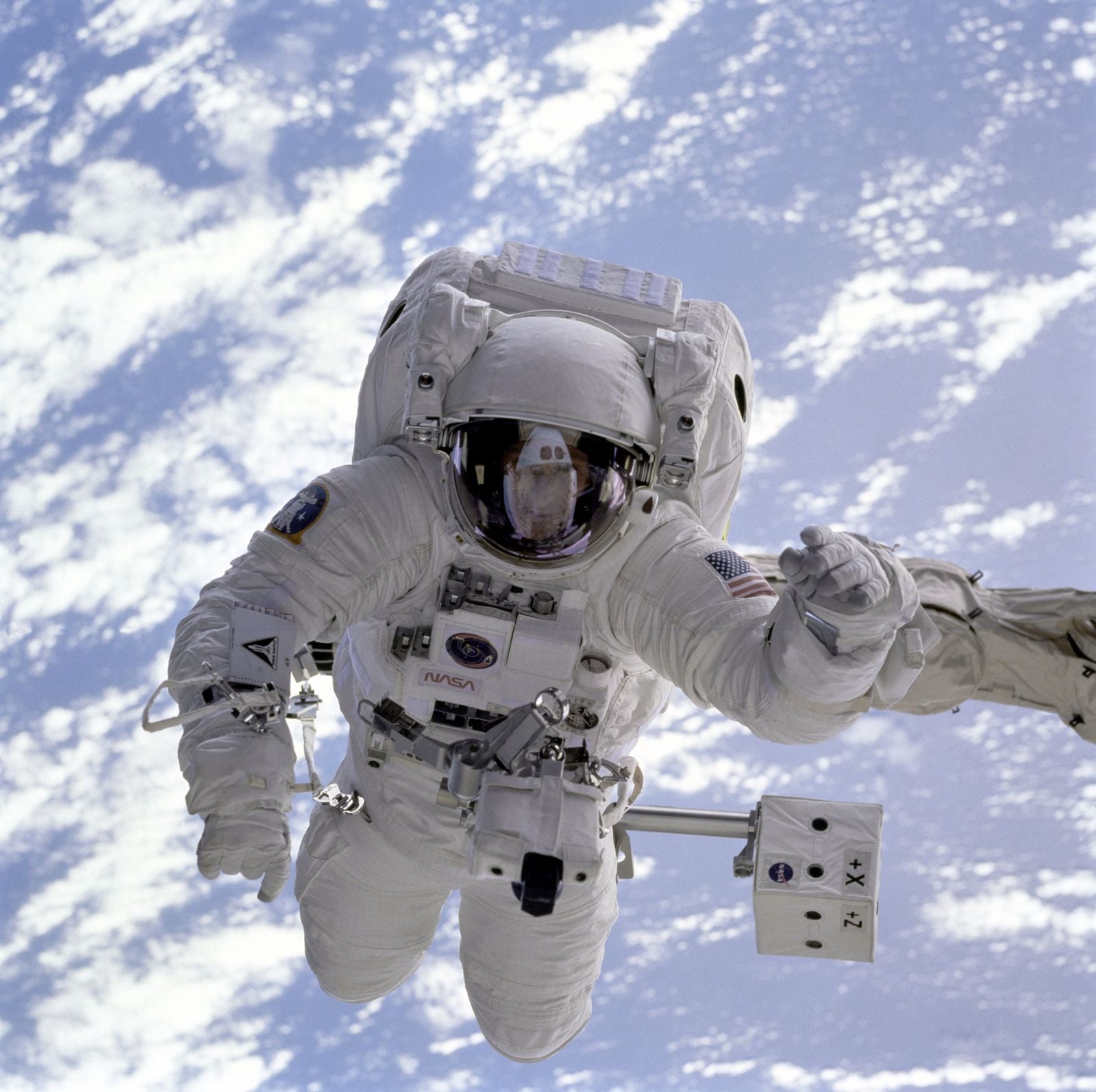
An astronaut does not return to Earth as someone who has forgotten gravity. The problem is quieter than that. After a long mission, the body knows intellectually that the floor is back, but the nervous system has been spending months solving movement in a world where weight no longer behaved as expected.
That mismatch can show up in ordinary actions: standing, walking, turning, stepping over an obstacle, or handling an object that now has weight again.
We are writers, not clinicians. What follows is a reading of the research on spaceflight adaptation, not medical advice.
The finding is worth taking seriously, but it should not be read as the final word on every astronaut or every mission. Spaceflight studies often involve small crews, constrained testing windows, and operational realities that make tidy laboratory comparisons hard. Even so, the pattern across the literature is consistent enough to matter: gravity is not just a force acting on the body. It is part of the body’s operating system.
Gravity is a reference signal
On Earth, the brain does not have to calculate gravity from scratch every time a person stands up. The inner ear, vision, touch, pressure under the feet, muscle stretch, and joint position all feed into a working model of where the body is and what forces are acting on it.
In orbit, that model is disrupted. The otolith organs in the inner ear, which normally help signal head tilt relative to gravity, no longer provide the same downward reference during free fall. A classic Spacelab 1 paper in Science by Laurence Young and colleagues described experiments on eye movements, postural control, orientation perception, and space motion sickness before, during, and after flight. The paper’s central point was not that astronauts become confused in a simple sense. It was that the sensory system has to reinterpret inputs that were built around a constant one-gravity world.
That reinterpretation is useful in orbit. It lets crew members move through a spacecraft, orient to walls and ceilings that no longer have the same meaning, and work without treating every floating object as a falling one.
Then landing reverses the problem.
The body has to bring back a model it has partly set aside. The floor pushes up again. The head has weight. Blood and fluid shift downward. A movement that worked in orbit may be poorly tuned for a world where mass, balance, and load have returned to their usual relationship.
Why standing and walking can look strange after landing
The most visible post-flight problem is often locomotion. Astronauts can be carried or assisted after landing not because they are helpless, but because the first hours back under gravity are a poor time to gamble on balance.
In a 1998 review in Brain Research Reviews, Millard Reschke and colleagues described posture, locomotion, spatial orientation, and motion sickness as connected outcomes of spaceflight adaptation. Their review discussed the way postural and movement strategies acquired in weightlessness can be inappropriate on return to Earth, with post-flight difficulties including standing, walking, turning corners, climbing stairs, and moving through obstacle-course style tasks.
That does not mean every returning astronaut has the same recovery. Mission length, individual physiology, in-flight exercise, landing conditions, vehicle design, sleep, hydration, and medical support all matter. The safer reading is that post-flight mobility is a known operational concern, not a dramatic surprise.
It is also not only a muscle problem. Muscle and bone deconditioning matter, and astronauts train hard in orbit because they do. But the awkwardness of early re-entry into Earth life is also sensorimotor. The body is combining vestibular signals, foot pressure, vision, and proprioception again under a load it has not carried in months.
The brain is not learning how to walk as if it were a child. It is retuning a prediction system.
The object in the hand has changed too
The same gravitational reset appears in the hand. A cup, a tool, or a piece of equipment is not simply “heavy” or “light”. On Earth, the brain predicts how much grip force to use from expected load force, friction, object movement, and the consequences of a slip. In orbit, the object still has mass and inertia, but its weight is absent.
A 2026 Journal of Neuroscience study led by Laurent Opsomer examined grip dynamics and movement in 11 European Space Agency astronauts, two women and nine men, on Earth and during spaceflight. The authors reported that the imprint of gravity remained visible even after months in weightlessness. In microgravity, the astronauts tended to overcompensate for the absence of weight when manipulating objects. After return to Earth, their early movements showed signs of incorrect load-force predictions.
That is the ordinary-object part of the story. A returning astronaut may know perfectly well that an item is back under Earth gravity. The hand may still be working from a prediction shaped by the recent past.
The study is narrow in the way spaceflight studies often are. Eleven astronauts is a valuable sample in this field, but it is not a population-level dataset. It also concerns grip dynamics under particular experimental conditions, not every form of hand use after every mission. Still, it gives a precise window into something broader: the brain anticipates the physical world, and those anticipations carry history.
Relearning does not mean starting over
“Relearn” can sound too strong if it is taken literally. Astronauts are not returning as blank slates. They bring years of terrestrial movement, extensive mission training, and medical support. What changes is the weighting of signals and predictions.
In orbit, vision may become more dominant for orientation because the old down signal is unreliable. Touch cues from hands and feet are used differently. Movements become efficient for floating, translating, bracing, and stabilising without normal weight-bearing. The body makes a workable bargain with weightlessness.
On Earth, that bargain expires.
The awkward first phase after landing is the cost of adaptation doing its job. A system that can adjust to one gravitational world must also adjust back to another. In that sense, the post-flight wobble is not a failure of the brain. It is evidence of a brain that changed because the environment changed.
Why this matters beyond recovery videos
The public version of astronaut recovery often becomes a small spectacle: crew members lifted from a capsule, sitting in chairs, smiling while medical teams work around them. The operational question is more serious and more practical.
If a crew lands on Earth, medical teams can meet them. If a crew lands on Mars, the first minutes and hours may demand useful movement before any outside rescue exists. Mars is not Earth gravity, but it is not microgravity either. The nervous system would be asked to switch again, this time into partial gravity after months of transit.
That is why the post-flight details matter. Standing is not a ceremonial act. Walking is not just fitness. Judging the weight of a tool is not merely a domestic convenience. These are mission functions when the next step is egress, surface work, emergency response, or repair.
Current countermeasures, including exercise and rehabilitation, reduce risk but do not erase the basic problem that the human nervous system adapts to the gravity field it inhabits. Future missions may need better pre-landing training, artificial-gravity exposure, sensory cueing, suit design, or task sequencing that assumes the first hours in a new gravity field are not normal hours.
The automatic world was learned once
Most of us experience gravity as background. We stand up, reach for a mug, turn a corner, catch ourselves on a step, and rarely notice the prediction running underneath the movement.
Spaceflight makes the prediction visible by taking it away.
The deeper lesson from these studies is not that astronauts are fragile when they come home. It is that the ordinary physical world is less automatic than it feels. The body treats gravity as a constant because, for almost all human life, it has been one. Send a person away from that constant for long enough, and the return is not just a landing. It is a negotiation with a rule the brain once stopped needing to mention.