
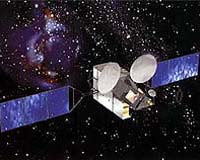
The WINDS (Wideband InterNetworking engineering test and Demonstration Satellite) satellite will be launched by an H-IIA Launch Vehicle in the fiscal year 2005 to establish the world’s most advanced information and telecommunications network.
The WINDS satellite communication system aims for a maximum speed of 155Mbps (receiving) / 6Mbps (transmitting) for households with 45-centimetre aperture antennas (the same size as existing Communications Satellite antennas), and ultra-high speed of 1.2 Gbps for offices with five-meter antennas.
In addition to establishing a domestic ultra high speed Internet network, the project also aims to construct ultra high speed international Internet access, especially with Asian Pacific countries and regions that are more closely related to Japan.
The WINDS project is responsible for the demonstration of the validity and usefulness of technologies related to large-capacity data communications in Japan’s space infrastructure project, “i-Space,” designed to promote the use of satellites in such fields as Internet communications, education, medicine, disaster measures and Intelligent Transport Systems.
The WINDS technology takes advantage of the fact that satellite communications are far-reaching, multicasting, and disaster-resistant.
Ultra-fast satellite-based Internet-based communications will remove the so-called digital divide by providing high-speed Internet service in areas where the terrestrial communications infrastructure is poor.
Among other uses, it will make telemedicine possible, bringing high-quality medical treatment to remote areas, and in distance education, connecting students and teachers who are geographically separated.
The WINDS project team has been carrying out tests on the system electric model (SEM) in parallel with tests on the structural thermal model (STM) since mid-June, 2004.
The SEM is a model for verifying the electric and communication system design that checks the following:
Verifying the electric design of the WINDS communication system and its network control
Normal operation as a satellite system is verified by combining the communication components with the SEM.
Then a comprehensive function as one communication system is verified by combining an “experimental user station” of a ultra-small earth station (USAT) that has an 45 cm-diameter antenna, and a prototype of a “base station”, that is an earth station which controls and manages the network with the SEM.
Verifying the stable power supply
Voltage fluctuation is checked when the heavy loads of the mission subsystems are powered up.
In April 2005, JAXA plans to carry out a “mission integration test” with all communication system components (except antennas) and a “compatibility test” with the components and the prototypes of user stations and earth stations to verify the high-speed switching function of the WINDS communication system.
The photo shows the SEM-MPA (Multi-port amplifier) combination test.
Using the MPA – a high-output power transmitter with eight input/output systems – power output can be controlled when radio frequency of the satellite downlink is attenuated due to rain.
WINDS is currently under joint development by JAXA and the National Institute of Information and Communications Technology, as part of the e-Japan Priority Policy Program of the Japanese government’s IT strategy headquarters.
