
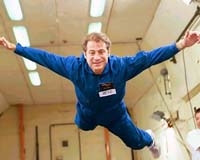
Zero Gravity Corporation (ZERO-G), a privately-held company with headquarters in Los Angeles, CA, today announced its plans to establish a commercial parabolic flight service within the U.S. Parabolic flight is the only way to create sustained weightlessness without going into space.
For years NASA has safely used its parabolic KC-135 aircraft to train astronauts and prepare experiments for spaceflight. Beginning in 2003 ZERO-G plans to begin offering commercial parabolic flights using a specially modified Boeing 727 aircraft. The company’s goal is simple: make the excitement and unique environment of weightlessness accessible to everyone in a safe and affordable fashion.
ZERO-G has identified five key markets for its weightless flights, including; the Entertainment Industry, Education & Training, Corporate Incentives, Research/Government services and the General Public.
“People have always dreamed of flying and floating free in weightlessness¿ ZERO-G is a space entertainment company that fulfills that dream,” explained Dr. Peter H. Diamandis, Chairman and CEO of Zero Gravity Corporation.
“During a parabola, you have 25 times more hang-time than the best basketball player, and are more acrobatic than any Olympic gold medalist.”
ZERO-G has achieved a number of important milestones towards its objective of establishing a US-based commercial parabolic flight service:
- ZERO-G has successfully completed a series of test flights utilizing a specially modified Boeing 727 aircraft. These tests resulted in an FAA-issued Supplemental Type Certificate (ST01051LA) allowing the Boeing 727 to conduct parabolic flights. These tests included the demonstration of safe operations of all the major aircraft systems.
- In partnership with a major Hollywood studio, ZERO-G conducted six zero-gravity flights of approximately 200 parabolas for the purpose of filming, under an experimental certificate from the FAA.
- ZERO-G has received guidance from the FAA that it will permit commercial parabolic flight operations to be conducted in partnership with a Part-121 aircraft operator. In conjunction with it’s selected aircraft operator, ZERO-G will seek final FAA approvals from the appropriate Flight Standards District Office (FSDO).
- ZERO-G has received a U.S. patent (#5,971,319), covering its modifications to the Boeing 727 and its business model of combining “night-time cargo” and “day-time parabolic flights.” In this fashion, cargo aircraft which normally fly cargo overnight during the week, will be made available to Zero Gravity Corporation during the weekends and during the days Monday through Friday for flying parabolic flights. This dual-use business model will allow ZERO-G to offer parabolic flights to customers in the most cost-effective manner.
- ZERO-G plans to enter commercial service in 2003. ZERO-G is currently establishing strategic partnerships with travel resellers, research organizations, entertainment companies and government agencies.
What is Parabolic Flight?
Specially-trained pilots fly the parabolic flight maneuvers between approximately 24,000 and 32,000 feet altitude. The maneuver is somewhat like a roller coaster in that the plane is initially pulled up to approximately 45 degrees ‘nose high.’
Next, the plane is ‘pushed over’ to begin the zero-gravity segment of the parabolas. For the next 25 – 30 seconds everything in the plane is weightless. At approximately 30 degrees ‘nose low,’ a gentle pull-out is started, which allows the participants to stabilize on the aircraft floor. Finally, the g-force is increased smoothly to about 1.8 G’s until the aircraft reaches a flight altitude of approximately 24,000 feet, and then the maneuver is repeated.
“During the course of my astronaut training I have flown over 2,000 parabolas and I know how much fun it is to be weightless,” said ZERO-G President Dr. Byron K. Lichtenberg.
“It’s awesome — pure and total freedom! I wish everyone could experience it: they’d become addicted.”
