
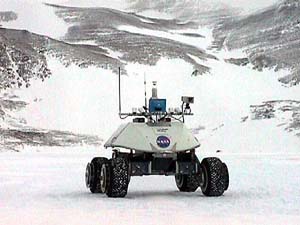
Big Signal an interactive Web site and interface for remote experience that features the daily activities of Nomad, a robot that has been searching for meteorites in Antarctica since Jan. 17, is now available to the public.
The Web site and interface were also deployed at the Carnegie Museum of Natural History, where it will be available to users at a Macintosh computer cluster for the next month.
It will also be used by teachers in classrooms at Pittsburgh’s Arsenal Middle School, Greenfield Elementary School, Columbus Middle School, as well as suburban locations including Peters Township Middle School, Keystone Oaks High School and Quaker Valley Middle School.
Big Signal, a two-year project directed by Peter Coppin, a research fellow in the STUDIO for Creative Inquiry in Carnegie Mellon’s College of Fine Arts, gives users the experience of exploring a remote location through Nomad’s sensors, including a 360-degree panoramic camera and other sensors that allow students to engage in remote geology. Big Signal receives information from Nomad daily, making the robot’s expedition easily accessible to users.
Nomad, a planetary rover prototype, is funded by NASA and was created at Carnegie Mellon’s Robotics Institute. The principal researcher on the Nomad project is William L. “Red” Whittaker and the project manager is Dimitrios Apostolopoulos.
“Big Signal extends the senses of ordinary people to a faraway place and lets users engage in a real remote experience” said Coppin. “The goal of Big Signal is to place students in a real scientific setting by giving them access to the same data that a scientist would access.”
NASA recently gave Coppin and colleagues at the Robotics Institute a three-year $500,000 grant to develop “EventScope,” an enhanced system based on Big Signal.
EventScope will allow its users to feel as if they are conducting their own scientific explorations when NASA sends rovers to other planets. Pittsburgh-based Three-Rivers Connect and the Heinz Endowments are providing more than $70,000 in matching funds for EventScope.
NOMAD SPONSORS: The Big Signal project has received more than $100,000 from foundation sources, including the Heinz Endowments, Grable Foundation and the Henry Clay Frick Fund of the Buhl Foundation. Engineers from Carnegie Mellon’s Robotics Institute, Carnegie Institute of Technology and The Center for Innovation in Learning have contributed to the project. William Cassidy, professor of geology and planetary science at the University of Pittsburgh, and Kurt Schwehr of NASA’s Ames Research Center, have also contributed to Big Signal. Web hosting has been provided by Electronic Information Network, a collaborative project of the Allegheny County Library Association (ACLA), Carnegie Library of Pittsburgh and the Commission on the Future of Libraries in Allegheny County.
