
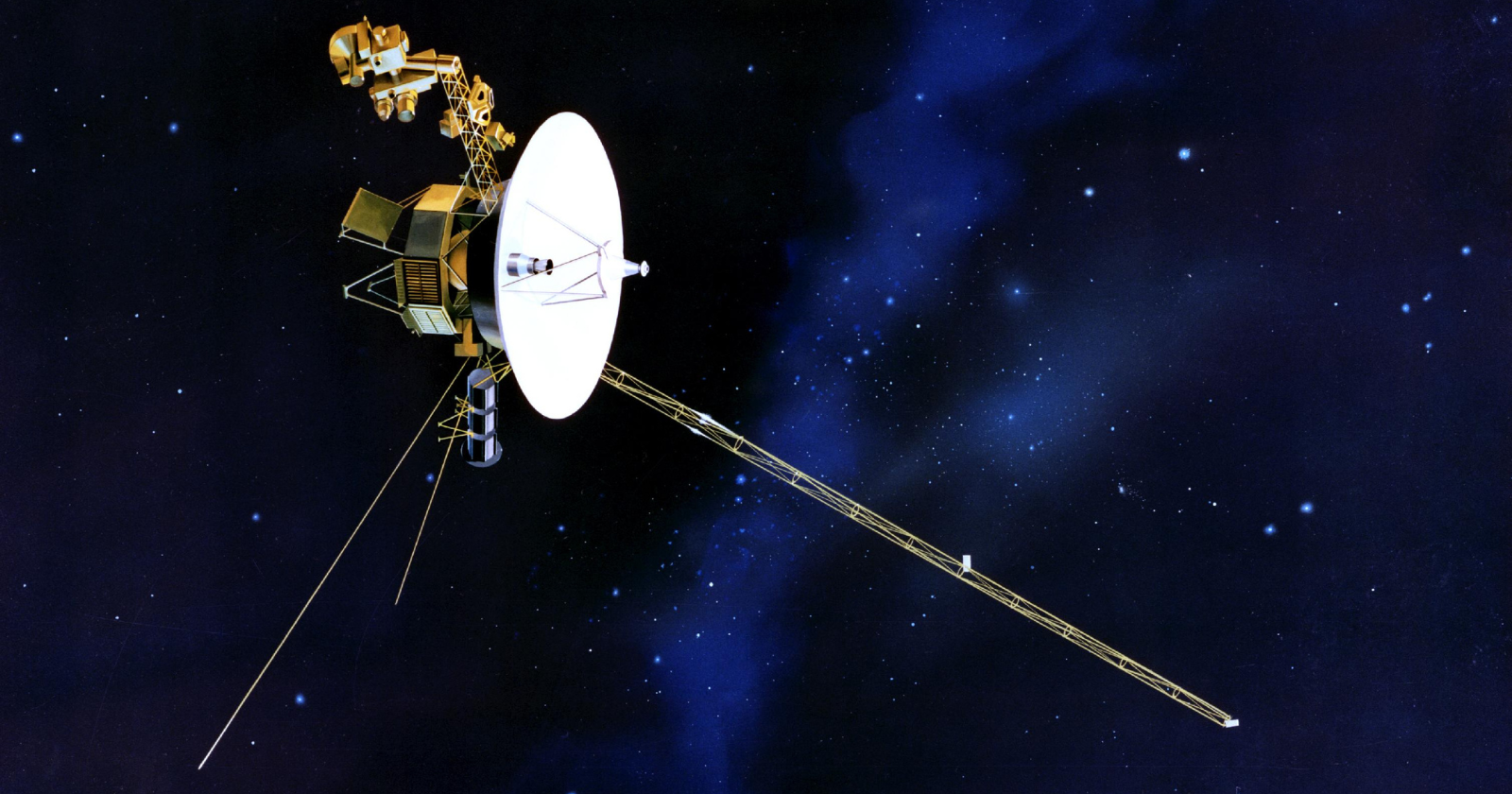
By the time NASA receives Voyager 1’s next status check, the spacecraft has already moved more than 1.4 million kilometres further into interstellar space.
NASA’s Voyager 1 spacecraft is now far enough from Earth that a radio signal between the probe and ground stations takes more than 23 hours each way, and the gap is widening by the day. In late 2026, on the team’s projection, that one-way signal time will reach roughly 24 hours, making Voyager 1 the first human-made object to sit about one full light-day from Earth.
According to CNN’s December 2025 reporting on the milestone, citing Suzy Dodd, the Voyager project manager at NASA’s Jet Propulsion Laboratory, the spacecraft was then around 15.8 billion miles, about 25.4 billion kilometres, from Earth, with the light-day mark expected in November 2026. The probe is travelling at roughly 17 kilometres per second relative to the sun, on the same outbound trajectory it has held since its Saturn flyby in November 1980.
What 23 hours actually means
The figure is worth slowing down on. The popular framing tends to make it sound like a simple delay, as if NASA is just waiting nearly a day to hear back from a stationary object. The reality is more interesting than that.
At 17 kilometres per second, in the roughly 23 and a half hours a signal from Voyager 1 currently takes to reach Earth, the spacecraft itself covers about 1.4 million kilometres further along its trajectory. The data arriving at a Deep Space Network antenna today was emitted from a position the probe has already left, more than a million kilometres back. By the time the bits land on the ground, Voyager 1 is somewhere new.
That is the operational reality of working with anything in interstellar space. The information arrives late, and from somewhere else.
The November 2026 milestone
One light-day is, by definition, the distance a radio signal travelling at the speed of light covers in twenty-four hours, around 25.9 billion kilometres. Voyager 1 will cross that line in November 2026 on NASA’s current projection, which the team has put at around the middle of the month. Voyager 2, on a different trajectory and at slightly lower speed, is not expected to reach the same mark until November 2035, by which time it is very unlikely to still be transmitting.
The milestone is not a physical boundary in space. It is a marker of how far Voyager 1 has travelled since launch in September 1977. But it changes the operational picture in one concrete way. From November 2026 onward, a command sent to the spacecraft will take a full day to arrive, and the response, if any, another full day to come back. The round-trip becomes two days, every time.
The data stream is thin
The information coming back from Voyager 1 is, in Dodd’s description in the CNN piece, comparable to dial-up internet: 160 bits per second. The signal strength dissipates over distance, and multiple antenna arrays are needed to gather it back. The team consequently receives a thin, slow stream of telemetry about each spacecraft’s health, and cannot respond quickly if something goes wrong.
The probes were designed for exactly this. Both Voyagers can put themselves into a safe state if an onboard fault is detected, then wait for ground intervention. Both have been doing this, periodically, for decades.
What is still running
As of mid-2026, two scientific instruments on Voyager 1 remain in operation: the Plasma Wave Subsystem and the magnetometer. Other instruments have been shut down over the past several years to conserve power as the radioisotope thermoelectric generators slowly lose output. Voyager 2 has retained one additional instrument, the Cosmic Ray Subsystem, which the team is hoping to keep running through the spacecraft’s 50th anniversary in 2027.
What the remaining instruments measure is, on Dodd’s framing, what the heliopause looks like from outside. That is the boundary where the sun’s outflowing solar wind meets the cold gas of interstellar space. Voyager 1 crossed it in 2012. Voyager 2 crossed it in 2018. Both are now operating as the only direct in-situ sources of data from beyond the heliosphere.
What to watch next
Three things are worth tracking in the next eighteen months. The first is the light-day mark itself, in November 2026. The second is the team’s ongoing power-management decisions: which instruments stay on, and which get switched off to keep the spacecraft warm enough to function. The third is Deep Space Station 43 in Canberra, Australia, the only antenna in NASA’s network capable of sending commands to either Voyager. According to JPL’s May 2025 announcement, DSS-43 was offline from May 2025 through February 2026 for major upgrades, with only brief operational windows in August and December 2025, and the team’s planning has had to work around that constraint.
Beyond the early 2030s, the available power on Voyager 1 is expected to drop below the threshold needed to operate any instrument or maintain a radio link at all. The spacecraft will keep travelling either way. The 17-kilometre-per-second outbound trajectory does not require power. What ends is the conversation.
