

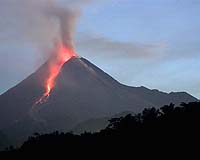
Indonesia’s Mount Merapi volcano, located near the epicentre of a strong weekend earthquake, showed increased activity Monday, belching more lava and heat clouds, scientists said.
Tri Yani, who works in the vulcanology office in the city of Yogyakarta, said numerous clouds of volcanic gases, ash and dust had spewed from the peak early in the day.
Merapi also sent 78 lava trails running 2.5 kilometres (one mile) down its slopes on Monday, she told AFP.
Authorities declared a code red alert for the simmering volcano earlier this month, forcing the evacuation of thousands of villagers living on its slopes.
Scientists say a dome that has formed rapidly at its peak may collapse, forcing millions of cubic metres of volcanic rock, lava and debris down the slopes along with the deadly heat clouds, known to locals as “shaggy goats”.
But residents have been slowly returning to their homes to look after their crops and animals, unconvinced they remain at risk from the smouldering peak.
Merapi’s deadliest eruption occurred in 1930 when more than 1,300 people were killed.
The volcano, one of the world’s most active, lies 35 kilometres to the north of Yogyakarta, the main city hit by Saturday’s earthquake, which killed nearly 5,000 people.
A meteorologist said Sunday the quake had the potential to increase magma volume at the peak of Merapi.
The Indonesian archipelago, made up of thousands of islands and islets, is the world’s most active zone for volcanoes, with 130 still considered dangerous. It is frequently plagued by earthquakes and eruptions.
