
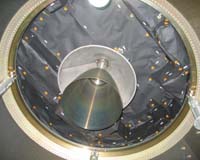
The Venus Express spacecraft has tested its main engine successfully for the first time in space, ESA said.
The main engine test is a critical step in the mission, because the spacecraft must be able to slow its velocity when it arrives at Venus on April 11, so it can be captured by the planet’s gravity and begin its orbit.
ESA said mission controllers fired the main engine during the night of Feb. 17, starting at 00:27 Universal Time. The burn lasted only about three seconds, but it was enough to change the spacecraft’s velocity by almost 3 meters (10 feet) per second.
Round-trip signal time to the spacecraft – which currently is about 47 million kilometers (29 million miles) from Earth – is only about five minutes, but confirmation of the burn, via ESA’s New Norcia antenna in Australia, did not arrive for about an hour, because the spacecraft had to regain control of its attitude and recalibrate its high-gain antenna back to a position aimed at Earth before it could resume communications.
The next big milestone for the Venus Express whose counterpart Mars Express has been conducting orbital surveys of the red planet since December 2003 – is the orbit-insertion maneuver, which will require the main engine to operate for about 51 minutes as a retrorocket. The deceleration will allow the spacecraft to counteract the pull of the Sun and Venus, and to start orbiting the planet.
Venus Express was built by EADS Astrium, which is 50 percent co-owned by Aerospatiale Matra and BAE Systems, and 50 percent by DaimlerChrysler Aerospace.
