
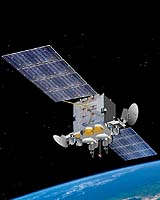
In support of the demanding nature of critical space applications, Texas Instruments Incorporated said announced Tuesday the release of several new military performance-38535 (MIL- PRF-38535) Qualified Manufacturer List (QML) Class V (space) products. Various power management, analog and mixed-signal, digital logic and digital signal processor (DSP) products from TI have been approved for TI’s QML Class V line.
The new devices are ideal for space-based applications such as satellite systems, space stations, launch vehicles, exploration vehicles, planetary robots and many more.
“Satellite systems, space flight and exploration requirements continue to outgrow the available space-level component technologies,” said Claude Huffer, general manager for TI’s military semiconductor division. “With the new QML Class V products, TI is meeting the demand for greater performance, lower power, higher integration levels and cost effectiveness.”
To meet the system performance and reliability requirements of the space market, TI offers Class V power supply products including voltage regulators, switching power supply controllers, voltage supervisors, virtual ground generators, intelligent power devices and power DMOS arrays.
In addition, the QML Class V product line includes a strong analog and mixed-signal portfolio. Complexity ranges from a low voltage single op amp to a high speed, high- resolution analog-to-digital converter (ADC). Also offered in this group are LVDS high-speed differential drivers and receivers.
Supporting the rigorous demands of the space industry, TI currently offers digital logic products for high-speed CMOS (HC and HCT families) and advanced high-speed CMOS (AHC, AHCT, AC and ACT families). QML Class V digital logic products also include low power Schottky in the LS family and low voltage CMOS and BiCMOS in the LVC and LVT families.
A Class V processing option for the SMJ320C6701 DSP has been developed for space-based designs that require high performance, floating-point DSP capability. Following are a few features of the C6701:
– W-temp — 55 degrees C to 115 degrees C
– S-temp — 40 degrees C to 90 degrees C
TI is currently evaluating the release of other Class V processed ceramic DSPs.
