

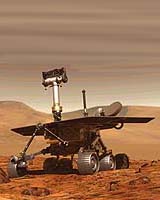
In May and June of this year, NASA will launch two Mars Exploration Rover (MER) spacecraft to the Red Planet. The process of getting these rovers ready for launch involves a complicated series of tests, trials and tribulations – all designed to insure a successful mission.
One such test was completed on January 16, when engineers used the world’s largest wind tunnel and an explosive mortar charge to successfully test MER’s final flight-ready parachute design.
Using the 80×120 ft. wind tunnel, a part of the National Full-Scale Aerodynamics Complex located at NASA’s Ames Research Center, engineers from the Jet Propulsion Laboratory (JPL) and Pioneer Aerospace conducted a series of experiments designed to test the strength of various parachute design options.
For MER, like the 1997 Pathfinder mission, a parachute will deploy automatically during the spacecraft’s descent through the Martian atmosphere. The testing of this system is vital to make sure the parachute can withstand opening at supersonic speeds (960 miles per hour or 1,550 km per hour) without sustaining damage.
The mission can’t just re-use the Pathfinder parachute design in part because MER is a heavier spacecraft. The parachute loads experienced by Pathfinder were approximately 8,000 pounds. MER loads will be over twice that, at 17,600 pounds.
So, while the MER parachute may look similar to Pathfinder’s, it is larger, made up of stronger materials and has slightly different dimensions – all of which require testing.
Why a Wind Tunnel Test?
In order to properly test the parachute design, it is critical to deploy the parachute at the pre-determined speed. Earlier parachute tests were conducted by dropping a parachute and attached mass out of a hovering helicopter. Tricky aerodynamics, winds, and other factors during these drop tests made it difficult to deploy the parachute at exactly the right speed.
To better test the system, engineers needed an environment where they could more accurately control the wind speeds and forces working on the parachute – and that environment would have to be large enough to handle a 27 foot (8.2 meter) diameter parachute and its 79 foot (24 meter) lines. This is where the 80×120 ft. wind tunnel came into play.
In the wind tunnel, engineers could dial in the desired wind velocity and be greeted with a steady stream of air at the exact speed required – the perfect setting for a parachute deploy test.
Earth Wind vs. Mars Wind
But can you simulate conditions found high up in the Martian atmosphere here on Earth? Yes. The pressures experienced by the parachute as it deploys at supersonic speeds in the rarified Martian atmosphere can be duplicated at much lower speeds on Earth because of Earth’s much thicker atmosphere. As a result, it is not necessary to subject the parachute to supersonic speeds. Instead, the same pressures can be experienced using wind speeds around 80 miles per hour (130 km per hour).
The Final Strength Test
For the final strength test, the polyester and nylon parachute and its 48 suspension lines were carefully folded and then pressure packed into a canister just like the one it will be traveling in to Mars.
The canister was then mounted on a tall pedestal inside the wind tunnel. The winds were set to the proper speed and then an explosive mortar charge released the parachute into the wind stream.
The parachute deployed to its full size in a matter of seconds without a hitch.
Even though the deployment time at Mars will be much faster, the test proved that the parachute will be able to withstand the forces it encounters.
Stay tuned as The Planetary Society brings you more updates on the upcoming MER mission. Be sure and visit the Society’s Red Rover Goes to Mars site, where you have a chance to be a part of the MER team.
