

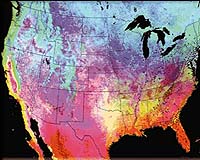
A searing heatwave across the United States has claimed dozens of lives, pole-axed cattle and triggered record power usage in cities like New York as residents cling to their air conditioners.
Heat advisories were in affect across all or part of nine US states on Wednesday, with higher-level excessive heat warnings posted in the urban centers of Philadelphia, Baltimore and Washington, the National Weather Service said.
Raleigh, North Carolina, recorded a temperature of 101 degrees Fahrenheit (38.3 degrees Celsius), breaking the heat record for the date.
The NWS issues excessive heat warnings when a combination of heat and humidity results in an apparent temperature in excess of 110 degrees Fahrenheit.
“That level can be dangerous, especially in large urban centers and among the very young or the elderly,” said NWS spokesman Chris Vaccaro.
The two-week heatwave has been blamed for nearly 60 deaths nationwide.
Border patrol officials in Arizona said 21 immigrants trying to cross the US-Mexico border had died, while police in Phoenix said the heat had also claimed the lives of 20 people in that city, most of them homeless.
With city dwellers putting their air conditioning systems into overdrive, New York City recorded a new record for power usage late Tuesday afternoon of 12,551 megawatts.
New York state as a whole set its own record of more than 32,000 megawatts.
In an effort to offer some relief from the sweltering conditions, New York Mayor Michael Bloomberg announced Tuesday the opening of “cooling centers” — public, air-conditioned facilities — across the city’s five boroughs.
As well as urging people to conserve power where possible, Bloomberg asked New Yorkers to keep a close check on elderly neighbors, relatives and friends.
“Heatwaves are part of summer living, but this one has been particularly strong and long-lived, especially in the West where we saw daily, monthly and all-time records,” Vaccaro said.
In Nebraska, the heat was held responsible for at least 1,200 cattle deaths, and crop farmers were also hit in the mid-western and western “cornbelt” states where rainfall in some areas was half the normal level.
Vaccaro said a cold front was expected to push southwards from Canada over the next few days, bringing some relief but also the warning of severe thunderstorms.
