
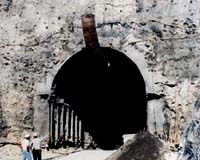
US Energy Secretary Spencer Abraham on Thursday delivered his recommendation to President George W. Bush for all US spent nuclear waste to be deposited at a facility at Yucca Mountain, Nevada.
The president will now decide whether the site is adequate for the thousands of gallons of spent nuclear material, despite vociferous opposition by Nevada residents and lawmakers.
Bush has “received the report on Yucca Mountain,” said Claire Buchan, White House spokeswoman. He will review it and “advise when he makes a decision.”
In a letter to the president, Abraham said he was “convinced” the Yucca Mountain site was “scientifically and technically suitable for the development of a repository.”
The secretary said a single repository was important to national energy and homeland security, non-proliferation and environmental protection.
According to Abraham, spent nuclear material is currently stored in 131 sites across 39 states, within 121 kilometers (75 miles) of more than 161 million US residents.
“These materials would be far better secured in a deep underground repository at Yucca Mountain, on federal land, far from popuation centers, that can withstand an attack well beyond any that is reasonably conceivable,” the secretary said in his letter.
Elected officials in the western desert state, despite the anticipated 50 billion-dollar windfall in jobs and income it could bring Nevada, fear the environmental and health consequences of storing spent nuclear fuel on their terrain.
Last month, when Abraham signalled his intention to recommend the site, Nevada Democratic Senator Harry Reid called the decision “hasty and dangerous.”
“President Bush has an opportunity to cut through the bureaucratic pseudo-science, see this project for the sham that it is, and do the right thing for America and Nevada by changing course,” Reid said at the time.
The Energy Department has “wasted 8 billion (dollars) on Yucca Mountain,” Reid said.
“Now they want taxpayers to spend another 50 billion to develop a dump they can’t prove to be safe. I hope the President will just say no,” he said.
Congress in 1987 chose Yucca Mountain — a desolate, uninhabited spot about 145 kilometers (90 miles) northwest of the glitzy Las Vegas — from among sites in three states as the optimal location for a national nuclear repository for the safe storage of waste.
A 1982 Nevada law allows the state to challenge the federal decision; only the US Congress can override the state’s veto.
