

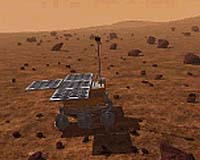
Unfazed by the loss of its Martian lander in December 2003, the European Space Agency (ESA) last Friday set its sights on sending a rover to the Red Planet in 2011 to join the search for traces of life.
A small mobile unmanned lab will be launched in June 2011, arriving on the surface of Mars in June 2013, if scientists’ recommendations are approved by ESA’s ministers at a meeting in December, a press conference here was told.
“The rover would be equipped with a suite of scientific instruments designed to search for traces of past and present life on Mars,” ESA added in a statement.
It would look for shallow water below Mars’ surface and also “identify surface and environmental hazards to future human missions,” it said.
The United States has two highly-acclaimed rovers, Spirit and Odyssey, which are taking images of the Red Planet and analysing surface rocks and soil.
The ESA rover would seek to add to knowledge gained by the US mission rather than duplicate it, notably by having a drill capable of penetrating deep into the soil, at a depth of up to two metres (6.5 feet).
It would also carry instruments to measure seismic phenomena that could be caused by volcanoes, hydrothermal activities or earthquakes, dubbed “marsquakes.”
ESA’s previous attempt to reach the surface of Mars was on December 25 2003, when a small lander, Beagle 2, was lost as it descended to the Martian surface.
But ESA’s orbiter, Mars Express, which gave Beagle 2 a piggyback ride to the Red Planet, has performed excellently.
Images and data sent back by Mars Express and the two American rovers have added enormously to knowledge about Mars, prompting scientists to conclude that the planet’s poles hold reservoirs of water ice and that oceans once covered the Martian surface.
Where the water has gone is the big mystery.
Some experts suggest that water may still exist in very large quantities beneath the surface, although the evidence for this is only visual and needs to be substantiated by proof on the ground, which explains the interest in a rover.
Water is one of the ingredients for life as we know it. A reserve of water on Mars would also be essential for staging any future human expedition there.
The scientists reached their recommendations at a space workshop held in Birmingham, England, on Wednesday and Thursday.
In addition to the rover project, they also reiterated their support for an existing proposal – a “Mars return” mission, sketched for 2016, in which various space powers would pool their resources to send an unmanned probe to Mars, take soil samples, and bring them back to Earth.
