

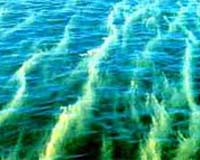
US scientists say they have found possible missing links to the global nitrogen cycle, which, in turn, is linked with ocean productivity. The lead authors of a new paper, Cabell Davis and co-author Dennis McGillicuddy suggest nitrogen fixation rates for Trichodesmium may be 2.7 to 5 times higher than previously estimated.
The researchers from the Woods Hole Oceanographic Institution towed an underwater digital microscope across the Atlantic and found abundant colonies of Trichodesmium — a multi-celled, filamentous organism thought to play a significant role in the input of nitrogen to the upper layers of the tropical and subtropical ocean — nearly half of the Earth’s surface.
Trichodesmium is one of many tiny photosynthetic organisms that use the sun’s energy, carbon dioxide and other nutrients to make organic material that constitutes the basis of the marine food web. Production of biomass in surface waters is typically limited by nitrogen, but Trichodesmium escapes that constraint by utilizing nitrogen, which is plentiful in the atmosphere and upper ocean.
Trichodesmium abundance has been difficult to measure using traditional net sampling because the colonies are easily damaged or destroyed during collection.
The research was detailed in a recent issue of the journal Science.
