

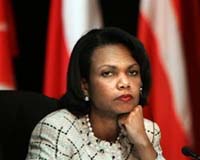
US Secretary of State Condoleezza Rice said Thursday the UN Security Council “has to act” over Iran’s failure to allay global concerns about its nuclear plans.
Speaking as Tehran ruled out suspending internationally condemned nuclear activities on the eve of a crunch UN deadline, Rice said the standoff called into question the global body’s credibility.
“The United States believes… that in order to be credible the Security Council of course has to act,” Rice told reporters on the sidelines of talks with her NATO counterparts in the Bulgarian capital Sofia.
“I sincerely hope that the Security Council is prepared to take some action,” she said, adding it was “highly unlikely that Iran will accede to the demands of the international community.”
The call was echoed by France’s Foreign Minister Philippe Douste-Blazy, who urged the Security Council to send a “rapid and firm” signal to Iran as the UN deadline for the Islamic republic to freeze uranium enrichment work loomed Friday.
Western powers, led by the United States, say Iran is trying to develop a nuclear missile capability but Iran insists it is developing nuclear technology only to produce atomic energy.
Washington has backed tough action but Moscow and Beijing, also permanent members of the Security Council, have called for continued negotiation through the UN nuclear watchdog, the International Atomic Energy Agency (IAEA).
The NATO talks in Bulgaria, in theory focused on Sudan’s Darfur crisis, Afghanistan and NATO enlargement, risked being overshadowed by the Iran standoff.
NATO chief Jaap de Hoop Scheffer voiced concern about Tehran’s nuclear ambitions even as ministers arrived in Sofia.
“Of course, the NATO allies are as worried as… I am about nuclear proliferation,” he said, citing also the threat of chemical and biological weapons.
Douste-Blazy meanwhile said that the UN needs to send an urgent message to Iran in particular “given Tehran’s attitude and the acceleration of its (nuclear) programmes.”
NATO stresses that it has no formal role in the crisis. But the situation will inevitably be discussed. “Although it is not playing the first violin, what happens there is a very NATO-relevant subject,” De Hoop Scheffer said.
On Thursday Iran’s hardline President Mahmoud Ahmadinejad vowed that his country “will not bow to injustice and pressure.”
“Thanks to God, we are a nuclear state. We want peace and security and we are not a threat to anyone. We are ready for dialogue on disarming the big powers in order to reinforce peace and security,” he added.
German Foreign Minister Frank-Walter Steinmeier also addressed the Iran crisis on the sidelines of the Sofia meeting.
“We expect it (Iran) to meet international standards and… to allay world suspicions that its civil nuclear operations are being used to develop a possible weapons program.”
The first session of talks started in Sofia shortly after the arrival of the ministers including Rice, who flew in from Iraq where she made a surprise visit on Wednesday.
On Darfur, NATO has said it is ready to extend and increase its support for an African Union-led peacekeeping force in the violence-scarred Sudanese region, as well as for a UN force expected to replace it later in the year.
The ministers were also set to take stock of NATO’s planned expansion in coming months into the dangerous south of Afghanistan, where it has led the International Security Assistance Force (ISAF) since 2003.
The expansion will see the current 9,000-strong force beefed up to 16,000 troops.
Security is tight for the Sofia talks, with some 3,000 police officers on the streets and around the National Palace of Culture, hosting the meeting.
Source: Agence France-Presse
