

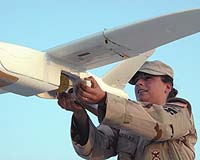
The UK’s Defence Procurement Agency has awarded Lockheed Martin a $2.65 million contract to enhance the British Army’s Desert Hawk Unmanned Aerial Systems. The Desert Hawk has been used in Afghanistan to protect air base perimeters, monitor suspicious vehicles and search for possible launch sites for mortars or anti-aircraft missiles.
The Air Force has 21 Desert Hawk systems, including 126 aircraft, deployed in the Middle East.
Powered by an electric motor, the eight-pound craft flies at altitudes under 1,000 feet at speeds between 40 kilometers to 80 kilometers per hour (25 to 50 miles per hour) for a maximum of 75 minutes. It carries a video system that can see about 10 kilometers (6.4 miles). It is launched by two people using a bungee cord as a slingshot, can fly either autonomously or as directed by its operator.
Each Desert Hawk system costs about $300,000 and comprises six aircraft, a ground station and spare parts.
Under the U.K. contract, Lockheed Martin will provide new Desert Hawk systems in addition to upgrading the country’s existing fleet with the craft’s new enhancements, including plug and play; infrared, color and low light electro-optical imager payloads; ground-control stations; remote video terminals; field repair kits, and global-positioning satellite tracking and location capabilities. The contract also defines provisions for spares and technical support. Future options will include electro-optical turrets. The air vehicles are scheduled for delivery to the British Army next month.
“Lockheed Martin’s whole systems approach to unmanned systems allows our customers to achieve sustainable force protection,” Richard Ambrose, vice president of the company’s maritime sensors and tactical systems business unit, said in a statement. “We are proud to provide this capability to allied front-line troops engaged in the global war on terror.”
