

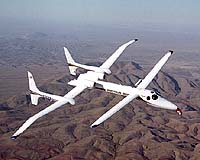
A new series of NASA-sponsored flight demonstrations of collision-avoidance systems being developed to enable remotely or autonomously operated aircraft to fly safely in civil airspace shared with piloted aircraft are planned for the first week in April over Southern California’s high desert.
NASA has sought to use remotely or autonomously operated unmanned aerial vehicles (UAVs) in scientific and commercial applications, particularly to study the Earth’s environment with high-altitude, long-endurance UAVs.
The full potential of UAVs cannot be realized, however, until they demonstrate the ability to operate safely and routinely within the existing air-traffic management system.
NASA Dryden Flight Research Center, Edwards, Calif., in cooperation with Scaled Composites, LLC, Mojave, Calif., has been conducting flight demonstrations of collision-avoidance systems necessary to achieve the “equivalent level of safety” of a piloted aircraft.
The ability to sense and avoid conflict is a key step toward allowing UAVs to fly routinely and reliably in the national civil airspace.
A series of flight evaluations of a “Detect, See and Avoid” system that can detect “non-cooperative” aircraft without operating transponders is scheduled for the first week of April near Mojave, Calif.
As with a prior flight series last year near Las Cruces, N.M., that focused on “cooperative” transponder-equipped aircraft, the primary test aircraft will be Scaled Composites’ Proteus.
For this series, the Proteus will be equipped with a 35 GHz radar system intended to detect any approaching aircraft on a potential collision course, regardless of whether the intruder is equipped with an operating transponder.
The Proteus and a variety of target aircraft, ranging from a hot-air balloon to a high-speed NASA F/A-18 jet, will fly 22 different simulated-conflict scenarios over a three-day period.
During the flight demonstrations, Proteus will be controlled remotely by a pilot in a ground station. Radar data will be relayed to the ground station via either a line-of-sight telemetry link or an over-the-horizon satellite link, and the ground pilot will command the Proteus to change course as needed. A vertical offset will be maintained throughout the tests for safety purposes.
