

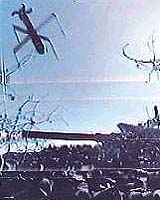
The US Army’s BAT submunition, supplied by Northrop Grumman Corporation, scored four hits in four attempts against an array of moving armored targets following dispense from a Hunter unmanned aerial vehicle in tests conducted Oct. 9 and 11.
Co-sponsored by the Army’s Precision Fires Rocket and Missile Systems and Unmanned Aerial Vehicle Systems Project Office, the drops were performed at White Sands Missile Range, N.M. They were intended to demonstrate operational capability of the integrated Hunter and baseline Bat systems.
This version of BAT, currently in production at Northrop Grumman’s Land Combat Systems facility at Redstone Arsenal, Huntsville, Ala., is an autonomous munition that uses a combination of passive acoustic and IR sensors to seek, identify and destroy moving targets deep in enemy territory.
For the Oct. 9 test, two Bats were fitted with flight data recorders and deployed against a moving array of eight armored targets.
From tactical altitude, the Hunter successfully released the two Bat ejection tubes, which in turn ejected the submunitions according to plan. Both Bats executed their predicted flight patterns, and both impacted targets — a BMP combat vehicle and a T-72 tank — in highly vulnerable areas.
On Oct. 11, the procedure was repeated, this time using two fully tactical Bats with warheads against an array of seven armored vehicles. Both submunitions again flew their predicted patterns and scored hits on a BMP and a T-72 respectively.
“These successes demonstrate the capability of the integrated Bat and Hunter systems to detect, acquire and destroy time-critical targets and obtain real-time bomb damage assessment,” said Emmitt Gibson, vice president of Precision Munitions at Northrop Grumman.
“This combination exploits the advantages of merging surveillance and strike capabilities on the same platform while providing a low-cost, precision munition that can loiter for extended periods of time.”
