
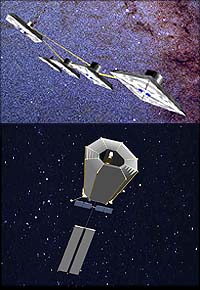
Included in the nation’s new vision for space is a plan for NASA to “conduct advanced telescope searches for Earth-like planets and habitable environments around other stars.” To meet this challenge, NASA has chosen to fly two separate missions with distinct and complementary architectures to achieve the goal of the Terrestrial Planet Finder.
The purpose will be to take family portraits of stars and their orbiting planets, and to study those planets to see which, if any, might be habitable, or might even have life. Both missions would launch within the next 10 to 15 years.
The two missions are:
Observing extra-solar planets in both visible and infrared light allows scientists to obtain a rich set of data to understand what chemical processes may be going on at various levels in a planet’s atmosphere and surface. That leads to understanding of whether a planet ever could or actually does harbor life.
A review of these two plans will be conducted over the summer by NASA and the National Academy of Sciences Committee on Astronomy and Astrophysics. Two other architectures that were studied, the large visible coronagraph and the structurally connected infrared interferometer, will be documented and further studies concluded this summer.
