
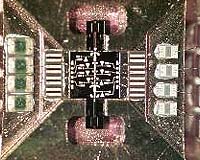
CSIRO and U.S. telecommunications giant TRW have formed a strategic alliance to develop high-performance gallium arsenide and indium phosphide components for radio astronomy, advanced millimetre-wave sensors and telecommunications systems.
Velocium, TRW’s telecommunication products company, and CSIRO have already worked together on upgrading CSIRO’s Australia Telescope, the Southern Hemisphere’s premier radio telescope.
Indium phosphide (InP) low-noise amplifiers and digital receiver chips, designed by CSIRO engineers and fabricated by Velocium, were a key part of the upgrade.
The telescope now operates at frequencies up to 100 billion cycles per second (100 GHz) and has just produced new, detailed observations of Centaurus A, the nearest galaxy known to harbour a supermassive black hole.
“We’ll now be able to trace for the first time the path of this gas as it feeds the black hole,” said Professor Ron Ekers, Director of the Australia Telescope National Facility.
“The Australia Telescope is a demanding test bed for our InP chips. The extremely high frequencies allow astronomers to take pictures of new phenomena with greater detail than ever before,” said Dr Dwight Streit, president of Velocium.
“Velocium’s InP chips are helping improve the science of astronomy now, and will soon be helping improve the performance of other sensor and telecommunication systems.”
CSIRO started working with TRW in 1993, and in 1999 gained early access to TRW’s InP technology for exploratory research, which helped expedite the technology’s development.
Research done under the new strategic alliance will have applications from vehicle guidance to the detection of concealed weapons and contraband.
