

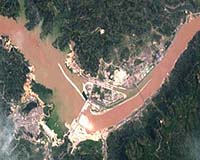
China may decide to divert water from the Three Gorges dam to another huge engineering scheme, a giant canal system aimed at relieving the parched north, state media said Sunday. The South-North Water Diversion Project is well underway, but experts have now spotted a weak link, the Danjiangkou reservoir in the central province of Hubei, originally designated as a key source of water, Xinhua news agency said.
“The rainfall on the upper reaches of the reservoir has decreased at an average annual speed of 15 percent in the past few years,” said Yu Xuexin, an official with the Beijing Municipal Development and Reform Commission.
To make up for this, scientists have suggested tapping the Three Gorges Reservoir, which will have a storage capacity of 39.3 billion cubic meters when completed, Xinhua said.
“It will provide sufficient freshwater as a backup for the South-North Water Diversion Project,” said Wu Gang, also with the Beijing Municipal Development and Reform Commission.
The project was first envisioned by communist China’s founder Mao Zedong in the 1950s, but only kicked off in late 2002.
When completed, in 2050, it is expected to divert an annual 44.8 billion cubic meters of water from the Yangtze, China’s longest river, to north China by three different routes.
It is expected to cost about 500 billion yuan (62 billion dollars), or nearly three times as much as the Three Gorges project.
China’s water crisis — from severe shortages to heavy pollution — is the worst in the world and requires urgent action, according to the construction ministry, which is in charge of supplying water to residents.
China’s water supply is widely considered too small for its huge population of 1.3 billion people.
Its per capita water availability is about a quarter of the world average and it is expected to get worse, partly due to falling groundwater tables.
