
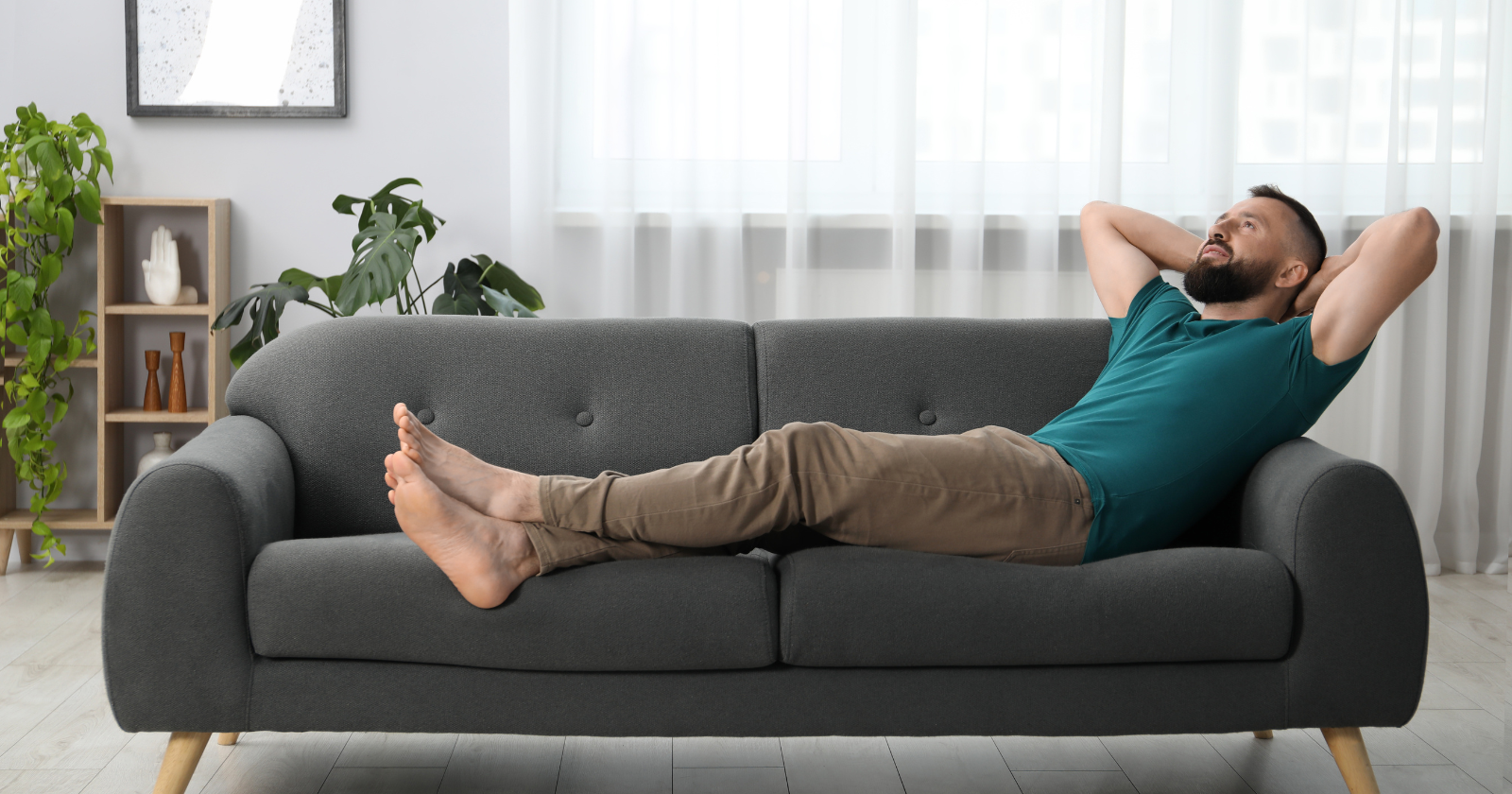
There is a particular kind of fatigue people describe about the rooms they live in, and they often cannot name it. They come back from a fortnight in a rented apartment they didn’t even particularly like, and feel inexplicably restored. They visit a friend’s flat and notice they breathe more easily there. They sit in their own living room on a Sunday afternoon, surrounded by everything they chose and paid for, and feel a little worse than they did when they walked in.
Most people, when asked, will reach for explanations they don’t entirely believe. The flat is too small. The neighbours are loud. The light isn’t right. These are usually true but rarely the whole story, because two flats with the same square metres, the same windows and the same neighbours can produce very different effects on the people living in them.
The body of work that has thought about this most carefully was not produced by interior designers or magazine editors. It was produced by NASA.
We are writers covering this beat, not architects or human-factors engineers. What follows is reporting on the research and a few observations from reading it.
What NASA actually means by habitability
“Habitability” in the NASA context is a technical term, not a marketing one. It refers to the degree to which an enclosed environment supports the health, performance and wellbeing of the people living inside it for an extended period.
The foundational document most often cited is Living Aloft: Human Requirements for Extended Spaceflight, published by NASA in 1985 and authored by Mary M. Connors, Albert A. Harrison and Faren R. Akins. The report is an extensive review of what the agency had learned, by then, from the Apollo programme, Skylab, and the early Soviet long-duration missions, together with what was known from analogue environments on Earth such as submarines, polar bases and isolated research stations.
That work has since been built on, and codified, in NASA-STD-3001 Volume 2, the agency’s standard for human factors, habitability and environmental health, which now governs design requirements for crewed vehicles and habitats.
What the Living Aloft report does, with unusual patience, is separate the obvious from the subtle. Air, food, water, temperature and pressure are the obvious requirements. They are necessary, and they are not interesting in the sense that an environment which fails on any of them is not a habitat, it is a problem. What the report spends most of its pages on is the layer above that: the factors which determine whether a person inside a survivable enclosure thrives, copes, or quietly degrades.
This is the layer that becomes surprisingly useful when thinking about ordinary homes, not because a flat is a spacecraft, but because both are enclosed environments that shape attention, recovery, privacy, friction and fatigue over time.
The factors that show up in the research
The recurring categories in the NASA habitability literature, and in later work by Sandra Häuplik-Meusburger in Architecture for Astronauts and elsewhere in the space architecture field, are reasonably stable.
Acoustic environment. Chronic background noise appears repeatedly in the habitability literature as one of the environmental factors that can wear on people in long-duration habitats. Not loud noise. Persistent, low-grade, unavoidable noise. Fans, pumps, ventilation. The body adapts to it in the sense that the person stops consciously hearing it. The cost of that adaptation is the part the research is interested in.
Lighting. Functional separation of light by activity, and circadian-appropriate lighting through the day, both matter more than overall brightness. An environment that is uniformly bright at all hours, or uniformly dim, can make it harder for people to separate work, rest and recovery.
Functional zoning. The separation of incompatible activities into distinct zones is a recurring theme. Eating, working, sleeping, washing and socialising do not coexist well in undifferentiated space. Early space habitats made this problem visible in unusually compressed form, because the same small volume had to support work, sleep, eating, hygiene and social life.
Privacy. Visual privacy, acoustic privacy, and what the literature sometimes calls “psychological privacy”, which is the sense of having a space where one is not observable. Habitats that offer little privacy can increase interpersonal friction over time, even between people who otherwise like each other.
Sensory variety. Monotony of texture, colour, smell and surface is its own stressor. Habitats that are visually uniform produce a flattening effect that the research describes carefully.
Restorative elements. Views of the outside, natural materials, plants, and what some of the environmental psychology literature, drawing on Stephen and Rachel Kaplan, calls “soft fascination”, the kind of looking that does not require effort. These are not luxuries in habitability terms. They are part of how an environment lets a person recover.
The translation to an ordinary flat
The reason this body of work is more useful than the average interior-design article is that it starts from a different question. It does not ask what a room should look like. It asks what a room is doing to the person inside it over weeks and months.
When the categories above are mapped onto an ordinary home, the things that often surface as problems are not the obvious ones. A flat can be tidy and well furnished and still score badly on habitability.
A kitchen that opens directly onto the only sofa is a zoning problem. A bedroom whose only light source is the overhead is a lighting problem. A workspace whose acoustic background is the building’s lift shaft is a noise problem. A living room with no view to anything beyond the room itself is a restoration problem. A flat in which there is no surface, anywhere, that a person can occupy without being observable is a privacy problem.
None of these are catastrophic on a given evening. The point of the research is that they accumulate.
The quiet drainers
The pattern the NASA literature describes, and that we have noticed in how people talk about their own homes, is that the most draining features are usually the ones the resident has stopped noticing.
The cupboard door that does not quite close. The bulb that has been the wrong temperature for two years. The chair that nobody sits in but that nobody throws out. The constant low hum from the appliance that was already there when they moved in. The bedroom that is also a wardrobe and a home office. The room that has good light at the only hour the person is never in it.
These are not design failures in any dramatic sense. They are small habitability costs that the body pays and the mind stops registering. The cost does not stop being paid. It just stops being legible.
The honest read of the research is that what makes a home restorative is not its style, its size or its price. It is whether the underlying habitability variables are quietly working in the resident’s favour. Most homes are a mixed picture. Some variables work, others quietly do not, and the resident knows something is off without being able to say what.
A way of looking at your own rooms
What the NASA frame offers, more than anything else, is a vocabulary. Once a person has the categories, which is to say noise, light, zoning, privacy, sensory variety and restoration, the question of why a particular room feels the way it does becomes easier to answer.
Some of the answers will turn out to be cheap to fix. A different bulb. A door closed at the right hour. A chair moved so the line of sight from the sofa lands on a window rather than a wall. Some of the answers will not be fixable inside the current flat at all, and that is also useful information.
The thing the research does not say, and that the better interior-design writing also does not say, is that a home is supposed to feel like one specific thing. What the research does say is that whatever a home is supposed to feel like, the same handful of variables is doing most of the work.
The people who designed the inside of a space station spent decades figuring that out, under constraints most homeowners will never face. The categories they ended up with are useful on the ground as well.
