
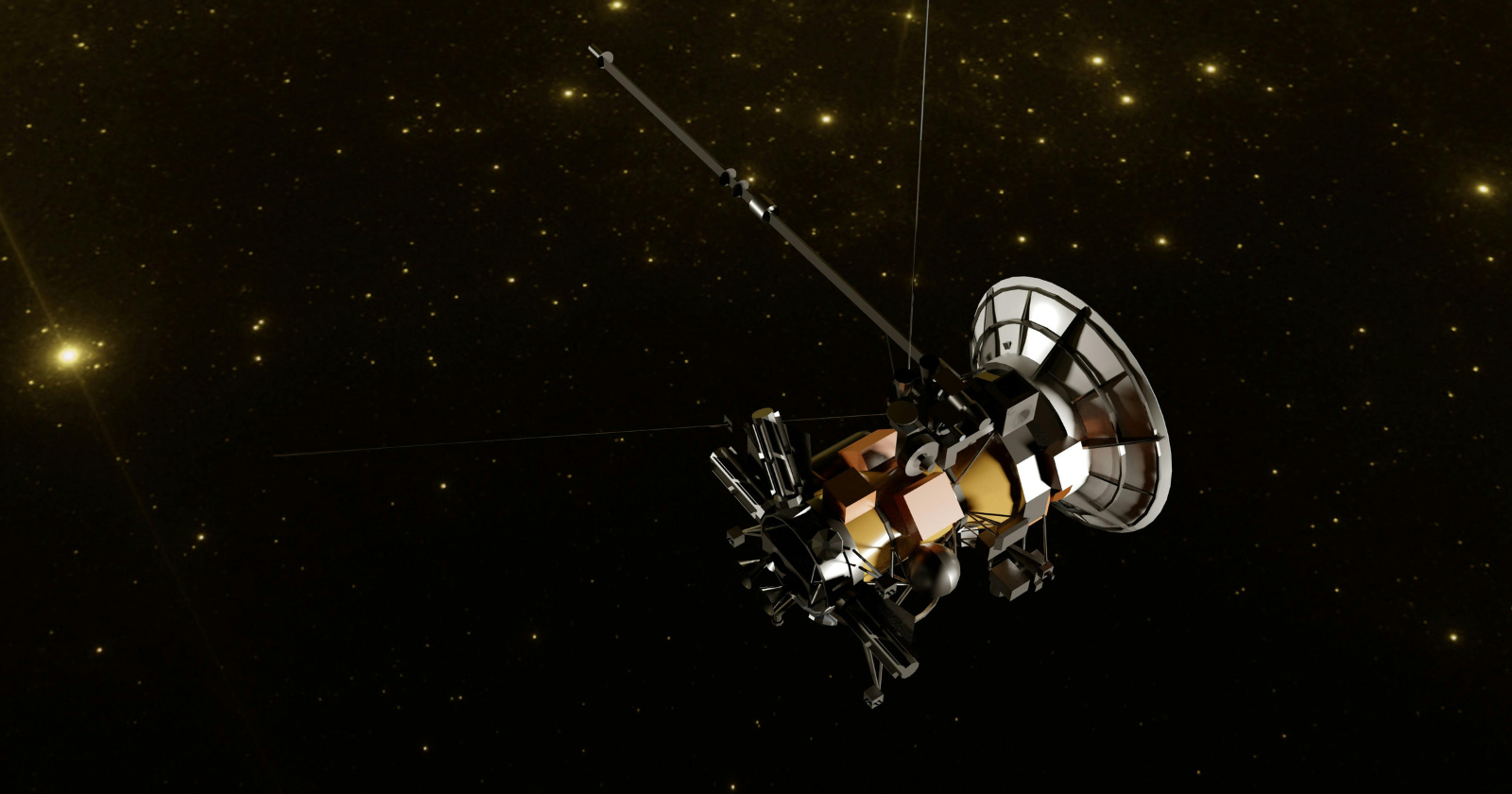
Both Voyager spacecraft are now operating with the smallest sets of active science instruments in their nearly 49-year history. As of May 2026, Voyager 1 carries two: the magnetometer and the Plasma Wave Subsystem. Voyager 2 still has three of the original ten, having most recently lost its Low-Energy Charged Particle Instrument in March 2025. Voyager 2’s Cosmic Ray Subsystem is scheduled to be turned off later this year, which will bring it to two as well.
The pattern over the past eighteen months has been steady and procedural. Voyager 2’s plasma science instrument was switched off in late September 2024. Voyager 1’s cosmic ray subsystem followed in February 2025, then Voyager 2’s LECP in March 2025, then Voyager 1’s LECP in April 2026. Each command travelled roughly 20 to 23 hours each way. Each shutdown is treated as potentially permanent, even if one narrow exception remains for Voyager 1’s LECP.
The framing that the engineering team is now making the hardest decisions of the mission is one we have seen in coverage repeatedly. In our reading of the JPL announcements, that framing is approximately right, but the structure of these decisions is less dramatic and more procedural than the headlines suggest.
How the order was decided
The order in which instruments come off was not improvised. The Voyager science and engineering teams agreed years ago on a priority list, the result of a joint deliberation about which measurements remained scientifically useful in interstellar space and which had effectively completed their work after the planetary flybys ended in 1989.
The two instruments left until last in that sequence are the magnetometer and the Plasma Wave Subsystem. The logic is straightforward. The magnetometer measures the magnetic field of the local interstellar medium directly. The Plasma Wave Subsystem measures the density of the surrounding interstellar plasma. Together, they return the science most specific to the place each spacecraft is now in, and least replicable by other missions.
Suzanne Dodd, the Voyager project manager at JPL, has framed the trade-off plainly: “If we don’t turn off an instrument on each Voyager now, they would probably have only a few more months of power before we would need to declare end of mission.” The choice is not between keeping all instruments and turning one off. It is between turning one off and losing the mission.
What “off” means
Most of these shutdowns are not meaningfully reversible.
There are small caveats. On Voyager 1’s LECP, a stepper motor that rotated the sensor head is kept running at low power. According to the JPL announcement in April, the motor draws around 0.5 watts and is being kept turning to preserve a thin chance of reviving the instrument if power conditions change. The instrument’s stepper motor had completed roughly 8.5 million steps by the time the LECP on Voyager 2 was deactivated in 2025, against an original certification of about 500,000.
For most other instruments, the procedure is simpler. The power feed is cut. The instrument is removed from the operating set. The team is not in a position to revisit the call.
The next call
The next scheduled shutdown is Voyager 2’s Cosmic Ray Subsystem, which JPL has said will be turned off in 2026. After that, both spacecraft will be down to two instruments, the same two on each: magnetometer and Plasma Wave Subsystem.
After that, the path narrows. The remaining decisions are which of the two to keep, on each spacecraft, and when.
There is also the so-called Big Bang plan, a coordinated swap of older powered components for lower-power alternatives that JPL has flagged as a possible way to keep at least one science instrument operating into the 2030s. Voyager 2 is to test the procedure first, in May and June 2026. Voyager 1 would follow if the test holds.
What to watch next
Three items sit on the near calendar. The result of the Big Bang procedure on Voyager 2. The CRS shutoff on Voyager 2 later in 2026. And, looking further out, the point at which only engineering telemetry rather than science data is what returns. According to NASA’s Voyager FAQ, that engineering signal could continue to reach the Deep Space Network until around 2036, depending on available power.
The four watts a year do not negotiate. The choices the team makes between now and the early 2030s are about which questions a still-operating Voyager can answer, and which it can no longer.
