

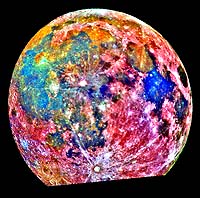
The Moon is not the geologically dead world that most astronomy textbooks claim, according to Hal Povenmire, a Florida Institute of Technology astronomer, long-time meteorite hunter and former NASA Project Apollo engineer.
In February, NASA officials announced new evidence that the Moon has an active, molten core. Povenmire concurs with NASA and believes that there are signs of geologically recent lunar volcanism right here on Earth.
The most recent eruption on the Moon, he claims, showered a portion of Asia and Australia with many tons of volcanic glass. This so-called Australasian event occurred within the past million years.
Povenmire’s interest in tektites was aroused long before he discovered both the Upsilon Pegasid meteor shower and a new asteroid, officially named 12753 Povenmire.
In 1970, realizing that 34.5 million year-old tektite stones found in Georgia were extremely rare and that their strewn field had never been mapped, he undertook a monumental effort to learn more about them.
To date, thanks to Povenmire’s fieldwork, the size of the Georgia tektite zone has been expanded from 500 square miles to over 7,000 square miles. The number of Georgia tektites he discovered increased from 200 to over 1,300.
Povenmire said thousands of tektites might have fallen on prehistoric Georgia in a single day or night.
Povenmire believes that these natural glass stones are volcanic material blown off the Moon by eruptions, an idea first proposed by a European geologist around 1900.
Many scientists disagree with Povenmire’s theory, but the Florida researcher is now convinced that the Moon belches and hurls tons of obsidian-like debris into Earth’s gravity well every few million years.
Tektite falls may also cause climate change and extinctions on Earth, he said.
Armed with his Georgia fieldwork data, Povenmire refutes the current theory that tektites were formed when asteroids or comets hit the Earth and melted sediments and rocks. Tektites, a dry homogeneous natural glass, he noted, do not resemble wet inhomogeneous impact glass found around many meteor craters.
Povenmire notes that the slow way tektite glass formed, and the volcanic features some researchers have observed within chunky, layered tektites, can’t be explained by the widely accepted terrestrial-impact theory.
Ablation studies also prove that the infall velocities of tektites reached 6 km per second or greater¿an unlikely speed for terrestrial ejecta to attain going up through the atmosphere.
Povenmire likes to point out that cosmic-ray traces inside tektites show they couldn’t come from beyond the Earth-Moon system implying that they didn’t spend a long time in space.
Based on still more circumstantial evidence¿such as the fact that Apollos 12 and 14 astronauts found several lunar highland and subcrustal rocks with tektite-like chemistry¿Povenmire believes the space-science community needs to drastically rethink what mechanisms caused the ancient stones to fall to Earth.
Louis Varricchio is a science writer living in Vermont and can be contacted via (morbiusATtogether.net – replace AT with an @ )
