
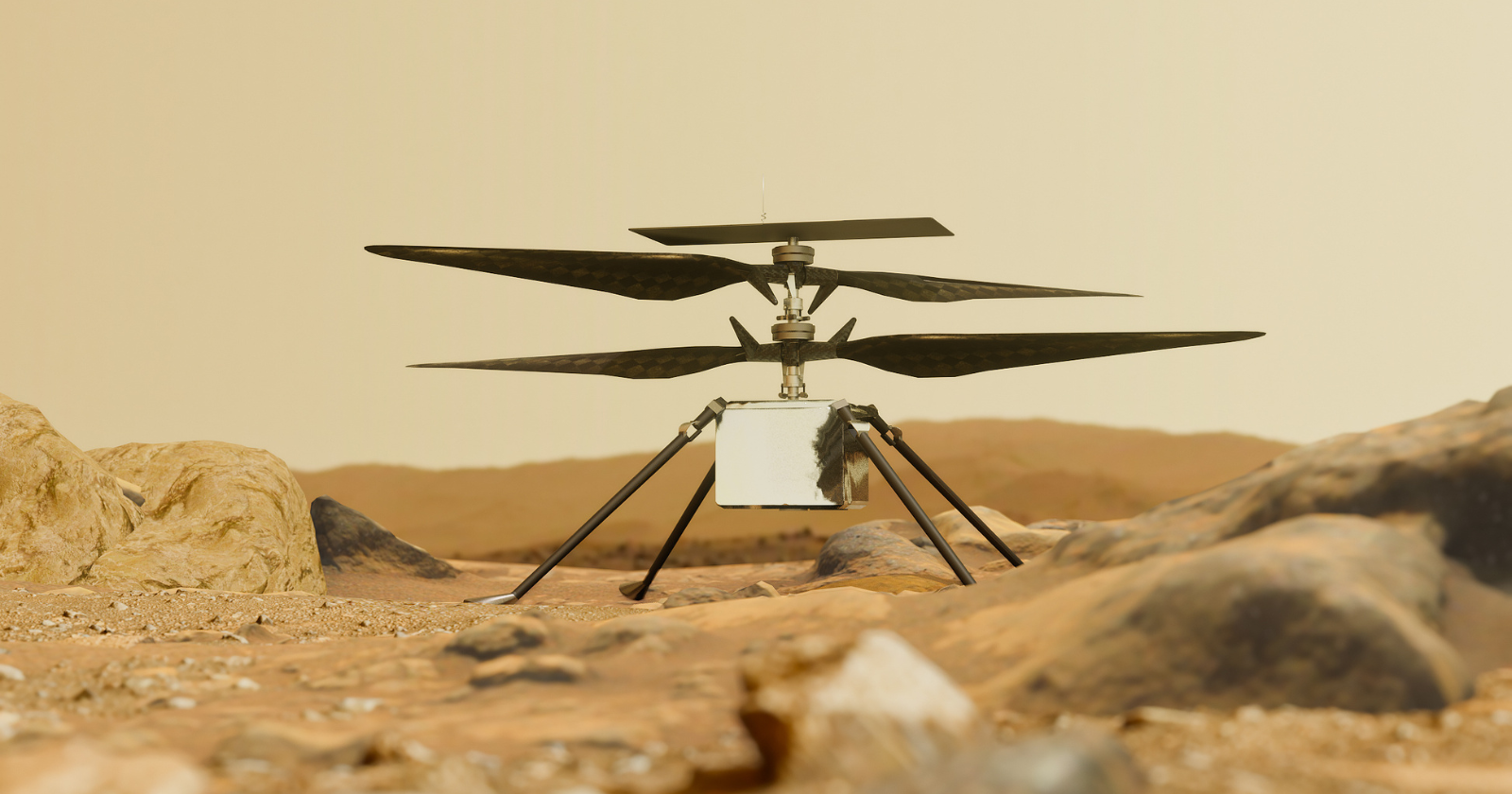
NASA’s Ingenuity Mars Helicopter was designed to attempt up to five experimental test flights over thirty days. It performed 72 flights over almost three years before rotor blade damage on 18 January 2024 grounded it for good. The follow-on work, inside JPL and at the agency’s industry partners, is now well underway.
The numbers behind the headline are worth keeping. According to NASA’s end-of-mission release, Ingenuity logged more than two hours of total flight time and flew many times farther than the original mission profile contemplated. The helicopter weighed about 1.8 kilograms, cost roughly US$85 million, and was carried to the surface attached to the underside of the Perseverance rover in February 2021. By the end of its life its team described it as the first deep-space mission to fly commercial off-the-shelf cellphone processors.
The atmosphere problem
The reason Ingenuity is worth taking seriously as an engineering result is the atmosphere it flew in. Mars surface pressure is well under one percent of Earth’s. A rotor that lifts a small drone on a still day in Pasadena has to spin much faster, with carefully shaped blades, to lift even a four-pound aircraft on Mars. Ingenuity’s rotors ran at around 2,400 rpm, several times the rate of an equivalent Earth-bound multirotor.
The atmospheric thinness is also why most of Ingenuity’s flights stayed low and short. The aircraft was operating near the edge of what its rotor system could sustain, and team members have said the longest flight, of 704 metres, sat close to the design margins.
What actually ended the mission
Flight 72 was meant to be brief, a vertical hop to check the helicopter’s systems after an emergency landing on Flight 71 in featureless terrain inside Jezero Crater. Ingenuity climbed to 12 metres, hovered, and began to descend. About 19 seconds in, the navigation camera lost the surface texture it needed to track the helicopter’s velocity.
The result was a hard landing on a sand ripple.
According to the December 2024 findings from NASA’s first aircraft accident investigation on another world, the high horizontal velocity at touchdown caused Ingenuity to pitch and roll. Loads on the fast-spinning rotor blades exceeded their design limits. All four blades snapped at their weakest point, roughly a third of the way from the tip. The resulting vibration ripped one blade from its root entirely, the helicopter’s power demand spiked, and communications ended. Håvard Grip, the helicopter’s first pilot at JPL, noted that the investigation had to be run without black boxes or eyewitnesses from a distance of about 100 million miles.
The outcome was not a design flaw in the conventional sense. The navigation system worked as specified. Its specification simply did not include featureless sand-ripple terrain at high horizontal velocity.
What is being built next
The follow-up concepts are not one project but several, and they are at different levels of maturity.
The most-discussed is Mars Chopper, a JPL concept revealed at the American Geophysical Union meeting in December 2024 and presented by Ingenuity’s project manager, Teddy Tzanetos. As outlined publicly so far, Chopper is closer in size to an SUV than to Ingenuity, with six rotors carrying six blades each. It is designed to lift around five kilograms of science payload and to travel up to three kilometres per Martian day, independent of any rover relay. NASA describes it as remaining in early conceptual and design stages. It is not a funded mission.
A separate proposal, Nighthawk, has been put forward as a possible science payload for the Mars Chopper platform, presented at the 2025 Lunar and Planetary Science Conference. It would carry an eight-camera imaging system, a spectrometer, and a neutron detector intended to assess near-subsurface water, flying considerably higher than Ingenuity could.
For the Mars Sample Return campaign, NASA has been testing smaller Mars Sample Recovery Helicopters as part of the architecture review. Tzanetos is project manager for that work as well. AeroVironment, Ingenuity’s original industry partner, unveiled a separate concept called Skyfall in mid-2025, proposing autonomous aerial scouts to support eventual crewed Mars landings.
The lesson the engineers actually emphasise
In our reading of the team’s public statements, the headline lesson from Ingenuity is not “Mars helicopters work”. That was established by Flight 1 in April 2021. The headline lesson is about design philosophy.
Tzanetos has made this point several times in briefings. Ingenuity used commercial smartphone processors. It was not built to traditional deep-space hardware standards. It survived almost three years of Martian temperature cycles, dust, and operations anyway, and it has continued to send weather and avionics data back to Perseverance even after Flight 72 ended its flying career. The point of leaving that on the record is to challenge the assumption that everything bound for the Martian surface has to be heavy, custom, and radiation-hardened to last.
The full NASA technical report on the accident, when published, will be worth reading on the navigation question. For now, the helicopter sits on a sand ripple about 15 metres from a detached rotor blade. Its weather data is still relayed by Perseverance roughly once a week. The next aircraft to fly on Mars has not yet been funded. Several teams are working on what it could look like.
