
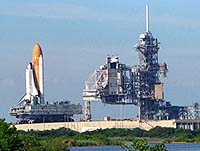
Once again, NASA has proposed to develop a replacement for the troubled Space Shuttle. This year’s project goes by the ungrammatical moniker “Orbital Space Plane”. An interim version of OSP called the CRV (Crew Rescue Vehicle) to be developed by 2010 will take over the International Space Station lifeboat task now done by Soyuz.
An improved OSP called the CTV (Crew Transfer Vehicle) will assume the ISS crew exchange task now done by Shuttle in 2012. To minimize development costs, the OSP will be launched on one of the new EELV family of expendable boosters, Delta 4 or Atlas V.
Sound familiar? It should. The OSP is only the latest of many “Shuttle replacement” programs that have all failed dismally. A close look at OSP shows that this program is also doomed to failure due to fundamental technical defects. It’s no surprise that such usually reliable NASA boosters as “Space Coast” Congressman Dave Weldon and aerospace lobbyist Lori Garver have publicly attacked OSP.
Most critics have focused on the suspiciously low development costs, or the embarrassing gap between 2006 and 2010 in which no ISS lifeboat is planned. In fact, the basic concept of the program is so stupid that every knowledgeable person involved in it must be perfectly aware that it will never fly.
The basic problem is that the OSP, as currently defined, must carry such heavy mass penalties in the form of wings, wheels, and various escape systems that its performance will not be much better than the Dyna-Soar design of 40 years ago.
Because it cannot carry any of the supplies needed to sustain its passengers once they arrive at the ISS, it will not reduce the number or expense of Shuttle missions needed to support the International Space Station, and will not provide “assured access to space” as NASA claims.
Instead OSP will force NASA to simultaneously fly two very expensive man-rated vehicles at a time when it is financially unable to support even one, and will double the risk of long stand-downs in ISS operations due to lack of either replacement crewmen or the supplies needed to keep them alive.
Click here for full paper – includes charts and figures:
Jeffrey F. Bell is Adjunct Professor for Planetary Science at the Hawai’i Institute of Geophysics & Planetology at the University of Hawai’i. He can be contacted via bell@NOSPAM@HIGP.hawaii.edu – replace @NOSPAM@ with a single @. Also this article was written in good faith as part of the ongoing debate about the future of America’s manned space exploration program. Please do not send abusive email, but rather debate the argument and not the man.
