

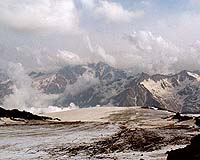
Hydrometeorologists have counted that within the last century the area, volume and length of the Big Caucasus glaciers decreased steadily. The process continues now and will go on in the future. Along with that, the quantity of glaciers grows.
The global climate change has naturally affected the glaciers. Researchers from the North-Caucasian Hydremeteorological Service have studied the recent changes in the area and size of glaciers in the Caucasus, and their perspectives for the future.
Dimensions of glaciation in the Big Caucasus have been changing for several centuries. The area of glaciers, their volume and length are reducing, but their number is increasing due to the fact that large glaciers come apart into smaller ones.
The lower boundary of glaciation is moving upwards. Thus, within the last century the area of the Caucasian glaciers reduced by 36%, and the volume by 48%, while the number of glaciers grew up, despite the fact that 535 glaciers melted. The glaciers became 600 meters shorter on average, and the ice thickness decreased by 50 to150 meters in the lower parts and by 20 to 30 meters in the upper parts.
Within the last decades (since 1970 through 2000), glaciation conditions in the Caucasus continue to change against a background of the atmospheric precipitation increase by 10-15% and the air temperature increase by 1 degree C. During this period, the area of glaciers decreased by 12%, ice volume by 15%, and the number of glaciers grew up by 2.4%.
The glaciers continued to recede and reduced the length by 100 meters on average within 30 years. Although some glaciers on the contrary assumed the offensive during this period, however the scale of these offensives was much less than previously, they generally did not exceed 50-100 meters (in this case, we don’t mean the mournfully known Kolka glacier).
In the future, glaciers of the Caucasus will not stay still either. According to the paleoenvironmental scenario, by 2050 the area of glaciation as well as the ice volume will decrease by one third as compared to those at the beginning of the century, and the length of glaciers will reduce by 150 meters.
The number of glaciers will grow by 4% mainly due to their break-up into smaller one. Glaciers will disappear chiefly in the western and eastern border areas of the Big Caucasus. Glaciation diminution will tell upon the reduction of glaciation drainage — it will become 37% less. However, there is no threat of drying up for rivers as they will be replenished with increased amount of precipitations.
