
In late August and early September 1859, Earth was struck by a sequence of geomagnetic disturbances, the largest of them on 1 and 2 September. The combined episode is widely regarded as the most extreme space weather event on record. It induced currents in telegraph lines across North America, Europe, and parts of Australia and Asia. Operators in some stations received electric shocks. Others watched paper catch fire as sparks leapt from their equipment. A few telegraph stations burned.
On the night of 2 September, two operators on the line between Boston and Portland, Maine, held a conversation over wires that had been disconnected from their batteries, exchanging messages on what they called the auroral current alone.
What the storm actually did
The Carrington Event takes its name from Richard Carrington, an English amateur astronomer who happened to be sketching sunspots from his private observatory in Surrey on the morning of 1 September when he saw a sudden white-light flash erupting from one of the spot groups. The flash lasted about five minutes.
It was the first solar flare ever recorded.
What Carrington could not see was the coronal mass ejection that accompanied the flare: a cloud of magnetised plasma hurled toward Earth at a speed that allowed it to cross 150 million kilometres in 17.6 hours, rather than the several days a typical CME takes. When it arrived, it compressed Earth’s magnetic field, allowed plasma to flood into the magnetosphere, and produced the largest geomagnetic storm in the instrumental record.
The auroral displays were extraordinary. Visible auroras reached as low as 18 degrees corrected geomagnetic latitude, near Panama. Gold miners in the Rocky Mountains were reportedly woken by the brightness and began preparing breakfast. People in the north-eastern United States could read newspaper print by the light from the sky. According to Armagh Observatory’s compilation of contemporary accounts, the auroral currents on the eastern telegraph lines were so steady and unidirectional that the Boston and Portland operators were able to hold communication and transmit messages over the line “the usual batteries being now disconnected from the wire”.
The conversation was useful at the time. It was also a warning.
The Lloyd’s estimate, and what it actually covers
In 2013, Lloyd’s of London and the US-based firm Atmospheric and Environmental Research published a joint risk assessment of solar storm exposure on the North American electric grid. The headline number from that report is an economic cost estimate of US$0.6 to $2.6 trillion in the event of a Carrington-level storm hitting the United States today.
The upper bound is the figure that tends to travel.
The scenario behind it is specific. Lloyd’s modelled a storm of equivalent magnitude striking the present-day North American grid, with risk concentrated along the Atlantic corridor between Washington DC and New York City, in the Midwest, and along the Gulf Coast. Between 20 and 40 million Americans would lose power, for durations ranging from 16 days at the low end to one to two years at the high end. The duration depends almost entirely on how quickly extra-high-voltage transformers, the equipment most vulnerable to geomagnetically induced currents, can be replaced. Lead times for new units run from 5 to 12 months from domestic suppliers, and 6 to 16 months internationally.
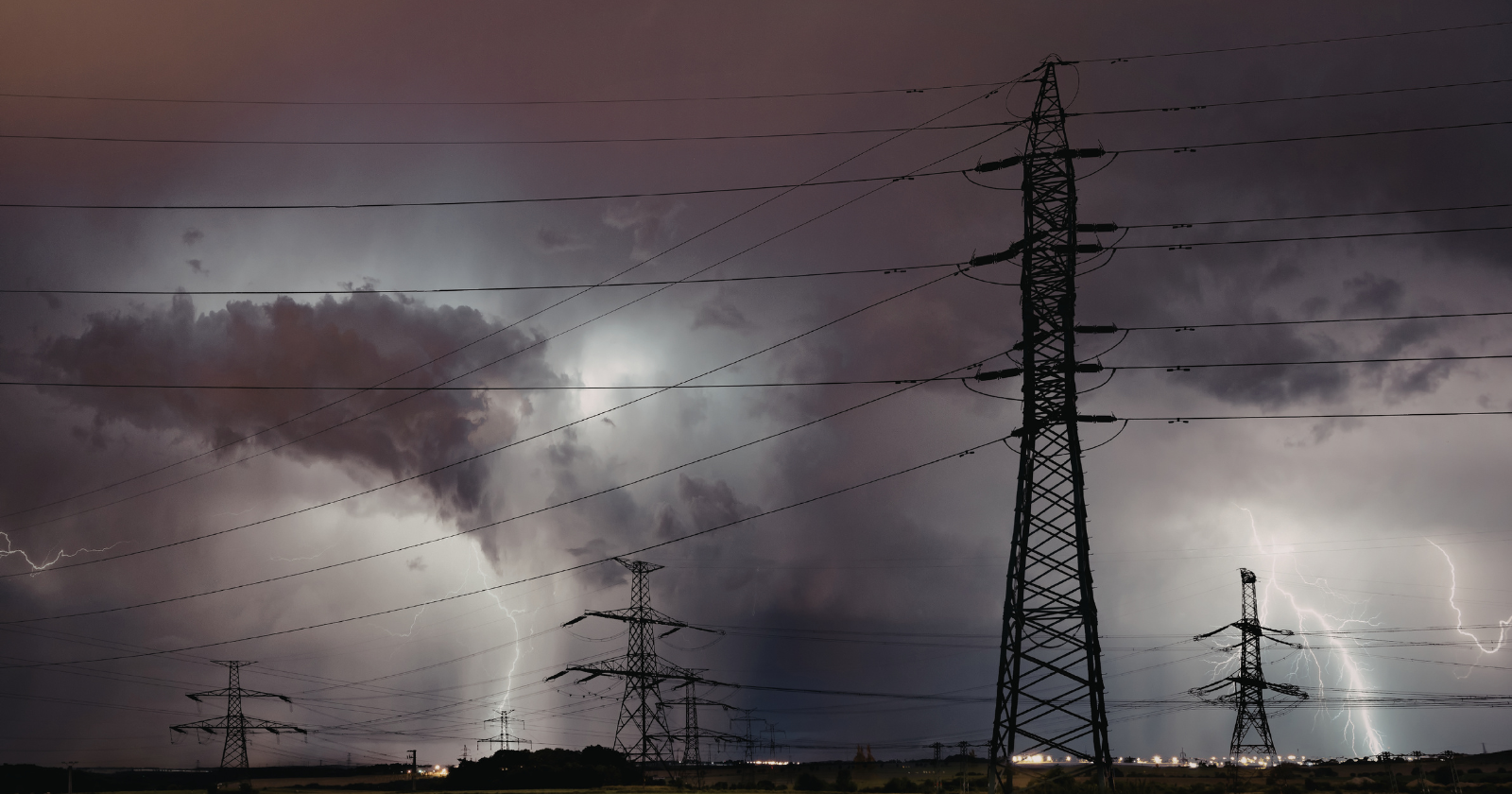
The mechanism is straightforward. When the magnetosphere is disturbed, slowly varying electric fields are induced at ground level. These fields drive direct currents through any long conducting structure, including high-voltage transmission lines. The transformers at each end of those lines were designed for alternating current, and they overheat and saturate when the induced currents are large enough. The 1989 storm in Quebec, considerably weaker than the Carrington Event, collapsed the Hydro-Quebec grid in under two minutes and left six million people without power for nine hours.
How rare an event this is
Carrington-level storms are not as exotic as they sound. The Lloyd’s report sets the mid-point estimate for the return period at 150 years, with a reasonable range of 100 to 250 years. Peer-reviewed work using power-law fits to the historical storm distribution puts the probability of a Carrington-class event occurring within the next decade somewhere between 1 and 10 percent.
There is a more uncomfortable fact lurking in the data. In July 2012, a coronal mass ejection of Carrington-class intensity was recorded by the STEREO-A spacecraft. It missed Earth by approximately nine days of orbital motion. Had the eruption occurred a week earlier, it would have struck the planet directly.
The Halloween storms of October 2003 were smaller than Carrington but still capable of damaging hardware. Twelve transformers in South Africa, at a magnetic latitude long assumed to be safe, were taken out of service. Sweden lost power for around an hour. The May 2024 storms produced auroras visible from Puerto Rico without taking down any major grid components, but they were also not in the Carrington class.
The pattern points to something uncomfortable. A society that has never operated continuously through a Carrington-level event in the era of widespread electrification carries an untested exposure, and the cost of being wrong about that has been independently estimated by a major insurance market at up to US$2.6 trillion in a single country alone.
What protection actually looks like
The Lloyd’s authors are blunt about the gap between the cost of prevention and the cost of damage. Hardening the grid with neutral-current-blocking capacitors on the most vulnerable transformers, improving the satellite-based warning network, and maintaining a strategic reserve of spare extra-high-voltage transformers would together cost a small fraction of the loss exposure. The figure quoted in the report for fitting blocking capacitors to the 1,000 most vulnerable transformers in the United States is roughly US$100 million.
After the 1989 Quebec storm, the Canadian government invested approximately CAD$1.2 billion in hardening the Hydro-Quebec grid. The United States has since introduced FERC-mandated reliability standards for geomagnetic disturbances, but capital investment in hardening the most exposed parts of the grid has been considerably more limited. Most of the satellites that currently provide the few hours of warning that allow grid operators to reduce load before a storm hits are operating well past their planned mission lives.
For now, the Carrington Event remains the benchmark for what a serious solar storm can do, and the auroral current that powered those telegraph lines in 1859 remains the most vivid demonstration anyone has recorded of the Sun’s ability to reach into terrestrial infrastructure and run it on its own terms.
