
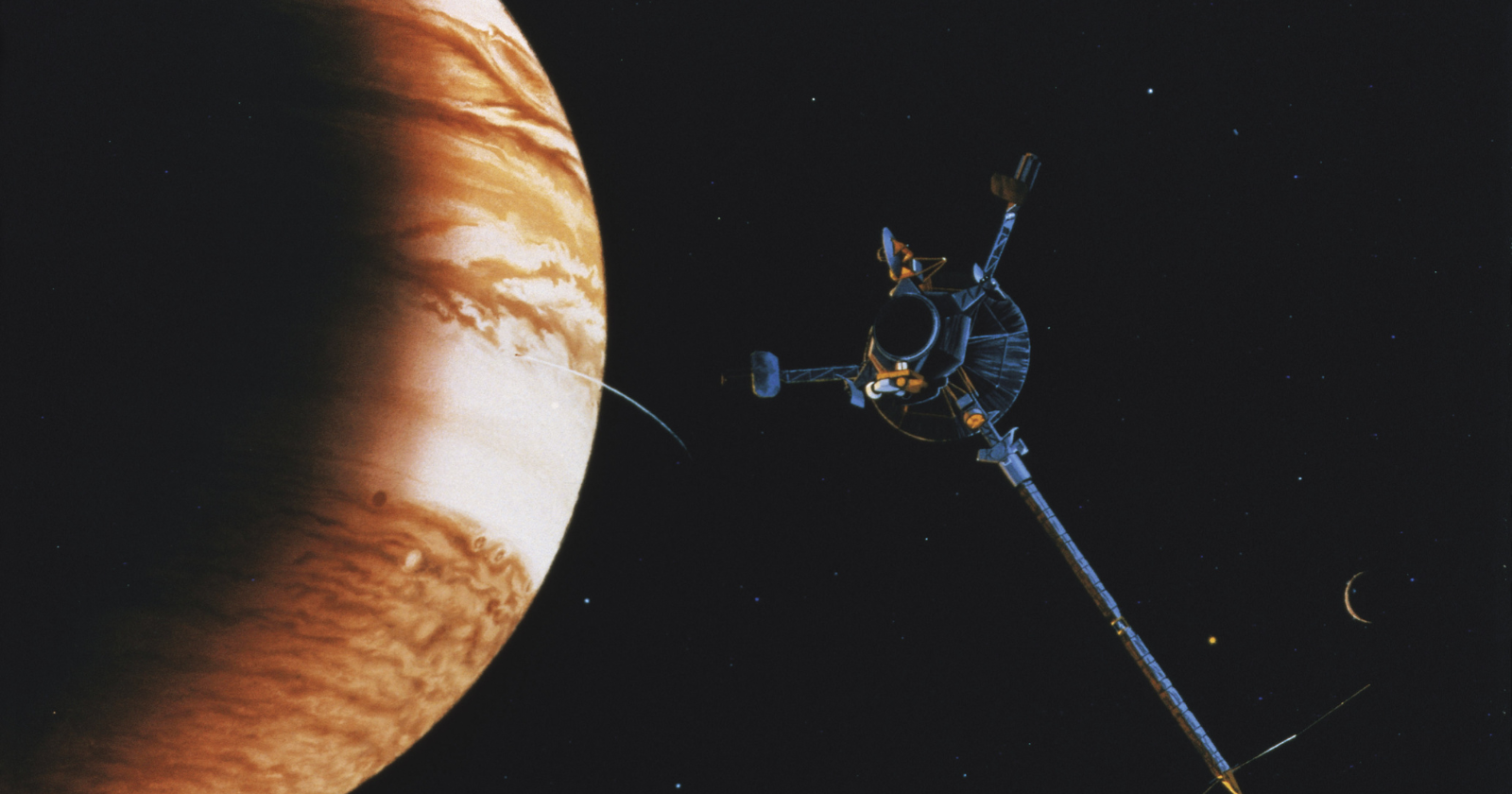
Galileo, NASA’s flagship mission to Jupiter, launched in 1989, and on 11 April 1991 its large high-gain antenna failed to open as commanded. The mission was not abandoned. Over the following years a workaround was built, centred on new software both on the spacecraft and on the ground, that let Galileo return most of its planned science through a small low-gain antenna that had never been intended for the job.
One detail in the popular telling is worth tightening at the start. The rescue is often described purely as reprogramming the spacecraft. The onboard software was central, but the recovery also depended on heavily upgraded ground systems, and that combination is the actual story.
What failed, and why it mattered
Galileo carried two kinds of antenna. The high-gain antenna was a mesh dish about 4.8 metres across, furled like an umbrella for launch and meant to open once the spacecraft was far enough from the Sun to avoid heat damage. It was the mission’s main link to Earth, designed to send data, including images, at high rates across the distance to Jupiter. The spacecraft also had two low-gain antennas, simple and robust, used for communication early in the flight. These were never intended to carry the heavy science return from Jupiter.
When the deployment command ran in April 1991, the high-gain antenna’s motors stalled and the dish opened only part way. A review team, working with telemetry and with an identical antenna on the ground, concluded that a few of the antenna’s 18 ribs, probably three, were stuck, held by friction between standoff pins and their sockets. The antenna had been stowed behind a sunshade since launch, almost eighteen months earlier. According to NASA’s account of the mission, new flight and ground software was then developed from 1993 to 1996, and the Deep Space Network was enhanced, so that the mission could be carried out through the spacecraft’s low-gain antennas.
Efforts to free the ribs ran for nearly two years. Engineers warmed the antenna in sunlight, cooled it to try to shrink the stuck parts, and repeatedly pulsed the deployment motors. None of it worked. By the mid-1990s the high-gain antenna was accepted as permanently unusable.
The size of the problem
The gap between the two antennas was not a modest shortfall. The high-gain antenna had been designed to transmit up to about 134,000 bits per second from Jupiter. Through the low-gain antenna, the unmodified rate would have been closer to 10 bits per second.
A mission planned around the first number cannot simply be run at the second. At 10 bits per second, the images and instrument data Galileo was built to gather at Jupiter would have trickled back so slowly as to make most of the science programme impossible. The spacecraft was healthy, its instruments worked, and it was on course. The single failed mechanism stood to waste almost all of it.
How the workaround was built
The recovery, developed from roughly 1993 to 1996, attacked the problem from several directions at once rather than through any single fix.
The most important spacecraft-side change was data compression. New flight software was written and radioed to Galileo to reprogram its onboard computers, so that images and other data were compressed before transmission. Compression discards predictable or redundant information, so that the essential content of an image could be sent in far fewer bits than the raw version required. The spacecraft’s tape recorder was used to store data so it could be played back slowly during quiet periods rather than lost. The team also changed how the data stream itself was structured and encoded, using more efficient error-correction coding and a packeted telemetry scheme, so that more usable information survived each second of transmission.
The other half of the work was on Earth. NASA’s Deep Space Network, the array of large antennas used to communicate with distant spacecraft, was upgraded to match the new onboard software. Several antennas at different sites were arrayed, combining their signals to receive the spacecraft’s faint transmission more sensitively than any single dish could, and receiver sensitivity at the ground stations was improved. The effect was to lift the rate at which Galileo’s weak signal could be pulled out of the noise, well above what a single antenna would manage.
Stacked together, compression, smarter coding, onboard storage, and a more capable ground network turned an unworkable trickle into a data rate the mission could be rebuilt around.
What it returned
Galileo reached Jupiter in December 1995 and operated in the Jovian system for eight years, through its primary mission and two extensions, before being deliberately flown into Jupiter in 2003 to avoid any chance of contaminating its moons.
What it sent back, entirely through the low-gain antenna, was a substantial body of science: close study of Jupiter’s atmosphere and magnetosphere, observations of active volcanism on the moon Io, and the data on Europa that strengthened the case for a subsurface ocean of liquid water beneath its ice. The mission returned far less raw data than the original high-gain plan would have allowed, and that loss was real. But pre-failure assessments had suggested the workaround might recover something like 70 percent of the original objectives, and in practice the scientific return was widely regarded as a success rather than a salvage job.
The episode is now a standard engineering case study, and the reason is worth stating plainly. Galileo could not be reached, repaired, or physically modified. Everything available to the team was a matter of changing how information was encoded, stored, transmitted, and received. The mission survived because the bottleneck was attacked at every point along the path the data travelled, on the spacecraft and on the ground, rather than at the one point that had actually broken.
