
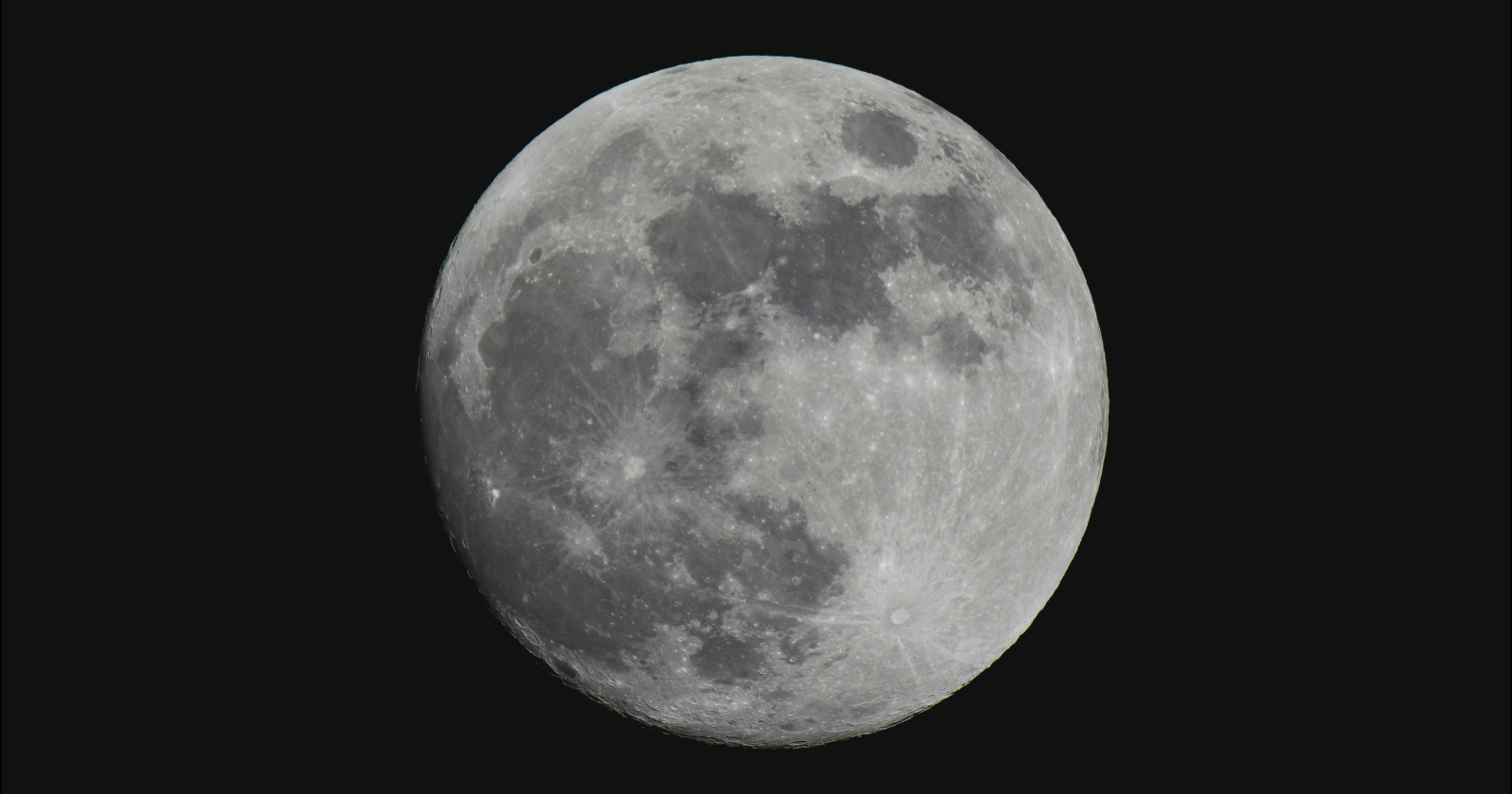
Between 1969 and 1972, NASA deliberately steered spent pieces of Apollo hardware into the Moon. Empty lunar module ascent stages and spent Saturn V third stages were aimed at the surface and allowed to crash. The point was not theatre. Each impact was a calibrated seismic source, set off near a network of seismometers the astronauts had left behind, so geologists could read how the shock travelled through the lunar interior.
The signals that came back did not look like anything recorded on Earth. After the Apollo 12 lunar module hit the surface in November 1969, the seismometer nearby registered a vibration that built slowly, peaked several minutes later, and then took close to an hour to fade. The result surprised the team. It is the origin of the line, repeated ever since, that the Moon “rang like a bell.”
The phrase is a metaphor, and it is worth being clear about what it does and does not mean.
Why crash hardware into the Moon
Apollo 11 left the first seismometer on the surface in July 1969, but it ran on solar power and lasted only about three weeks. The instruments that did the real work came later. Apollo 12, 14, 15, and 16 each deployed a passive seismic experiment as part of the Apollo Lunar Surface Experiments Package, powered by a small nuclear source rather than sunlight. Together they formed a four-station network on the near side that ran continuously until it was switched to standby on 30 September 1977.
A seismometer is only useful if something shakes the ground. On Earth there are earthquakes to spare. The Moon is far quieter, so the mission planners supplied their own sources. Once the astronauts had transferred back to the command module, the empty ascent stage of the lunar module was sent down onto the surface at a known time, place, and speed. The larger Saturn V third stages were crashed in the same way. A source of known energy at a known location let the team work backwards from the recorded signal to the structure it had passed through. The early results are set out in G. Latham’s report from the Apollo 12 passive seismic experiment.
What the seismometers recorded
The Apollo 12 lunar module struck the surface at roughly 6,000 kilometres per hour and left a crater about nine metres across.
The shape of the signal was the strange part. A terrestrial earthquake produces sharp arrivals, the primary and secondary waves a seismologist can pick out and time. The lunar signal had almost none of that. It arrived as a diffuse swell that rose, held, and decayed slowly, with no clean wave fronts to read. The deliberate impacts that followed behaved the same way. The Apollo 13 Saturn V third stage, crashed in April 1970, produced the largest signal recorded to that point and reverberated for about four hours, according to NASA’s ALSEP status reporting from late 1970.
So the “nearly an hour” figure belongs to the lunar module impact specifically. The bigger third-stage impacts rang for longer still.
Why it lasts so long
The explanation is not that the Moon is hollow, and not that it is metal. It is closer to the opposite. The Moon is a dry, solid body with a near-surface layer that has been shattered by billions of years of bombardment. This megaregolith, fractured rock several kilometres deep beneath a coating of fine dust, scatters seismic energy intensely. Waves do not travel cleanly through it. They bounce among the fractures and arrive at the seismometer from many directions over a long stretch of time, which is why the signal smears into a slow coda rather than a sharp pulse. The scattering character of the lunar wavefield is documented in the lunar seismology literature.
The second factor is what the Moon lacks. Earth’s rock holds water, and its interior is hot and partly molten. Both absorb seismic energy quickly, which is why an earthquake is usually over in under two minutes. The Moon is dry and cold through most of its volume, so it absorbs very little. Seismologists describe this as a high quality factor, or high Q. Energy that would be soaked up on Earth keeps moving on the Moon until scattering and the small remaining losses finally wear it down.
That combination, strong scattering near the surface and very low absorption overall, produces the slow ring. It resembles the sustained decay of a struck bell closely enough that the comparison stuck. The mechanism is not a bell’s. A bell rings at clean tones set by its shape; the lunar signal is scattered energy bleeding away, not a resonant note.
The reading the data does not support
The bell line has had a long second life as evidence for a hollow Moon. It is not evidence for anything of the sort. A long reverberation is what a solid, dry, heavily fractured body does, not what an empty shell does. Later gravity mapping by the GRAIL mission detailed the interior and found nothing resembling a hollow structure, and the seismic network itself recorded more than twelve thousand moonquakes over its lifetime, the basis for the interior models still in use.
The metaphor outran the measurement.
What the Apollo seismic network delivered was the first direct look inside another world, and the deliberate impacts were part of it: calibrated knocks on a body that had never been sounded before. The instruments were commanded to standby in 1977. The records they sent back are still being reanalysed, and they remain the main seismic evidence we have for what the inside of the Moon is made of.
