

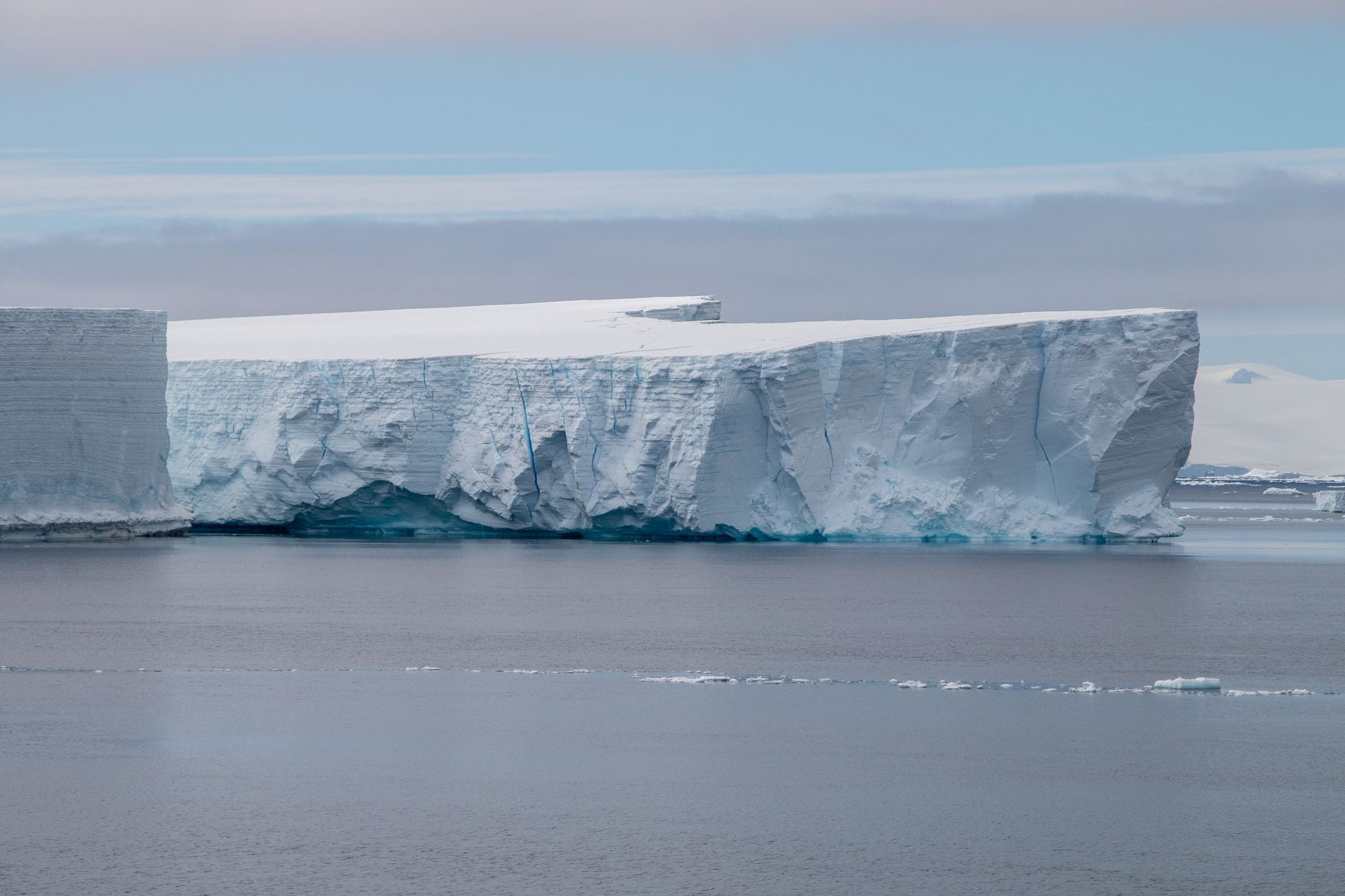
On 13 January 2025, an iceberg named A-84 broke away from Antarctica’s George VI Ice Shelf, opening a section of seafloor that had been sealed beneath floating ice.
The timing was unusually fortunate. A research team aboard Schmidt Ocean Institute’s R/V Falkor (too) was already working in the Bellingshausen Sea. According to a Schmidt Ocean Institute release published on 20 March 2025, the team changed its expedition plan and reached the newly exposed site on 25 January, becoming the first to investigate that area after the calving event.
The result was not the barren seafloor some might expect under an ice shelf. Using the remotely operated vehicle SuBastian, the researchers observed large sponges, corals, anemones, icefish, giant sea spiders, octopus and other animals living in a place that may have been dark and covered for centuries.
What the iceberg exposed
NASA Earth Observatory reported that A-84 measured about 30 kilometres long and 17 kilometres wide, with an area approaching the size of Chicago. The new berg had calved from the southern end of the George VI Ice Shelf and then moved quickly along the West Antarctic coastline. NASA’s February 2025 account of A-84 notes that calving is a normal process for ice shelves, while also adding that warming air and water and reduced protective sea ice can accelerate calving and contribute to collapse.
The area newly exposed by A-84 was about 510 square kilometres, according to Schmidt Ocean Institute. That matters because most scientific access to ice-shelf cavities is narrow. Researchers can drill through ice and lower cameras or instruments, but that gives only a small window. A large calving event, if a ship is nearby and conditions allow, can suddenly make a wider landscape reachable.
This was still not simple access. The ship had to work in a remote Antarctic sea, around ice, weather and short operational windows. The ROV observations lasted eight days and reached seafloor depths as great as 1,300 metres.
That is enough time to change a research question, not enough to complete it.
A dark habitat with visible life
Deep-sea ecosystems are often described as depending on material falling from above. NOAA calls this marine snow: dead organisms, faecal material, mucus and other organic particles that drift down through the water column. In much of the deep ocean, this slow rain of surface production helps feed animals and microbes far below sunlight.
Under a floating ice shelf, that pathway becomes harder to imagine. Photosynthesis does not occur beneath thick ice. The Schmidt Ocean Institute release says the ecosystems observed by the expedition had been covered by roughly 150 metres of ice for centuries and cut off from surface nutrients in the ordinary sense.
Yet the ROV footage showed animals that do not appear overnight. A large sponge photographed at about 230 metres depth was accompanied by anemones and other life. Schmidt Ocean Institute noted that sponges can grow very slowly, sometimes less than two centimetres a year, so the size of some specimens suggests that the community may have persisted for decades, perhaps hundreds of years.
That phrasing matters. The animals have not yet been dated as individuals in the way a tree ring might be counted. The age estimate is an inference from size, growth rates and the ice history. It is still significant, but it should be read as a cautious interpretation rather than a final measurement.
The food source is still uncertain
The central question is not only what lives there, but how.
Schmidt Ocean Institute said the team suspects ocean currents may be one mechanism carrying nutrients beneath the ice shelf, but the precise source of energy for the ecosystem remains unresolved. Glacial meltwater, circulation patterns, microbial processes and occasional transport of organic material may all be relevant. The expedition also deployed autonomous gliders to study the physical and chemical properties of the region and the influence of meltwater.
This is where the finding becomes more interesting than a list of animals. A visible community beneath an ice shelf implies a supply chain. Something is moving carbon, nutrients or both into a place where direct surface production is absent. The answer may not be one mechanism. It may be a set of currents, sediments, microbial recycling and seasonal or long-term inputs that together make survival possible.
That is why the newly exposed site is valuable as a baseline. If researchers can return, they may be able to watch how a formerly ice-covered ecosystem changes once light, open-water circulation and new biological arrivals begin to affect it.
Why earlier clues were not enough
The idea of life beneath Antarctic ice shelves is not entirely new. In 2021, British Antarctic Survey researchers reported a hard-substrate community beneath the Filchner-Ronne Ice Shelf after a camera encountered life on a boulder under hundreds of metres of ice. The paper, published in Frontiers in Marine Science as Breaking all the rules, showed that attached animals could live much farther under an ice shelf than expected.
What the 2025 expedition adds is scale. The earlier discovery was a narrow look through a borehole. The Falkor team used an ROV to explore broader seafloor landscapes soon after a large area became accessible. That difference changes what can be inferred. A camera lowered through ice can show presence. A mobile ROV can begin to show distribution, habitat structure and the range of organisms living together.
The comparison also prevents overstatement. The A-84 site is not the first evidence of under-ice life. It is a rare, detailed look at a newly exposed Antarctic seafloor community across a larger area.
The climate question sits behind the biology
The George VI Ice Shelf has been losing ice over recent decades, according to NASA Earth Observatory’s summary of observations and remote-sensing history. The A-84 calving event should not be treated as a single proof point for any one climate claim. Ice shelves calve. They always have.
But the setting is still a warming Antarctic Peninsula region, and the opening of formerly covered seafloor gives researchers a chance to document what was there before open-water conditions begin changing it. That makes the discovery both a biological surprise and a time-sensitive record.
If the community has been sheltered for decades or centuries, the moment after exposure is scientifically unusual. It is not yet a new normal. It is a transition.
The next work will be slower than the first images. Samples need to be analysed. Species identifications need to be checked. Growth rates, currents, food sources and meltwater effects need to be tested rather than assumed.
For now, the value of the discovery is that it makes an unseen system visible just as the cover above it has changed.