
A body in the young star cluster IC 348 weighs only about twice as much as Jupiter. It does not orbit a star, yet it carries a warm disk of gas and dust that may contain the raw material for smaller worlds. Its mass says “planet.” Its setting, disk and relationship to the cluster say it was probably born through a star-like collapse.
The object is one of nine new brown dwarfs confirmed by the James Webb Space Telescope in a deeper survey of IC 348, a star-forming region about 1,000 light-years away in Perseus. The Astrophysical Journal Letters study extends the population of spectroscopically classified brown dwarfs down to an estimated two Jupiter masses.
That combination exposes a weakness in astronomical labels. Mass, nuclear physics, orbital status and formation history do not always draw the same boundary. The new object is light enough to be called a planet by one convention and a brown dwarf by another.
Mass alone cannot decide what the object is
Stars begin when regions inside cold molecular clouds collapse under their own gravity. The contracting material heats, while conservation of angular momentum leaves some gas and dust rotating in a disk. Planets generally assemble later inside such a disk around the young star.
Brown dwarfs are independently formed bodies that never become massive enough to sustain the hydrogen fusion that powers ordinary stars. The hydrogen-burning threshold is close to 75 to 80 Jupiter masses, depending on composition. Many brown dwarfs can briefly fuse deuterium, a heavy isotope of hydrogen, above a rough threshold near 13 Jupiter masses.
The IC 348 object sits far below both limits. At approximately two Jupiter masses, it would never burn deuterium. A classification based only on nuclear capability would place it in the planetary-mass regime. A classification based on formation can still call it a brown dwarf if it condensed independently from the cluster’s molecular cloud.
That is why “free-floating planet,” “planetary-mass brown dwarf” and “sub-brown dwarf” sometimes describe overlapping populations. The terms encode different answers to a question that cannot always be settled by weighing an object.
Webb pushed an earlier record even lower
IC 348 is only a few million years old. Newborn brown dwarfs retain heat from formation and glow much more brightly in infrared light than old examples of the same mass. The cluster is also nearby by Galactic standards, at roughly 300 parsecs, or about 1,000 light-years.
In 2022, Kevin Luhman of Penn State and Catarina Alves de Oliveira of the European Space Agency used Webb to search the cluster’s center. A SpaceDaily report on that first survey described a three-to-four-Jupiter-mass object that became the leading candidate for the least massive known free-floating brown dwarf with a spectrum.
The deeper program expanded the field and sensitivity. Webb’s NIRCam recorded the warm infrared glow of stars and candidate brown dwarfs in 2024. The team selected 39 candidates from their colors and brightness, then used NIRSpec in 2025 to obtain spectra from 15 of them.
Spectroscopy separated genuine cluster members from lookalikes. Nine candidates showed the cool, low-gravity signatures expected of young substellar members. Four were unrelated T-type brown dwarfs in the background, and two were active galaxies. That result demonstrates why a faint red point in an image is not enough to establish a newborn brown dwarf.
The disk showed itself through excess heat
Two of the new members, catalogued as LRL 2296 and LRL 11040, became unusually bright at wavelengths longer than 3.5 micrometres compared with cluster members of similar luminosity. The excess infrared emission is the signature of warm material around the central objects rather than light coming from their atmospheres alone.
The researchers estimate masses near two and ten Jupiters for the pair. That makes the fainter LRL 2296 the least massive known brown dwarf with evidence of a circumstellar disk. Its NIRSpec data, along with those of the more massive object, also show absorption that may arise from water, carbon dioxide, carbon monoxide and OCN minus ions frozen in circumstellar ice.
Webb did not image the disk itself, which is inferred from the object’s colors and spectrum, and it detected no planets inside it. The gas, dust and ice are the kind of material from which companions can grow, but no planet formation has been observed.
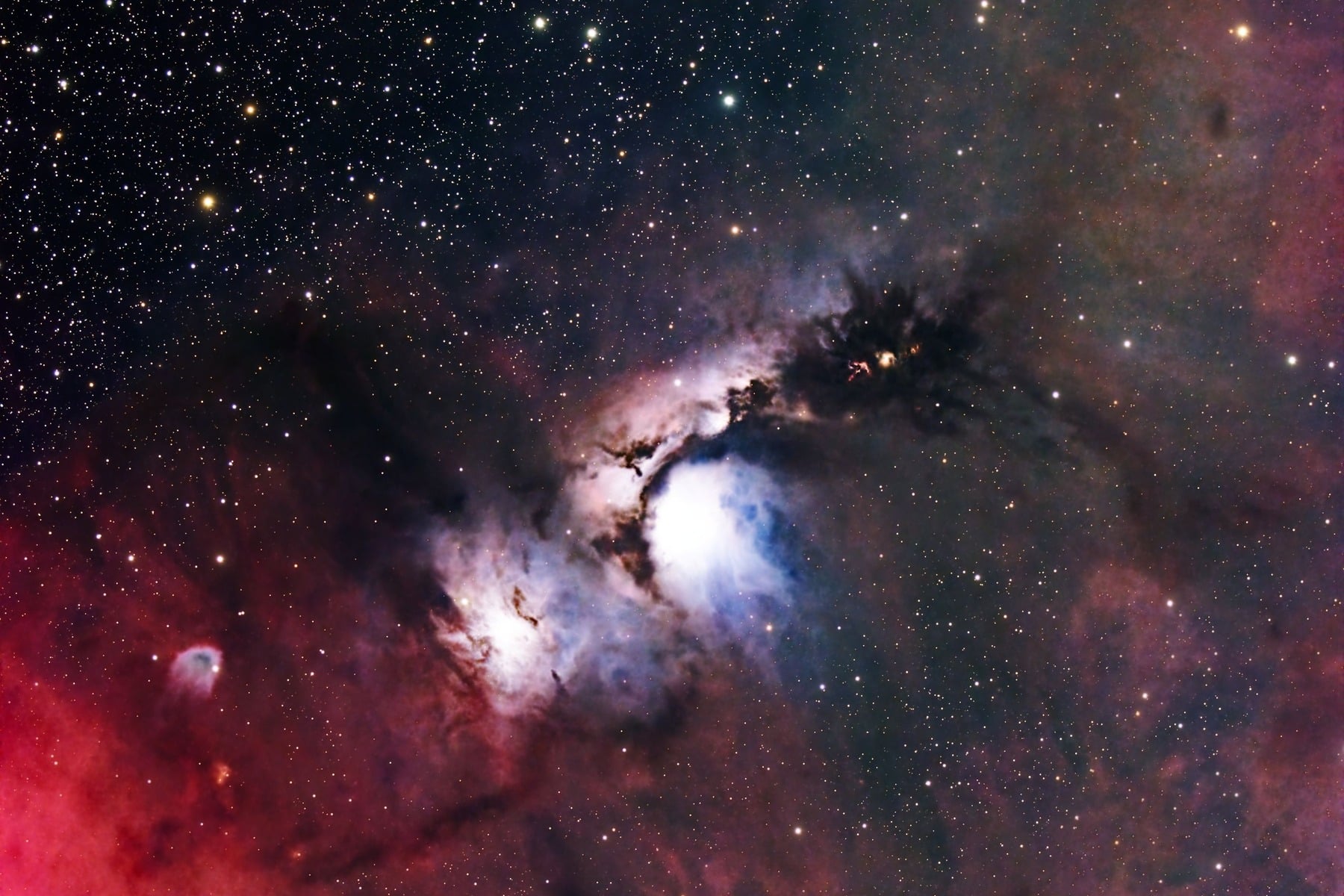
The new NASA Webb panorama of IC 348 places this result inside its broader nursery, where protostars, outflows and glowing dust share the field. The two-Jupiter-mass object itself remains an unresolved point in that enormous scene.
A disk supports star-like formation, but does not prove it
A collapsing cloud fragment naturally produces a disk because even slight initial rotation is amplified as the material contracts. In that sense, a disk around an isolated object is exactly what a scaled-down version of star formation would be expected to leave behind.
The inference is not airtight. A giant planet born in a disk around a star can acquire its own circumplanetary disk. Gravitational encounters might later eject both the planet and some surrounding material. A disk therefore establishes youth and a reservoir of orbiting matter, but it is not a unique birth certificate.
A separate 2026 study tested the ejection alternative using the spatial distribution of nine ultralow-mass, hydrocarbon-bearing objects in IC 348. Their positions and local stellar densities were statistically indistinguishable from those of stars and more massive brown dwarfs in the cluster.
In N-body simulations designed to resemble IC 348, planets liberated from stellar systems were generally scattered across a wider area and occupied lower-density environments after about three million years. The observed objects did not show that pattern, leading the authors to favor formation through the same broad cloud-collapse family as stars and brown dwarfs.
There is still a caveat. If IC 348 is closer to five million years old, some simulated ejected populations had enough time to disperse or dynamically relax until their distribution became harder to distinguish. The spatial evidence makes a star-like origin more likely, but it remains indirect.
The two-Jupiter figure comes from evolutionary models
LRL 2296 has no measured orbit around a companion that would reveal its mass through gravity. Researchers instead estimated its total luminosity, adopted the cluster’s age and compared the result with models describing how young substellar bodies cool and fade.
Those models are least secure in precisely this new regime. The discovery paper notes that evolutionary calculations for young brown dwarfs below about five percent of the Sun’s mass lack direct tests from dynamical masses. Systematic errors could therefore be substantial.
The authors estimate that even an error approaching 50 percent would not change the qualitative conclusion. LRL 2296 would still have only a few Jupiter masses and would remain an extreme test of how little material cloud fragmentation can isolate.
Future discoveries of binaries with measurable orbits could calibrate the models.
Its disk might build a scaled-down system
Inside disks, dust grains can collide, stick and grow into larger bodies. Whether LRL 2296’s disk contains enough material, persists long enough or has the right structure to complete that process is unknown. Longer-wavelength observations are needed because warm near-infrared emission reveals only part of the disk.
If companions did form, their names would be as debatable as the central object. Bodies born in a disk around a planet-mass primary might be called moons; bodies born around an independently formed brown dwarf might be called planets. The underlying physics would not change with the vocabulary.
SpaceDaily previously reported that other free-floating planetary-mass objects carry dusty disks containing silicate grains that have begun to grow and crystallize. Together, the observations suggest that disk processing does not require a Sun-like central star.
The bottom of the stellar mass function is moving
The faintest confirmed members matter beyond classification. Astronomers use the initial mass function to describe how many objects of different masses star formation produces. Finding the low-mass cutoff tests whether gravity, turbulence, radiation or dynamical interactions impose a minimum fragment size.
Webb found 19 additional candidates with colors resembling confirmed members but without spectra. Two could be near one Jupiter mass if they belong to IC 348. Spectroscopy is essential because the first sample also contained background brown dwarfs and galaxies.
The same survey identified an unexplained absorption band at 3.4 micrometres in eight of the nine new members and in another known object. The researchers attribute it to an aliphatic hydrocarbon and propose an “H” spectral class for these exceptionally cool newborn brown dwarfs. Atmospheric models do not yet reproduce all the spectral changes accompanying the feature, adding another uncertainty to mass estimates.
SpaceDaily has previously covered evidence that giant planets and brown dwarfs can follow different formation routes. LRL 2296 brings those routes into the same mass range, showing that weight alone cannot preserve a clean boundary.
The answer may be origin, not size
The lightest star is still much heavier than LRL 2296 because sustained hydrogen fusion has a real physical threshold. The line between a giant planet and a brown dwarf is less absolute. Deuterium fusion offers a convenient mass marker, but it does not say where an object formed.
A two-Jupiter-mass body embedded in the normal population of a young cluster, sharing its distribution and carrying a disk, looks like the extreme low-mass product of star formation. An object of the same mass orbiting a star inside a mature planetary system would be called a planet without hesitation.
Webb has not erased the categories. It has shown where their definitions disagree. LRL 2296 has the mass of a planet, the surroundings of a newborn brown dwarf and enough orbiting material to attempt a system of its own.