

Europa’s radiation clock runs fast enough to erase order from its exposed ice in about a fortnight.
Charged particles trapped in Jupiter’s magnetosphere strike the moon continuously. In the uppermost ice, that bombardment knocks water molecules out of an orderly crystal lattice and leaves a disordered, glass-like structure called amorphous ice. A 2025 study estimated that at low latitudes on Europa’s leading hemisphere, the process should remove the exposed crystalline signature in roughly 15 days.
James Webb found that signature anyway.
Its Near-Infrared Spectrograph detected crystalline water ice at the exposed surface in Tara Regio and Powys Regio, two southern areas of broken, rearranged terrain. The mismatch means some process must preserve or rebuild the crystal structure faster than Jupiter’s radiation can disorder it.
The headline compresses an important distinction. Radiation is not destroying the water itself in less than 15 days, and Webb did not watch patches of ground get replaced. The study’s leading explanation is rapid thermal recrystallisation in a thin layer of porous frost. That can renew molecular order in existing ice. Fresh material arriving from below is one possible source of the frost, but it is not the only explanation.
A 3.1-micrometre glint reveals the uppermost grains
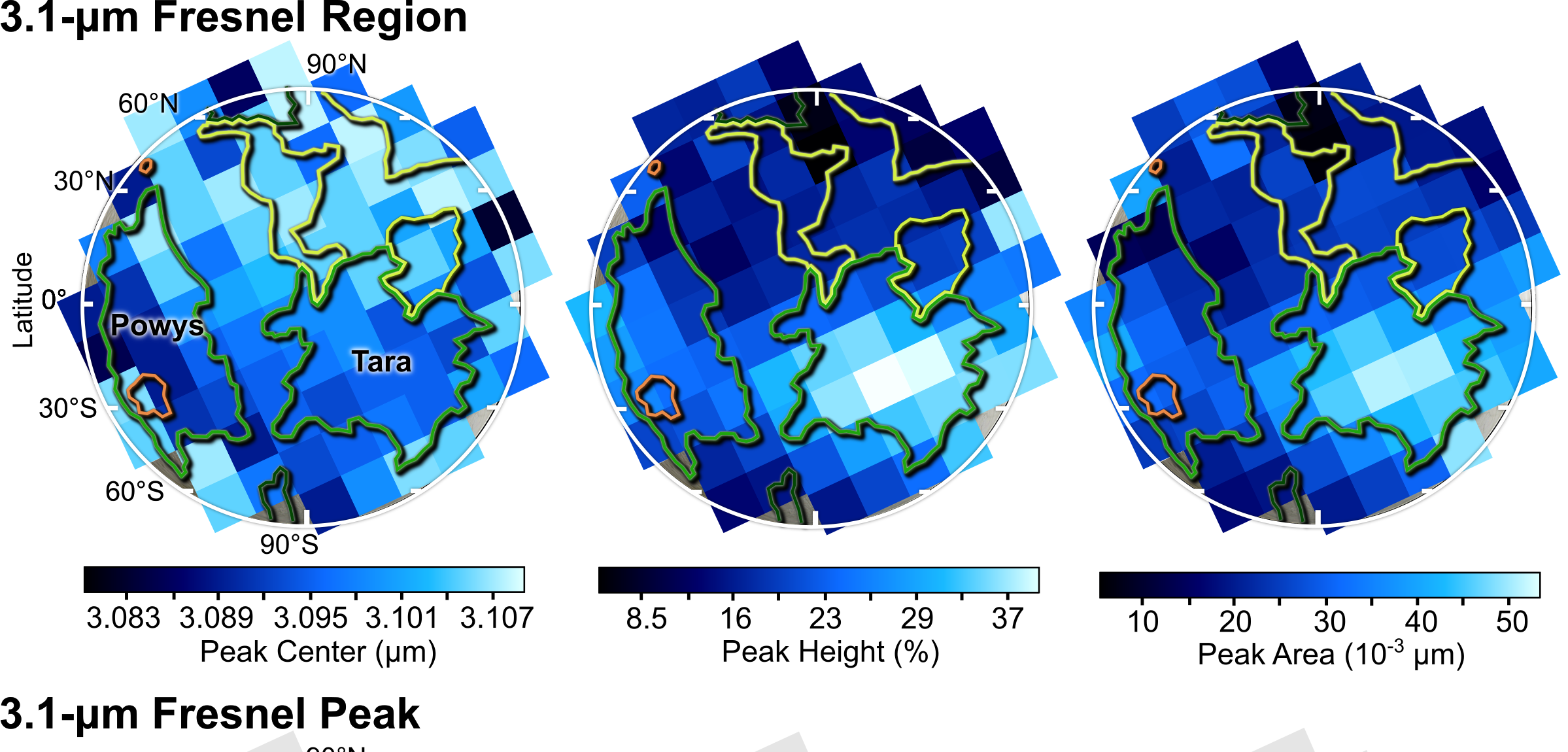
The finding comes from spectra, not a conventional close-up image. Webb’s NIRSpec instrument observed Europa’s leading hemisphere on 23 November 2022, gathering light from 1.48 to 5.35 micrometres. The researchers mapped several water-ice features across a disk that covered only a few dozen detector elements.
The decisive clue was a narrow reflection feature near 3.1 micrometres, known as a Fresnel peak. Laboratory spectra show that this peak identifies crystalline water ice. Because water absorbs strongly at these wavelengths, the returning photons sample less than about one micrometre into the exposed surfaces of ice grains.
In the peer-reviewed Planetary Science Journal study, the narrow peak was concentrated mainly in Tara and Powys. It was largely absent from northern low latitudes. That geography turned a signal about ice structure into evidence that Europa’s surface is being processed differently from place to place.
Europa can be crystalline underneath and amorphous on top
Another spectral feature creates what initially looks like a contradiction. A band near 1.65 micrometres, also associated with crystalline ice, appeared stronger at northern latitudes. How could those regions look more crystalline at one wavelength and less crystalline at another?
The wavelengths probe different depths. The 3.1-micrometre peak is sensitive to the very surface of a grain, below about one micrometre. The 1.65-micrometre band can sample roughly 300 to 500 micrometres deep.
The authors interpret the combination as a vertically layered regolith. Across much of the observed hemisphere, crystalline ice survives below a thin amorphous skin. In Tara and Powys, crystalline structure persists all the way to the exposed grain surface.
That is what “fresh” means in this result. It does not date an entire ridge or prove that a new slab of ice arrived yesterday. It identifies an ordered lattice at the optical surface, where radiation should erase that order quickly.
The 15-day lifetime is calculated, not watched
To estimate the radiation clock, the team modelled how energetic ions deposit energy into a square centimetre of ice extending 10 micrometres down. They combined Europa’s particle environment with laboratory measurements of how efficiently bombardment amorphises water ice near 100 kelvin.
The calculation indicated that exposed crystalline ice at low latitudes on the leading hemisphere should be substantially amorphised in about 15 days. The paper describes that as an estimated upper limit for the modelled layer, not a direct observation of a patch fading between two Webb visits.
The distinction separates three different clocks. The landscape has a geological age. Individual frost grains have a history of deposition and movement. Their molecules can switch between ordered and disordered arrangements on a much shorter thermal and radiation timescale.
A later Icarus model coupling irradiation, temperature and crystallisation independently reproduced the broad pattern seen by Webb. It also predicted that Europa’s near-surface crystallinity can change with local thermal conditions, a kind of molecular “blinking” that does not require wholesale resurfacing.
Warm porous frost may repair itself in days
The immediate explanation favoured by the Webb team is thermal recrystallisation. In amorphous ice, molecules lack long-range order. Give them sufficient mobility and they can rearrange into a crystal again. For highly porous grains under plausible Tara Regio conditions, earlier modelling suggested recrystallisation could take roughly 0.15 to two days.
That is fast enough to beat the estimated radiation damage. Darker terrain absorbs more sunlight and becomes warmer than brighter ice. A porous layer also changes the thermal behaviour and offers abundant grain surfaces. Together, warmth and porosity could maintain a detectable crystalline signature even under constant bombardment.
This is renewal, but not necessarily replacement. The same water molecules can lose and recover crystalline order. Saying the terrain must receive a completely new coating every 15 days would go beyond the evidence.
The paper nevertheless asks why Tara and Powys should carry suitable porous frost. Candidate sources include exposure of saline meltwater, intermittent plumes or vapour outgassing, sublimation followed by migration and redeposition, and impact gardening.
The geography makes the interior difficult to ignore
Tara and Powys are chaos regions, landscapes in which plates and blocks appear fractured, shifted and refrozen. They also host chemistry that is hard to explain as ordinary clean surface ice.
Previous Webb observations mapped carbon dioxide concentrated in the same chaos terrain. Two research teams argued that the carbon was probably derived from Europa’s interior. The 2025 ice study also mapped a feature from the rarer carbon-13 isotope of carbon dioxide almost exclusively in Tara and Powys, again favouring an internal source for the carbon-bearing material.
Sodium chloride and hydrogen peroxide have also been identified in Tara. The combination makes exposure of saline meltwater an attractive way to produce porous frost, and the authors call it perhaps the most likely of the options they discuss.
It is still not proof that liquid from the global ocean is reaching the surface now. Meltwater could reside within the shell rather than travel from the ocean. Vapour could migrate locally. Thermal recrystallisation can explain the ice structure without any new subsurface delivery at all. The spectra identify a place where several clues overlap, not an open pipe through the crust.
The scale mismatch is immense. NASA’s Europa overview places the global ocean beneath a shell perhaps 15 to 25 kilometres thick, although regional estimates and model assumptions vary. Webb’s most surface-sensitive ice signature comes from the first micrometre of exposed grains.
That ratio is why the finding cannot establish a direct ocean connection. A signal from a microscopic skin says nothing by itself about the full path through kilometres of cold ice, possible warmer convecting ice and local pockets of melt.
It does, however, mark terrain worth examining. As Space Daily’s earlier coverage of the changing crystallinity result reported, Tara Regio is a natural target for asking how exterior radiation and interior geology meet. The new emphasis is methodological: Webb inferred a very fast process from the survival of a spectral feature. It did not image terrain changing in real time.
Europa Clipper can test what Webb cannot resolve
Webb sees Europa as a small disk, and each NIRSpec spatial element covers hundreds of kilometres. NASA’s Europa Clipper will approach far more closely during repeated flybys after reaching Jupiter.
Its instrument suite includes the MISE imaging spectrometer, which covers the near-infrared wavelengths needed to map ices and salts at much finer spatial scales. Cameras, thermal imaging, radar, magnetic measurements and dust and gas instruments can test whether crystalline patches align with heat anomalies, young fractures, shallow structure or escaping material.
A Nature Astronomy research highlight described the Webb work as evidence for changes occurring over mere days. That is a fair summary of the competition between lattice damage and repair. It should not be confused with watching new crust form over 15 days.
The result is compelling precisely because it is narrow. Jupiter’s radiation supplies a fast eraser. Crystalline ice in Tara and Powys shows that some local process writes order back even faster. Whether that writer is sunlight acting on porous frost, recent material exposed from within the shell, or a combination of both is the question that turns a tiny spectral peak into a clue about Europa’s hidden machinery.