
Astronomers using the James Webb Space Telescope were examining the atmosphere of the known planet Beta Pictoris b when another planet announced itself in the same data. The unexpected signal became Beta Pictoris d, a cold giant orbiting a young star 63 light-years from Earth.
The discovery was serendipitous, but it was not a single unexplained bright spot. Webb detected the molecular fingerprint of a planetary atmosphere, then recorded it again at a second epoch. An independent team found the same world with the Very Large Telescope in Chile and traced it through archival images extending back 11 years.
That independent confirmation also qualifies the most dramatic version of the story. The bright debris disk made Beta Pictoris d extraordinarily difficult to separate from its surroundings, but it did not block every conventional search permanently. Improved ground-based imaging eventually found it too.
Webb was studying a planet already known
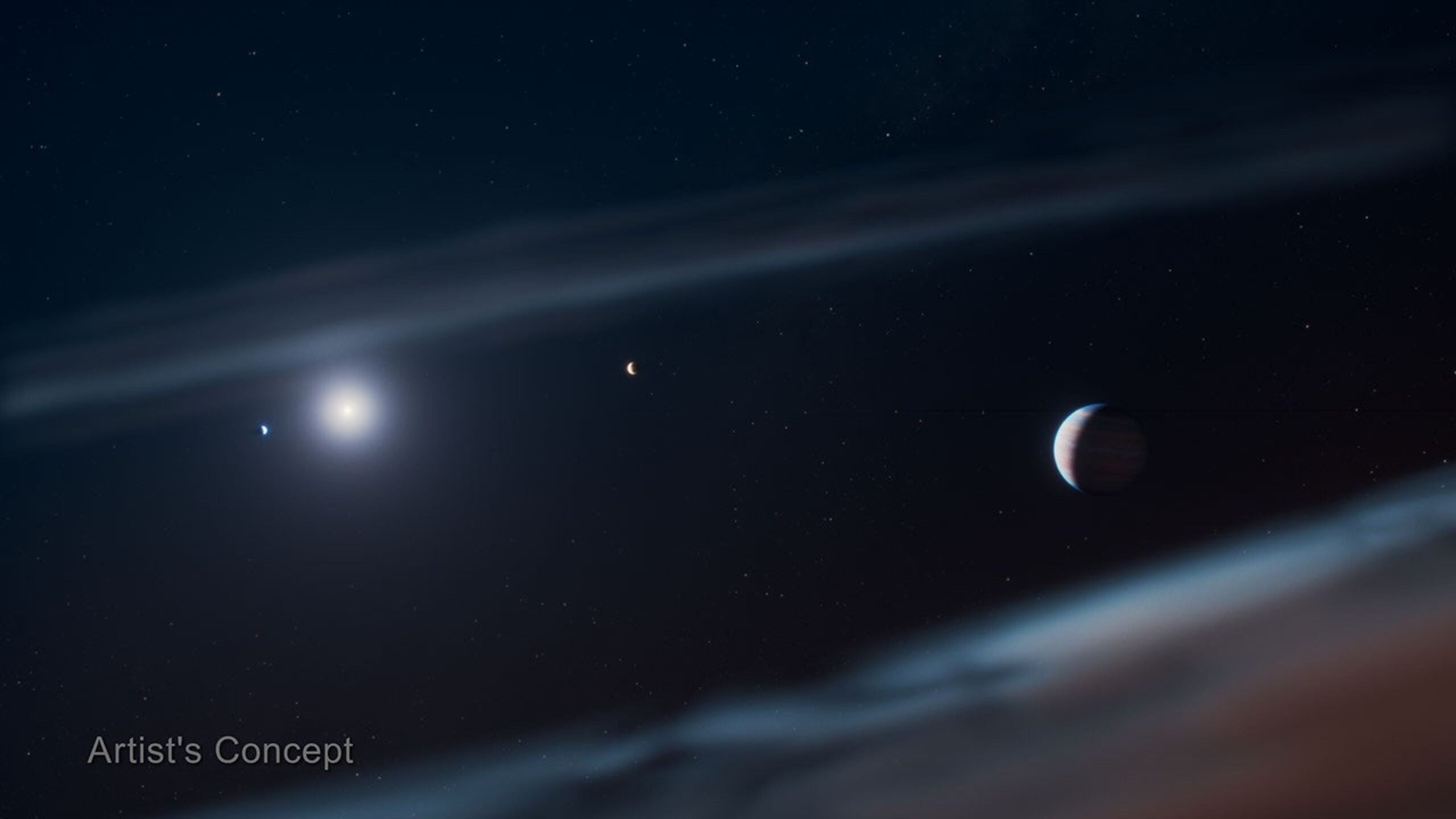
Beta Pictoris is a young star surrounded by one of the brightest debris disks astronomers have observed. Before the new work, the system was known to contain two giant planets, Beta Pictoris b and c.
A team led by Aidan Gibbs of the University of California, San Diego, used Webb’s NIRSpec instrument to study Beta Pictoris b. NIRSpec’s integral field unit records a spectrum at every position in a small image, allowing the team to separate chemical information spatially rather than collecting only a conventional picture.
According to NASA’s July 2026 account, the researchers were not searching for a third planet. A signal appeared where they expected dust. Instead of treating it as another feature in the disk, they tested whether it carried the molecular absorption pattern expected from a planetary atmosphere.
A chemical fingerprint emerged from the dust
The Webb team identified absorption from methane, carbon monoxide and water vapour. By matching that combination against atmospheric templates, they isolated Beta Pictoris d from the much brighter star and the disk’s scattered light.
The peer-reviewed study, led by Gibbs and published in The Astrophysical Journal Letters, describes this as the first planet discovered primarily through moderate-resolution spectral template matching. A second set of NIRSpec observations and data from Webb’s MIRI instrument confirmed that the signal moved consistently with a planet.
The team estimated a mass of roughly two to four Jupiters. Its orbit appears to lie beyond 30 astronomical units from the star, although that value depends on combining limited observations with orbital-stability modelling. One astronomical unit is the average Earth-Sun distance.
The disk concealed the planet rather than physically blocking it
Beta Pictoris d sits inside the inner edge of the system’s debris disk. Dust grains scatter the star’s light and create complex structures that can resemble or obscure faint point sources. The problem is contrast, not a solid curtain of material between the telescope and the planet.
That distinction matters because the new method did not simply see through opaque dust. It filtered the scene by chemistry. Dust does not carry the same narrow combination of methane, carbon monoxide and water signatures as a cooling giant planet, so spectroscopy could pick out a signal that broadband imaging had struggled to recognise.
The result suggests that other planets may already be present in integral-field spectroscopy archives as unresolved molecular patterns. It does not mean imaging is obsolete, as the second discovery team demonstrated.
A separate team found the same world from Earth
Researchers led by Ben Sutlieff of the University of Edinburgh and Markus Bonse of the European Southern Observatory independently noticed Beta Pictoris d in observations from the Very Large Telescope’s ERIS instrument. The ESO announcement says that team was also examining Beta Pictoris b when it saw the additional source.
Once the researchers knew where to look, they recovered the planet in VLT/SPHERE and Webb/NIRCam archives. Their 11-year astrometric record showed that the source was bound to Beta Pictoris and moving along an orbit rather than sitting in the distant background.
The ground-based analysis estimated Beta Pictoris d at 2.4 plus or minus 0.6 Jupiter masses, with a temperature near 600 kelvin and an orbital radius of about 26 astronomical units. It is about 100 times fainter than Beta Pictoris b and, after correcting for distance, the intrinsically faintest exoplanet yet directly imaged from Earth. These estimates are compatible with the Webb result, although the two analyses do not assign identical orbital distances.
A third planet changes the map of the system
Beta Pictoris is now only the second planetary system, after HR 8799, known to contain more than two directly imaged planets. The three worlds also offer an unusually controlled comparison because they formed around the same star at roughly the same time.
Planet d may explain a feature that predated its discovery. Its inferred mass and orbit place it where a planet could gravitationally sculpt the sharply defined inner edge of the debris disk. That possibility is consistent with the data, not yet a direct measurement of the sculpting process.
The Max Planck Institute for Astronomy reports an orbital period near 91 years from the ground-based fit. A much longer observing arc will be needed to map that orbit securely.
The striking part of the discovery is therefore not that a disk defeated every telescope for a decade. Beta Pictoris d was faint, cold and confused with a bright environment, yet it had left traces in old data. Webb found it by asking what each patch of light was made of, while a separate team found it by pushing imaging and archival analysis far enough to reveal the source itself.