
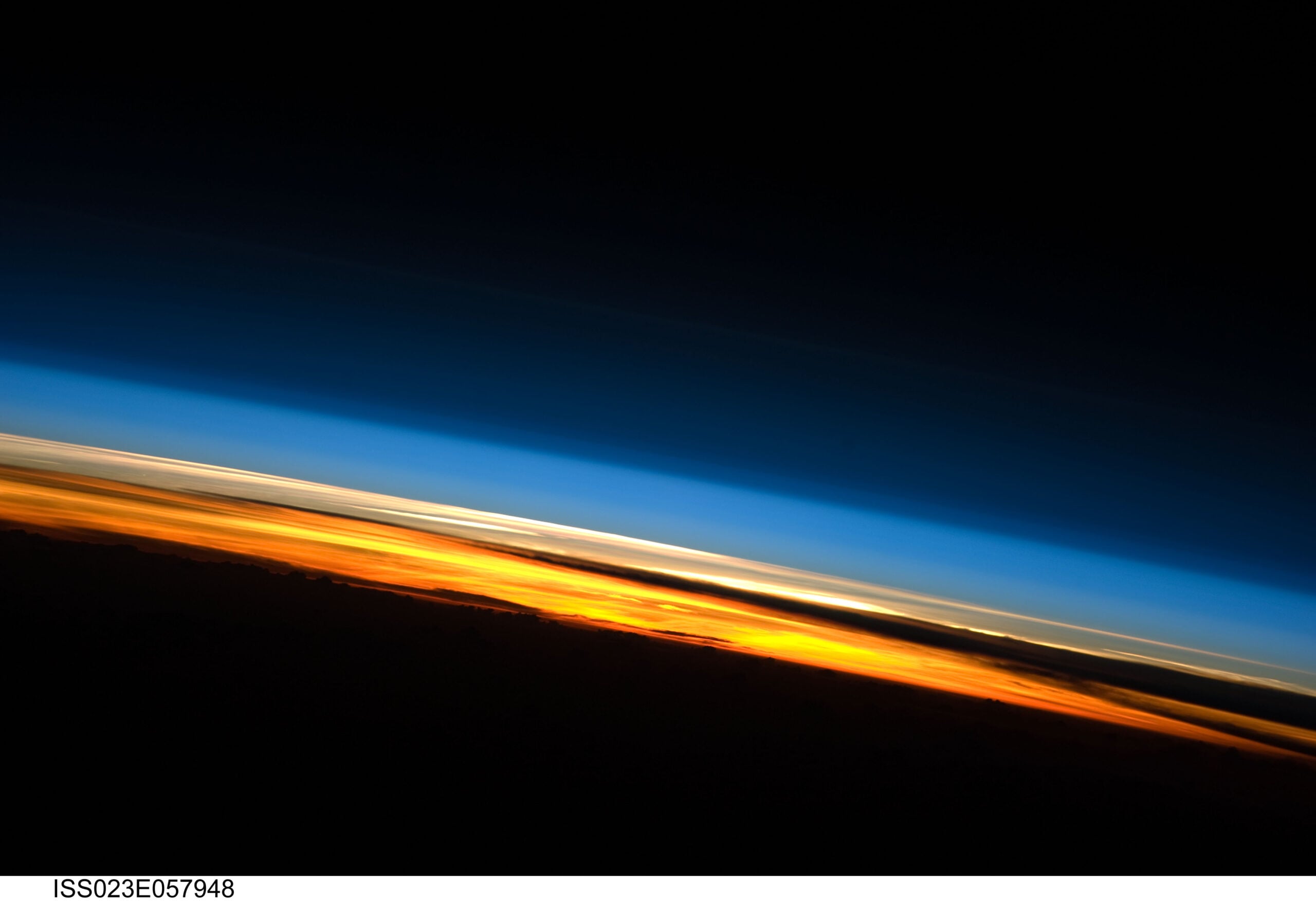
From the ground, the atmosphere can feel almost limitless. It is the sky above every roof, the weather moving across oceans, the air column that scatters sunlight into blue. Seen from the International Space Station, though, that same system becomes visually small. It appears as a narrow band of colour on the curved edge of Earth, with black space beyond it.
That is the tension inside one of the most repeated impressions from orbital flight: Earth looks protected, but the protection looks slight. The atmosphere is not a hard shell. It has no clean outer wall. It thins gradually, layer by layer, until air becomes too sparse to mean what it means at the surface. Yet photographs taken from orbit can make the planet’s life-support system look like a delicate blue-green rim.
NASA’s own educational description of Earth’s atmosphere calls it a kind of jacket for the planet, noting that it surrounds Earth, keeps the surface warm, provides oxygen, and is where weather occurs. The same NASA Space Place overview also compares the atmosphere to the peel of an orange, a plain image for a difficult scale problem. The familiar apple-skin and basketball comparison works in the same way. It is not a precision measurement. It is a reminder that the breathable, weather-making part of the planet is thin compared with the body it covers.
The thin line is real, but it is not simple
The line seen from orbit is partly geometry. Astronauts are looking sideways through the limb of the atmosphere, so sunlight passes through a long, slanting path of air before reaching the camera or the eye. The effect compresses layers, colours, haze, clouds, aerosols, and scattering into a narrow visual band.
One NASA image taken by an Expedition 23 crew member in 2010 makes this especially clear. The photograph, catalogued as ISS023-E-057948, shows an edge-on view of Earth’s atmosphere at sunset over the Indian Ocean. NASA’s description identifies the deep orange and yellow region as the troposphere, the lowest atmospheric layer, extending roughly 6 to 20 kilometres above the surface and containing more than 80 percent of the mass of the atmosphere. Above it, paler bands mark the stratosphere and upper atmosphere, gradually fading into the blackness of space.
That description matters because the atmosphere is easy to misunderstand when reduced to a single pretty strip. The ISS orbits well above the dense lower layers. NASA’s station facts page says the outpost circles Earth about every 90 minutes and that crew members see 16 sunrises and sunsets in a 24-hour period. Each sunrise or sunset gives astronauts a side view through the atmosphere, showing layers that are normally invisible to people standing beneath them.
From that height, the atmosphere can look like a border. In physical terms, it is more like a gradient. Pressure and density fall with altitude. The weather layer gives way to the stratosphere, the mesosphere, the thermosphere, and farther reaches where the few remaining atoms and molecules are spread so thinly that the language of ordinary air starts to fail. There is no glass dome around Earth. There is gravity holding gases to a planet, chemistry shaping those gases, sunlight interacting with them, and life depending on the result.
Why the view changes the observer
The emotional force of seeing Earth from orbit is often discussed under the term “overview effect”. The phrase was popularised by writer Frank White, but psychologists have also tried to examine the pattern more carefully. In a 2016 paper in Psychology of Consciousness: Theory, Research, and Practice, David B. Yaden and colleagues described the overview effect as a form of awe and self-transcendent experience reported by some space travellers. The paper is indexed under DOI 10.1037/cns0000086.
It is worth being precise here. Not every astronaut describes the experience in the same way. Not every account should be turned into a neat moral lesson. The view from orbit is filtered through training, culture, mission demands, personality, and language. But there is a recurring theme in many accounts: from above, Earth looks whole, finite, and exposed.
The atmosphere is central to that impression because it is both visible and insufficient-looking. It is the sign that this planet is not simply a rock. It is also a visual reminder that the conditions humans take for granted are held inside a comparatively narrow zone. On the surface, the air is background. In orbit, it becomes foreground.
This is why the phrase “protective shield” is both accurate and misleading. The atmosphere does shield life. It absorbs and scatters parts of solar radiation, moderates surface temperatures, drives the water cycle, and burns up many small incoming particles before they reach the ground. But shield can imply thickness, rigidity, and invulnerability. The orbital view suggests something else: protection can be thin, dynamic, and constantly maintained by planetary processes.
The apple-skin metaphor should make us more exact
The apple-skin analogy endures because it helps the mind with scale. Earth’s mean radius is about 6,371 kilometres. The lowest layer of the atmosphere, where nearly all weather occurs and where most atmospheric mass is concentrated, occupies only a small fraction of that distance. Even the conventional 100-kilometre Karman line, often used as a rough boundary for space, is small beside the planet’s radius.
Still, the metaphor needs handling. An apple skin has an edge. Earth’s atmosphere does not. A basketball is solid and inert. Earth is geologically, chemically, and biologically active. The atmosphere is not a wrapper added to the planet. It is part of a coupled system involving oceans, rocks, sunlight, ice, organisms, and human activity. A metaphor can be useful as long as it does not replace the system it is meant to clarify.
The ISS view is valuable because it holds both ideas at once. The atmosphere is large enough to produce continents of cloud, global circulation, jet streams, storms, auroras, airglow, and sunsets that astronauts can watch repeatedly in a single day. It is also thin enough, from orbit, to appear as a narrow luminous boundary between life and vacuum.
That boundary is not merely symbolic. Beyond it, unprotected humans face near-vacuum, extreme temperature swings, radiation hazards, and the absence of breathable air. Spacecraft and spacesuits are built precisely because the human body cannot negotiate those conditions directly. The line seen from the ISS is beautiful, but its beauty comes partly from the fact that it marks a constraint.
There is no need to make the view more dramatic than it is. The facts are already enough. A planet more than twelve thousand kilometres wide carries the main conditions for known life in a layer that, from orbit, can look like a wash of colour. Astronauts see that line not as an abstraction, but as a physical feature of home. The rest of us mostly live beneath it, which may be why we forget it is there.
