
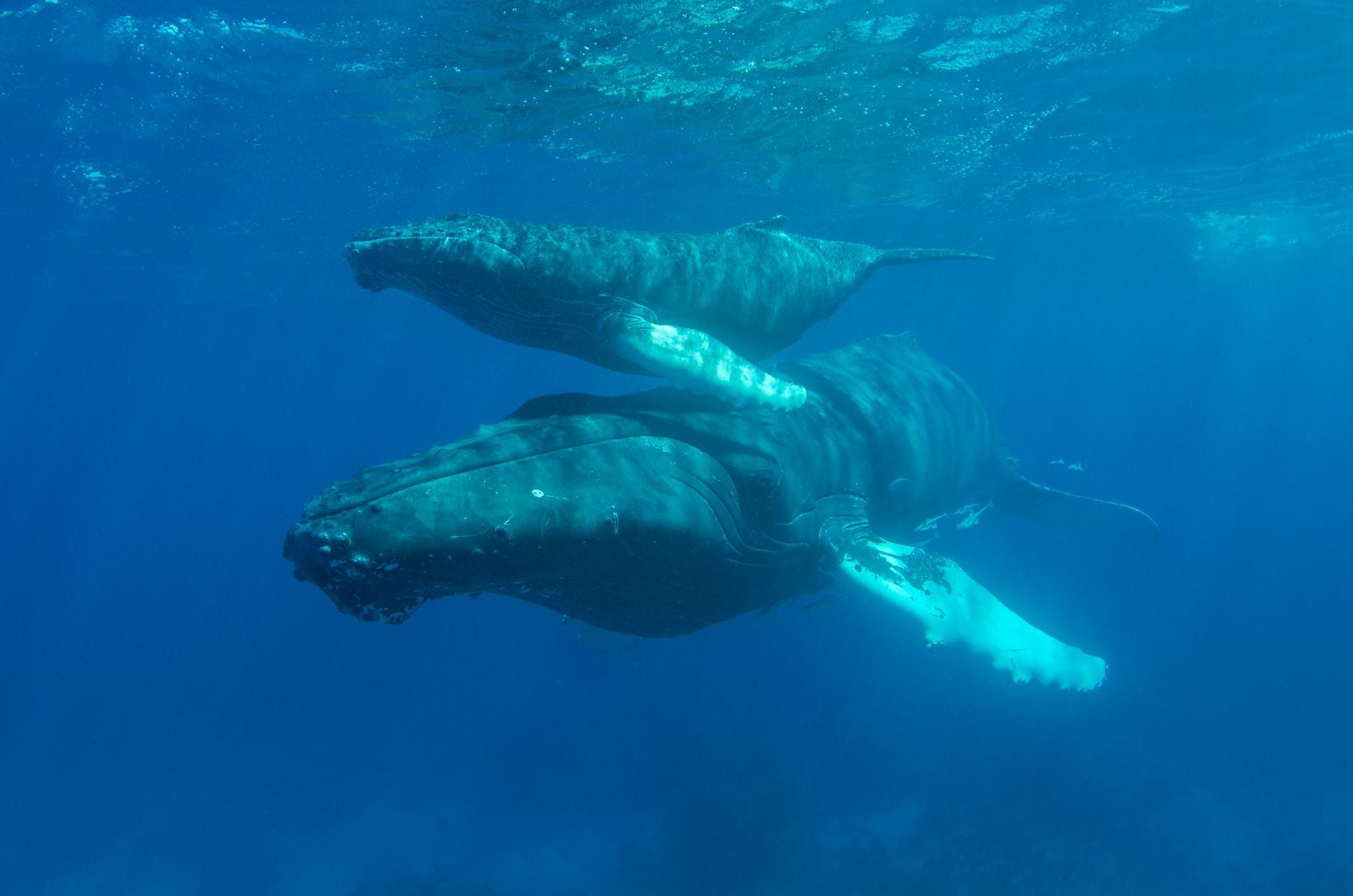
For decades, the clean version of humpback whale migration was easy to describe. The whales fed in cold, productive southern waters, then travelled north to warmer tropical and subtropical waters where mating, birth and early maternal care were assumed to belong.
A 2025 paper in Frontiers in Marine Science makes that picture less tidy. The study, led by Jane McPhee-Frew at the University of New South Wales, gathered records of newborn humpback calves across Australia and New Zealand and found them far south of the accepted calving limits, including two live records in Tasmania.
This is one study, not settled consensus. But it is a useful correction to a habit of thinking about migration as a simple line between feeding grounds and breeding grounds. The paper suggests that for at least some humpback mothers, birth may happen while the migration is still underway.
The old map had a tropical endpoint
The general background is still true. Humpback whales are long-distance migrants. NOAA Fisheries describes some populations as swimming thousands of miles between tropical breeding grounds and colder feeding grounds, and lists entanglement, vessel strikes, harassment and ocean noise among the ongoing threats they face.
In Australia, that broad model has long placed calving habitat in warm northern waters. The 2025 study notes that eastern Australian calving was accepted as extending no farther south than Gold Coast Bay, at about 28 degrees south, while the Western Australian limit was placed around North West Cape, at about 22.5 degrees south. The recognised wintering grounds were farther north again.
That made intuitive sense. Warm, shallow and protected waters have often been treated as safer places for a newborn calf, which is small, dependent and still developing the strength and insulation needed for long travel. It also made migration easier to narrate: feed in the south, give birth in the north, then return south with a growing calf.
The new paper does not say tropical calving grounds are unimportant. In fact, the authors explicitly caution that most calves are still probably born north of the study area. What it does say is that the older southern boundary was too neat.
What the study found
McPhee-Frew and her co-authors collected records of neonate humpback calves south of the previously accepted calving limits in Australia and New Zealand. The sources were mixed: government stranding records, annual whale surveys, professional whale-watching operators, aerial observations, photographers and other citizen science contributions.
The final dataset included 209 records of neonate calves in the study area. After accounting for known resightings and possible duplicates, the authors gave a conservative minimum of 169 unique records. These were not all from one coastline or one anomalous season. Neonates were recorded across New South Wales, Victoria, Tasmania, South Australia, Western Australia and New Zealand.
The Tasmanian finding is the one that most sharply disrupts the familiar map. The paper reports two live neonate records in Tasmania, with the highest latitude observation near Port Arthur at 43 degrees south. In the authors’ words, that calf appears to be the highest latitude record of a neonate humpback whale anywhere in the world.
Measured against the previously recognised eastern Australian limit near 28 degrees south, that extends the observed calving area by about 14 degrees of latitude, or roughly 1,500 kilometres. In Western Australia, the extension was about 12 degrees of latitude, or roughly 1,300 kilometres.
How they knew the calves were newborns
The paper is careful on this point because the whole argument depends on not mistaking older calves for neonates. The authors used strict inclusion criteria. Size was the essential requirement: calves had to be less than five metres long or roughly one third the length of the mother. Calves that did not meet the size threshold were excluded even if other details sounded suggestive.
Other features helped support the identification. Very young calves may be light grey, have smooth skin without barnacles or healed scars, show foetal folds as pale bands or shallow grooves, or have a dorsal fin that has not yet become fully erect. Behaviour mattered too. Cow-calf pairs were identified by close association, often touching or remaining less than one body length apart.
Timing was also used to avoid a different mistake. The study focused on the northward migration period and excluded live calf observations after 31 August, so the researchers were not counting calves that had already been born in the north and were heading back south later in the year. In some cases, there was stronger evidence of very recent birth, including plumes of blood or placenta, or stranded calves with the umbilicus still attached.
The calves kept moving
The second part of the finding matters as much as the location. The question was not only whether calves could be born outside the expected calving grounds. It was whether birth ended the migration.
For eastern Australia and New Zealand, the answer appears to be no. Direction of travel was available for 118 of the 168 live cow-calf observations. In New South Wales, all 94 pairs with direction data were moving north. In New Zealand, all three were northbound. In Tasmania, one of the two pairs was travelling north and the other was milling. In Victoria, most movements were still consistent with following the coast around before continuing north.
Western Australia was less clear because the available live observations came from south coast locations and direction data were sparse. The authors were careful not to overstate that region. But for eastern Australia and New Zealand, the pattern was strong enough for them to argue that giving birth does not necessarily mark the endpoint of the northward migration.
Why the finding matters
The tempting overstatement would be to say humpback whales no longer need warm waters. The paper does not show that. It does not tell us how often mid-migration births happen across the full population, or whether calves born in temperate waters survive at the same rate as calves born in the tropics. The authors point out that their dataset was opportunistic, not a systematic survey with equal effort across every coastline.
What it does show is narrower and still important: newborn calves are present well south of the accepted calving limits, and some mothers appear to continue north with them. That means the migration corridor is not just a passage between two biological events. It can be part of the event itself.
There are practical consequences. A calf born near Tasmania would have to travel for weeks with its mother through busy coastal waters before reaching the warmer northern areas traditionally treated as the calving and breeding zone. The study notes exposure to shipping lanes, fishing gear, shark mitigation devices, pollution and underwater noise along that route. If management plans assume newborn calves are absent from temperate waters, they may miss some of the most vulnerable animals in the population.
There is also a scientific consequence. The classic explanation for migration often centres on the calf: warmer water may reduce thermoregulatory costs, calmer protected waters may improve early survival, and lower-latitude wintering grounds may reduce predation risk. If some mothers give birth before reaching those habitats and then continue north, the reason for continuing may not be as simple as “get to the place where birth happens.”
The authors do not claim to have solved that problem. They suggest future work using satellite telemetry, photo matching and survival comparisons could test whether cow-calf pairs born during migration complete the full route, and whether their calves fare differently from those born in the wintering grounds.
For now, the study changes the question. The warmer northern waters still matter. But the clean boundary between migration corridor and calving habitat looks increasingly like a human convenience rather than a whale rule.
