
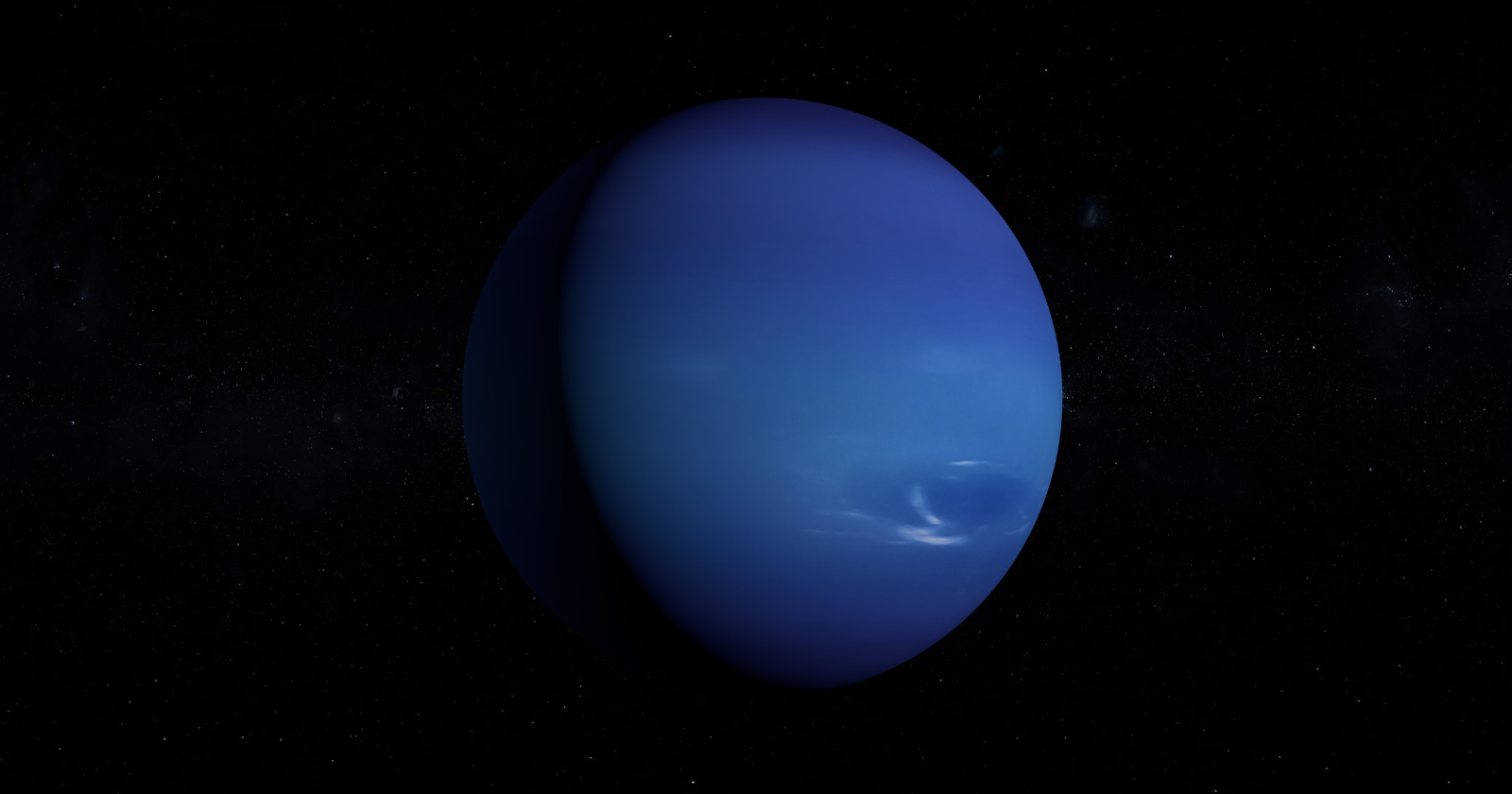
On 25 August 1989, Voyager 2 passed Neptune, the last planet of its tour and the most distant. The images it returned are still the sharpest close-up views of Neptune that exist. No spacecraft has visited the planet since.
Neptune is about 30 times farther from the Sun than Earth. According to NASA, it receives roughly 0.001 times the sunlight Earth does. For a camera, that is a severe constraint. The exposures Voyager needed at Neptune ran far longer than anything required earlier in the mission. Short exposures were on the order of 15 seconds. Longer ones ran into minutes.
A long exposure is only useful if the camera holds still relative to its subject. Voyager 2 was not holding still. It was moving past Neptune at tens of thousands of kilometres an hour. A multi-minute exposure taken from a craft moving that fast would smear the planet across the frame, in the way a photograph taken from a moving car smears a roadside sign.
Image motion compensation
The technique the engineers used to solve this is called image motion compensation. The principle is simple to state. If the spacecraft moves during the exposure, move the spacecraft so that the camera stays pointed at the same spot on the planet for the whole exposure.
Voyager 2’s cameras were mounted on a scan platform, but at Neptune the ordinary imaging setup was not enough on its own. The spacecraft’s motion during long exposures had to be compensated for by the attitude-control system as part of the imaging sequence. In effect, Voyager 2 was not just taking the picture; the spacecraft itself was being used to keep the target steady in the camera’s view.
During some long exposures, Voyager 2 was commanded through carefully calculated attitude motions so that the cameras tracked the target rather than letting the planet smear across the frame.
There was a complication inside the solution. Voyager controlled its orientation with small hydrazine thrusters. Firing a thruster the ordinary way would have given the spacecraft a jolt, and a jolt during a multi-minute exposure is its own kind of blur. The engineers addressed this by firing the thrusters in very short pulses, brief enough that each one nudged the craft almost imperceptibly. The compensating motion was assembled out of many tiny increments rather than one smooth push.
None of this was improvised at Neptune. Image motion compensation had been developed and trialled at Uranus in January 1986, where light levels were already low. Neptune, dimmer still, was where the technique was most needed and most fully used.
What the constraints were
It is worth being precise about what made this hard, because the difficulty was a combination of factors rather than any single one.
The light was faint, which forced long exposures. The spacecraft was fast, which meant long exposures would smear. The distance from Earth, about 4.7 billion kilometres at the encounter, meant a radio command took round-trip hours, so nothing could be corrected in real time. Everything Voyager did at Neptune had been computed, sequenced, and loaded in advance. And the hardware was old. Voyager 2 had launched in 1977 and had been in flight for twelve years. The imaging and pointing routines used at Neptune were uploaded to a spacecraft built before any of these techniques existed.
The data rate was also low. To help with it, the Deep Space Network’s ground antennas were enhanced for the encounter, and Voyager’s onboard data was compressed, so that the images the spacecraft worked so hard to take could actually be returned to Earth.
What it produced
The encounter returned more than 9,000 images of Neptune, its rings, and its moons. Among them were clear views of the Great Dark Spot, a storm system in Neptune’s atmosphere, and the faint ring system, parts of which were captured with long exposures and backlighting from the Sun.
The flyby also delivered the mission’s images of Triton, Neptune’s largest moon, taken a few hours after closest approach. In JPL’s account of the encounter, the engineering team adjusted the spacecraft’s path specifically to allow a close pass of Triton. Those images showed a young surface and evidence of active geyser-like plumes.
Neptune has not had a close visitor since. Proposals for a dedicated Neptune orbiter have been studied repeatedly and none has been funded and flown. As NASA noted on the 30th anniversary of the flyby, the encounter completed the Voyager mission’s survey of the four giant planets. For Neptune specifically, it is still the only close look humanity has, which is why a set of images taken in 1989, by a spacecraft turning its whole body through the dark to hold a planet steady, remain the reference images for an entire world.
