
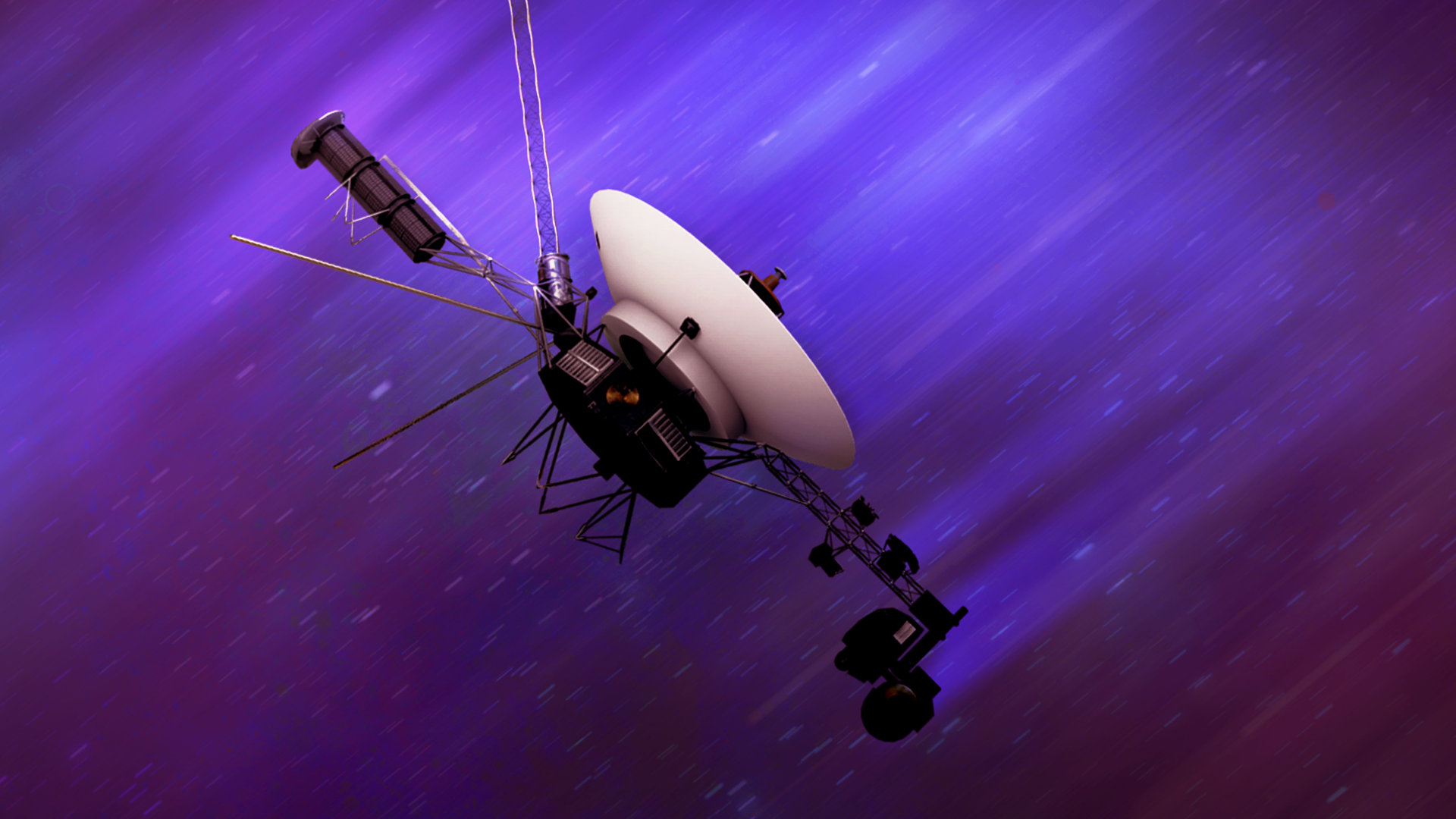
In November 2026, Voyager 1 will cross a boundary that is not marked by dust, plasma, gravity or any visible edge. It will become a spacecraft one full light-day from Earth.
NASA now lists the moment as Wednesday, November 18, 2026, at 2:16:07 a.m. PST. At that point, a radio command leaving Earth will need 24 hours to reach Voyager 1. A reply, if the spacecraft is able to send one, will need another day to come home.
The milestone is easy to misunderstand. Voyager 1 will not be leaving the solar system in the clean, schoolbook sense of crossing a final line. It passed beyond the Sun’s heliosphere in 2012, becoming the first spacecraft to operate in interstellar space, but the Sun’s gravitational influence stretches much farther. One light-day is instead a measure of communication, patience and scale.
A light-day is the distance light travels in vacuum in 86,400 seconds. Using the SI value for the speed of light, 299,792,458 metres per second, that comes to about 25.9 billion kilometres, or about 16.1 billion miles. NASA’s Voyager status page gives the same milestone in miles and identifies Voyager 1 as the first human-made object to reach that distance from Earth.
That number is large enough to feel abstract, but the practical effect is plain. By late 2026, Voyager engineers will no longer be able to send a command in the morning and learn the result the same day. The conversation with the spacecraft will take at least two days, even before the time needed for onboard actions, processing, scheduling through the Deep Space Network and Earth-side analysis.
A milestone built out of delay
Voyager 1 launched in 1977 with a primary mission to visit Jupiter and Saturn. It finished that planetary tour decades ago. Since then, it has become something quieter and, in some ways, stranger: an ageing observatory moving outward through the region beyond the Sun’s protective bubble.
NASA describes Voyager 1 and Voyager 2 as the only spacecraft ever to operate outside the heliosphere, the bubble of particles and magnetic fields generated by the Sun. Voyager 1 reached that boundary in 2012; Voyager 2 followed in 2018. That does not put either craft near another star. It places them in interstellar space locally, still moving through the outer reaches of the Sun’s domain on a timescale that belongs less to missions than to geology.
The one-light-day mark shows how far the mission has stretched from its original design. A spacecraft built in the 1970s, with computers and memory that now seem almost absurdly modest by terrestrial standards, is still being commanded from Earth across a gap that turns engineering into slow correspondence.
NASA’s April 2026 Voyager update gives a sense of that discipline. Engineers at the Jet Propulsion Laboratory shut down Voyager 1’s Low-Energy Charged Particles experiment to save power. The spacecraft, NASA wrote, was more than 15 billion miles from Earth at the time, so the command sequence would take about 23 hours just to arrive. The shutdown itself would then take more than three hours.
At one light-day, even the simplest confirmation becomes an exercise in waiting. If the team sends a command at noon on Monday, Voyager 1 receives it at about noon on Tuesday. If it responds immediately, Earth hears back around noon on Wednesday. For most spacecraft operations, that is not a delay around the edges of real time. It is the working reality.
The spacecraft is still operating, but narrowly
Voyager 1’s survival is not a matter of untouched durability. It has been actively managed for decades. Its radioisotope thermoelectric generators lose power as their plutonium heat source decays and as the hardware ages. NASA says the twin Voyagers lose about four watts of power each year, forcing engineers to shut down heaters, instruments and other systems in a carefully chosen order.
By April 2026, NASA’s status table listed only two Voyager 1 science instruments still operating: the magnetometer and the plasma wave subsystem. The cosmic ray subsystem had been turned off in February 2025, and the low-energy charged particle instrument followed in April 2026. The spacecraft still has scientific value because no other working probe is sampling the same region from the same distance.
The mission’s age also changes the meaning of risk. A small command error, a cold thruster, an unexpected power dip or a fault-protection response can take days to diagnose. Engineers are not working with a spacecraft they can service, reload or physically inspect. They are working with a machine moving away from Earth faster than any repair crew could ever follow, using a radio link that is becoming slower by the month.
That makes the November 2026 milestone less a triumphal banner than a sober measurement of remoteness. The probe is not close to another destination. It is not about to encounter a new planet or cross into some neatly named next zone. It is simply far enough away that Earth and spacecraft are now separated by an entire day of light.
One light-day is still close, by stellar standards
There is another scale hidden inside the milestone. One light-day is only about 0.0027 light-years. The nearest star system to the Sun is more than four light-years away. Voyager 1 has travelled farther than any human-made object, yet it has covered only a minute fraction of the distance to even the closest stellar neighbour.
That contrast is part of what makes Voyager useful as a measure of space travel. It is both astonishingly far and nowhere near far, depending on the scale being used. For human operations, it is remote enough that a command-and-response cycle can swallow a working week. For interstellar distance, it has only begun.
NASA’s own framing is careful. The status page invites readers to track Voyager 1 with the agency’s Eyes on the Solar System visualisation, while noting that precision matters as the spacecraft closes in on one light-day. The page also identifies the Voyagers as the only spacecraft to operate outside the heliosphere, not as craft approaching another star system.
That distinction matters because Voyager 1 is often turned into a symbol before it is treated as a machine. It is a symbol, of course. It carries the Golden Record. It has lasted far beyond its first assignment. It has become a reference point for the outer edge of human hardware. But in 2026, its most important fact may be more prosaic: it still has to point its antenna at Earth, conserve power and answer when called.
When Voyager 1 reaches one light-day from Earth, the milestone will be made of radio time. A signal will leave home, cross the planetary system, pass the orbit of Neptune, continue outward through the dark between known worlds and arrive, one day later, at a spacecraft launched before most people alive today were born.
The reply, if there is one waiting, will take just as long.
