
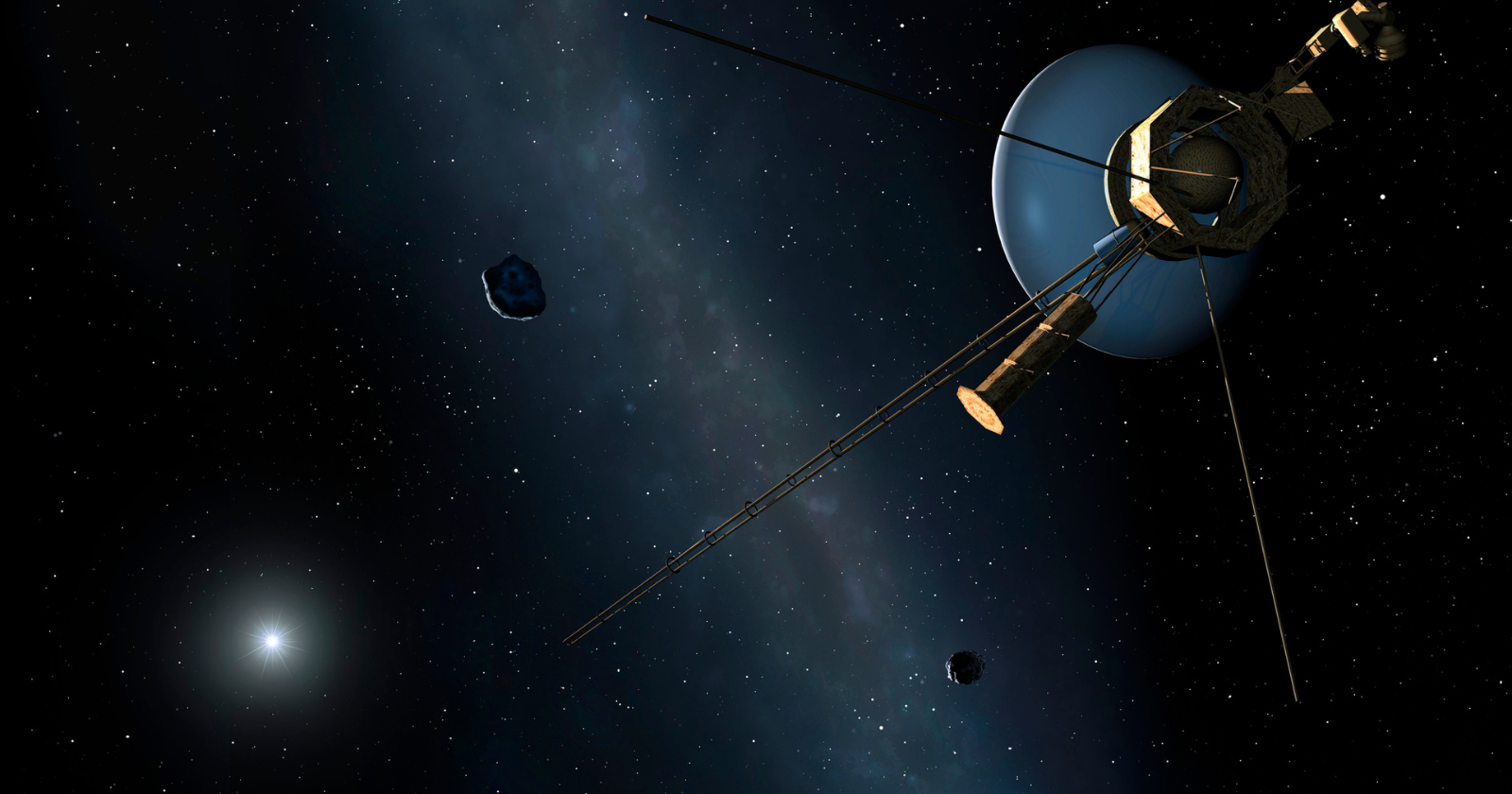
Voyager 1 began transmitting unreadable data on 14 November 2023. The flight data subsystem, one of three onboard computers built in the 1970s, had stopped packaging the spacecraft’s science and engineering telemetry into anything the Deep Space Network could decode. The carrier signal was still there. The contents were no longer meaningful.
Five months later, in April 2024, NASA’s Jet Propulsion Laboratory restored engineering data. The fix was not a hardware swap, which is impossible at the distance involved, but a remote rewrite of the spacecraft’s onboard software, broken into pieces and redistributed around a failed memory chip.
The first relocated code was sent on 18 April 2024 and confirmed on 20 April, after a round trip of just under two days at the speed of light.
What the FDS does, and what stopped working
Voyager 1 carries three onboard computers, designed in the 1970s. The flight data subsystem, or FDS, collects readings from the science instruments and the spacecraft’s own health sensors, packages them into a single telemetry stream, and hands the result to the radio system for transmission to Earth.
In March 2024, JPL engineers traced the November failure to one chip. According to NASA’s announcement on 22 April 2024, the chip stored a portion of the FDS memory that included some of the computer’s own software code. The loss of that code rendered the data stream unusable.
In subsequent technical reporting, JPL’s Jeff Mellstrom, chief engineer for the Astronomy and Physics Directorate, identified the failed component as a single RCA CD4061A CMOS SRAM chip, which held 256 words of FDS memory. Whether it had worn out after 46 years aloft or been struck by a cosmic-ray particle could not be determined, and made no practical difference. The chip could not be replaced.
The workaround
Unable to repair the chip, the JPL team had to place the affected software elsewhere in the FDS memory. No single free block was large enough to hold it. The solution was to break the code into sections, store each section in a different location, and rewrite the cross-references so that the pieces would still operate as one program.
The team began with the code responsible for packaging the spacecraft’s engineering data, because restoring engineering telemetry was the prerequisite to assessing the spacecraft’s overall state. That section was sent on 18 April 2024. Confirmation that it had taken effect arrived on 20 April. Over the following weeks, the remaining affected code was relocated and adjusted in the same way. Science data from the four operating instruments resumed by June 2024.
Working at interstellar distances
Voyager 1 is currently around 25.8 billion kilometres from Earth, and recedes by roughly half a million kilometres a day. A radio signal travelling at the speed of light takes more than 23 hours to reach the spacecraft, and another 23 to come back. The 22.5-hour one-way figure that applied during the April 2024 repair has lengthened by about an hour since.
The mission is heading toward a specific milestone in November 2026, when the one-way light time will pass 24 hours and Voyager 1 will become the first human-made object to sit a full light-day from Earth. From that point on, a command sent to the spacecraft and acknowledged by it involves more than two full days of waiting.
This is what the engineering culture around Voyager has been built to do. JPL still operates the spacecraft with a small project team. Suzy Dodd has been Voyager project manager since 2010. The institutional knowledge required to write FDS patches, run them against a 1970s computer architecture, and verify them against the spacecraft’s actual behaviour over multi-day round-trips is held by a particular group of engineers, and is being held intentionally.
What comes next
The 2024 episode is not unique. Voyager 1 has been losing instruments and capabilities steadily as its plutonium power source decays. Engineers have switched off heaters, retired instruments, and devised various workarounds to keep the spacecraft returning useful interstellar data for as long as possible. As of April 2026, Voyager 1 is down to two operating science instruments: its magnetometer and plasma wave subsystem.
NASA has said the Voyagers could have enough electricity to keep at least one science instrument operating into the 2030s, though the agency also cautions that unforeseen failures could shorten that timeline. The carrier signal itself will continue beyond that, unmodulated, with no one able to listen meaningfully on the other end.
What we keep returning to, in pieces like this, is how unusual the operational discipline around Voyager has become. The spacecraft is from one era. The team that keeps it alive is, by necessity, fluent across half a century of design choices. The 2024 patch was not a flourish. It was what an interstellar probe with a failed memory chip required to keep speaking. The next thing on Voyager 1 to fail will need something similar, and the team will be expected to write it.
