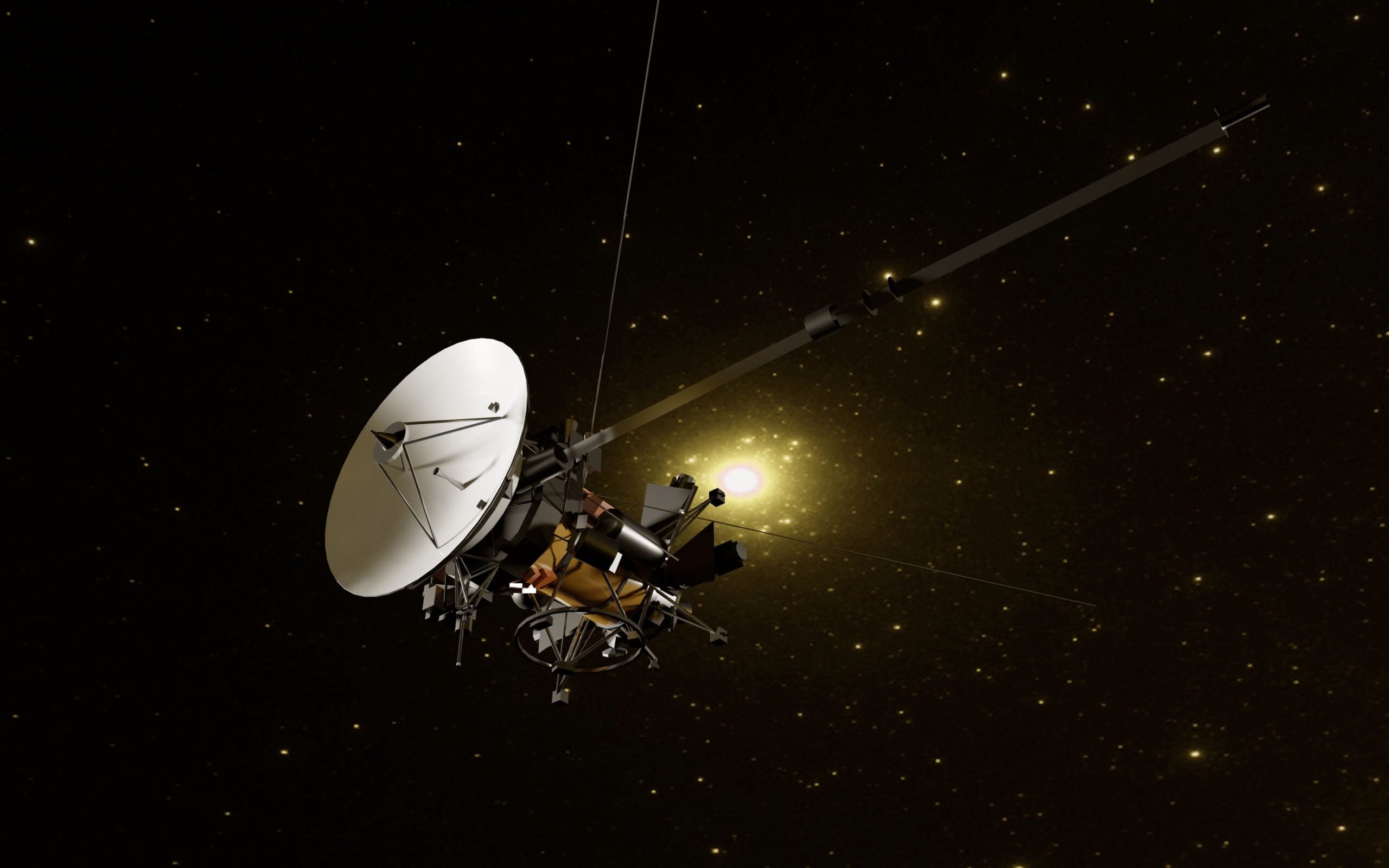
Voyager 1’s power test came back at the end of July, and by Kareem Badaruddin’s own account it went about as well as an engineer could hope. Badaruddin is the Voyager project manager at NASA’s Jet Propulsion Laboratory, and what he’s describing is the early stage of an attempt to do for Voyager 1 what a nearly identical procedure just did for its twin, Voyager 2: buy a dying power supply another year of science, on a spacecraft nobody can reach, touch, or send a spare part to.
I wrote a while back about the sliver of plutonium that’s kept both Voyagers running for close to half a century, and this is really that same story arriving at its next decision point. Voyager 1 needs the fix worse than Voyager 2 did. It has less power in reserve, it’s already lost more of its original instruments, and in February this year it came close to tripping its own emergency shutdown during a routine manoeuvre. Whether the fix behaves the same way on Voyager 1 as it did on Voyager 2 is, as of this week, still an open question, and NASA’s own engineers have said they’re not entirely sure of the answer.
A tighter margin than its twin ever had
Voyager 1 currently has two working science instruments left: a magnetometer and a plasma wave subsystem. Voyager 2 has three. Both spacecraft launched in 1977 with ten identical instrument sets, mostly built for flybys of Jupiter, Saturn, Uranus and Neptune that wrapped up decades ago, and both have been shedding instruments ever since, in an order the mission’s engineers settled on years in advance.
Voyager 1’s most recent loss came in April, when NASA switched off its Low-energy Charged Particles experiment, the instrument that had measured ions, electrons and cosmic rays almost continuously since launch. The shutdown wasn’t part of the planned sequence running ahead of schedule. It was prompted by an unexpected power dip during a roll manoeuvre on 27 February, one that brought Voyager 1 close enough to its automatic undervoltage fault protection that engineers chose to retire the instrument rather than risk a shutdown they hadn’t chosen themselves. A small motor inside the instrument, using half a watt, was deliberately left running, specifically so the whole thing could be switched back on if the power situation ever improved.
The same design, a different spacecraft
The fix both probes are attempting is nicknamed the Big Bang inside the mission, and the name refers to how it’s done rather than what it does. Rather than switching off one low-priority load at a time, engineers turn off several ageing devices at once, tape recorders and heaters that had been drawing power for decades, and replace them in the same moment with lower-power alternatives, all while keeping the spacecraft’s electronics above the temperature at which they’d fail for good. On Voyager 2, the swap went ahead in July and freed up close to ten watts a year, enough to keep its three remaining instruments running for at least another year.
Voyager 1 is next, and this is the part I find genuinely interesting rather than just procedurally interesting. Badaruddin has said plainly that although the two spacecraft were built to the same design, the team has observed real differences between them after forty-nine years of separate flight. That’s not a small caveat. It means a fix that worked cleanly on one twin isn’t guaranteed to work the same way on the other, even though the hardware started out identical. Voyager 1 is also farther out, more than 25 billion kilometres from Earth compared with Voyager 2’s roughly 21 billion, which means a command takes close to a day to arrive and just as long for confirmation to come back.
What the next few weeks decide
The power test Voyager 1 passed at the end of July checked whether the swap would draw more electricity than expected. The next hurdle is a thermal test, provisionally scheduled for the end of August, which checks whether the spacecraft’s temperature holds inside safe limits once the swap is made, since a heater or an electronic component that drops too cold in interstellar space doesn’t recover. If that goes well, the actual implementation on Voyager 1 follows, on the same cautious timeline that governs everything the mission does now, where a single command takes close to a day just to arrive.
There’s a genuinely hopeful detail sitting at the end of all this. If the fix frees up enough power on Voyager 1, NASA has said there’s a real chance the Low-energy Charged Particles experiment could be switched back on, not replaced, the same physical instrument, resuming measurements it’s been taking since 1977. I don’t want to overstate that. It depends on results NASA hasn’t published yet, and the agency has been careful not to promise it. But it’s the kind of small reversal that doesn’t happen often in a mission that has otherwise been a long, one-way process of turning things off.
What I’d watch next
Two dates sit ahead of each other on the calendar. The thermal test is due by the end of this month, and Voyager 1 is separately expected to cross one light-day from Earth in mid-November, a distance at which a signal travelling at the speed of light takes a full day to arrive. Neither date guarantees anything about the other. But together they’re a reasonable way to think about where this mission actually is: still capable of a genuine engineering surprise, still adding distance every second, and still, forty-nine years on, being managed one careful decision at a time by people who can’t see it, can’t touch it, and have learned to work within that.