
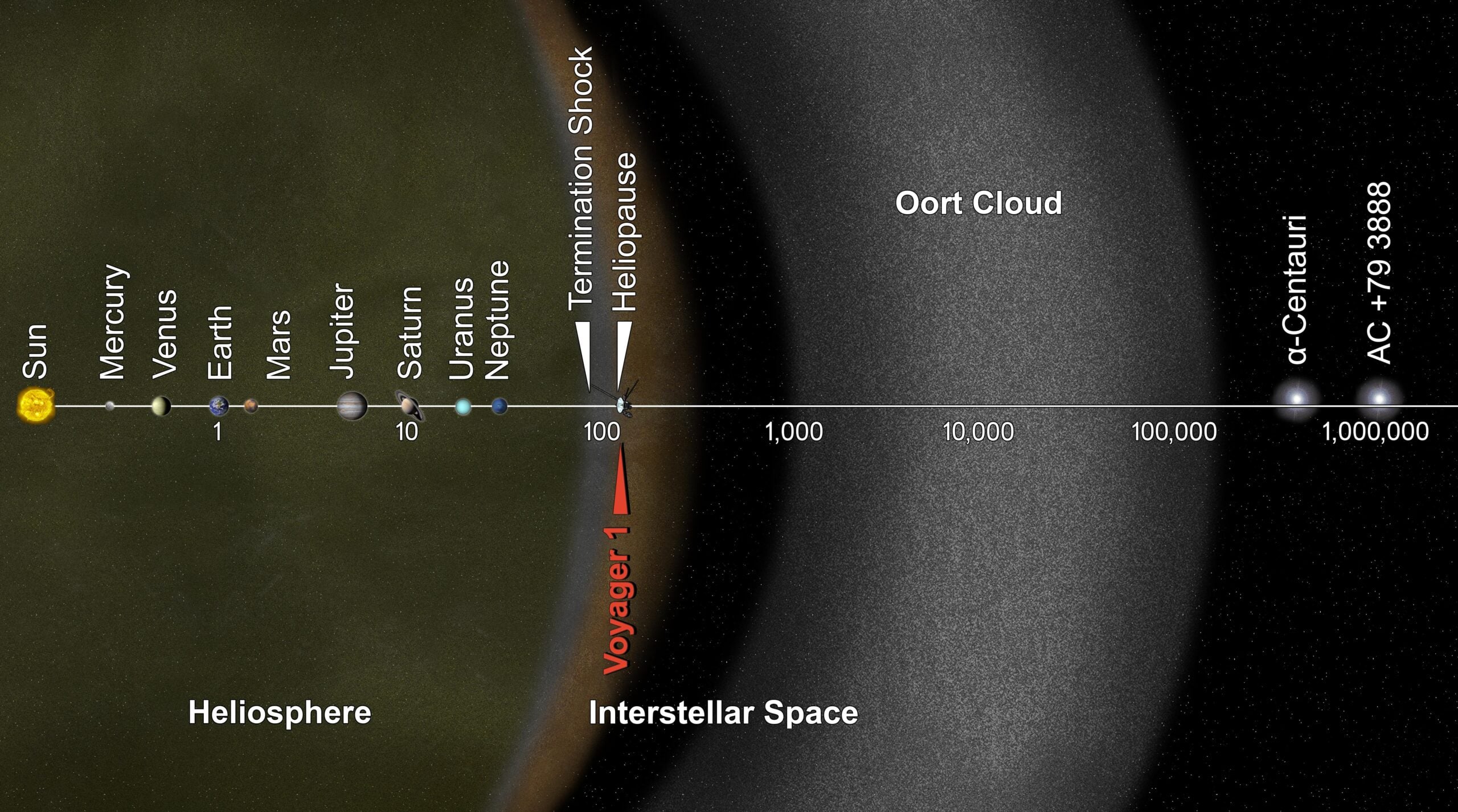
Voyager 1 is in interstellar space. It is also still inside the Solar System. Those statements appear contradictory only because there is no single physical line that can serve every meaning of the Solar System’s edge.
On 25 August 2012, the probe crossed the heliopause, the boundary where the outflow of particles from the Sun gives way to the plasma between the stars. NASA therefore describes Voyager 1 as the first human-made object to enter interstellar space. Yet the Sun’s gravity holds distant objects far beyond that plasma boundary. On the gravitational definition favoured by many planetary scientists, the Solar System continues through the Oort Cloud, a vast and still largely hypothetical reservoir of icy bodies. NASA estimates that Voyager 1 will take about 300 years to enter the cloud and perhaps 30,000 years to pass beyond its outer edge.
There is more than one useful edge
The familiar map of the Solar System ends near Neptune, about 30 astronomical units from the Sun. One astronomical unit, or AU, is the average Earth-Sun distance. Beyond Neptune lies the Kuiper Belt, which contains Pluto and many other small icy worlds. Voyager 1 passed that planetary neighbourhood decades ago.
A second boundary is set by the solar wind. The Sun continuously releases a thin stream of charged particles that expands through space, carrying the solar magnetic field with it. This flow inflates the heliosphere, a huge cavity within the surrounding interstellar medium. The heliopause forms where the outward pressure of that flow is balanced by pressure from material outside. It is often described as the boundary of the Sun’s protective bubble because the heliosphere changes the mix of energetic particles reaching the planets, although it is not a rigid shell.
The third edge is gravitational. Far outside the heliosphere, objects can still orbit the Sun. The most distant such population is thought to occupy the Oort Cloud. NASA’s scale comparison of Voyager and the Oort Cloud explains why everyday language causes trouble: much of what astronomers call interstellar space can still lie inside the Solar System when the latter is defined by the Sun’s gravitational domain.
What Voyager 1 actually crossed
Voyager 1 did not pass directly from an ordinary solar wind into completely untouched interstellar space. In December 2004, at about 94 AU, it crossed the termination shock. There the supersonic solar wind abruptly slowed as it began to feel the pressure of the interstellar medium. The probe then travelled through the heliosheath, a turbulent outer layer of slowed solar material, before reaching the heliopause at about 122 AU.
The 2012 crossing was established from several changes in Voyager’s environment. The abundance of particles associated with the heliosphere dropped sharply, while galactic cosmic rays increased. Voyager 1’s plasma instrument had ceased operating long before the crossing, but its plasma-wave instrument could still infer electron density from oscillations excited by solar eruptions. Those measurements showed that the probe was moving through plasma with the density expected in interstellar space. NASA’s account of the interstellar mission consequently gives 25 August 2012 as the crossing date.
This was a genuine transition, not a semantic consolation prize. Voyager 1 became the first spacecraft to sample the local interstellar medium directly. Its measurements also showed that the boundary is more complicated than a clean diagram suggests. Data from Voyager 2, which crossed the heliopause in 2018 with a working plasma instrument, found a transition layer and evidence that some solar influence persists beyond the nominal boundary. Five papers based on that crossing described an active, variable frontier rather than a fixed spherical wall.
The Oort Cloud is a different kind of boundary
The Oort Cloud has never been photographed. Its existence is inferred mainly from the paths of long-period comets that arrive from every direction. Astronomers think it forms a broad, roughly spherical population of remnants left from the Solar System’s formation, some of which were scattered outward by the giant planets.
Even its dimensions are uncertain. NASA places the inner edge of its main region at roughly 2,000 to 5,000 AU, with the outer boundary somewhere between about 10,000 and 100,000 AU. Other descriptions allow an inner component beginning closer to 1,000 AU. At the far edge, the Sun’s grip competes with the gravity of the Milky Way and passing stars. There is no fence beyond which every object suddenly ceases to belong to the Sun.
This is why the Oort Cloud provides a useful but approximate outer frontier. Inside it, small bodies can remain gravitationally tied to the Sun over immense periods. Beyond it, perturbations from the Galaxy and other stars are increasingly likely to dominate. A Jet Propulsion Laboratory explanation published as Voyager approached its historic announcement noted that mission scientists preferred the phrase “interstellar space” precisely because saying the craft had left the Solar System would invite confusion about this larger gravitational realm.
Why 300 and 30,000 years are estimates
Voyager 1 is escaping at about 3.5 AU per year. Extending that speed along its present outward path produces the memorable timescales: centuries to reach the Oort Cloud and tens of millennia to travel through the region assigned to it. These are scale estimates, not scheduled events with boundaries that a future controller could identify to the day.
The uncertainty in the cloud’s location alone spans tens of thousands of AU. Its objects are sparse, so Voyager is not expected to encounter a bright ring or a dense field of comets. It may pass through the supposed region without coming close to any Oort Cloud body. Its trajectory will also be influenced over long periods by the Galaxy, while the cloud itself is continually affected by stellar passages and the galactic tide.
Nor will the spacecraft be reporting its arrival. Launched in 1977, Voyager 1 runs on a radioisotope power source whose output declines each year. Engineers have progressively turned off equipment to preserve the remaining science. In April 2026, NASA switched off its low-energy charged particle instrument, leaving two science instruments operating. The communications lifetime is measured in years, not centuries.
Interstellar, but not beyond the Sun
Calling Voyager 1 an interstellar spacecraft is scientifically accurate. It is moving through material that belongs to the space between stars, outside the heliosphere created by the solar wind. Saying it has completely left the Solar System is accurate only under a narrower definition that treats the heliopause as the system’s edge.
The apparent paradox reveals something important about nature. A star’s influence does not stop in every sense at one surface. The solar wind ends at one boundary, stable planetary orbits occupy another scale, and the Sun’s gravitational family thins gradually into the Galaxy much farther out. Voyager 1 crossed the first of those great frontiers in 2012. The last lies tens of thousands of years ahead.
