
The simplest way to make Venus feel strange is not to begin with its heat, its pressure, or its acid clouds. It is to begin with a clock.
On Earth, the difference between a day and a year is obvious. One is the spin of the planet beneath our feet. The other is the long orbit around the Sun. Venus breaks that intuition almost immediately. According to NASA’s Venus facts page, one Venus day lasts 243 Earth days, while one Venus year lasts only 225 Earth days.
In plain terms, Venus takes longer to turn once on its axis than it takes to complete an orbit around the Sun. A calendar year on Venus would end before the planet had finished a single rotation.
That alone would make Venus an outlier. But the planet adds another complication: it rotates backward compared with Earth and most other planets. NASA puts the surface-view consequence simply: from Venus, the Sun would rise in the west and set in the east.
A planet where the clock and calendar argue
The phrase “a day is longer than a year” can be confusing because day can mean more than one thing. Astronomers distinguish between a sidereal day, the time a planet takes to rotate once relative to distant stars, and a solar day, the time from one noon to the next as seen from the surface.
Venus’ 243-Earth-day figure is its slow rotation relative to the stars. Its solar day is different because the planet is also moving around the Sun while it turns. NASA says sunrise to sunset on Venus would take 117 Earth days. That means a full solar day, from one sunrise to the next, is about 117 Earth days as well under NASA’s simplified surface description.
Even the shorter solar-day number is hard to make ordinary. A sunrise-to-sunset stretch on Venus lasts almost four Earth months. The next night would last roughly as long. If a lander could survive the surface long enough, the light would change with a patience completely unlike anything in ordinary human experience.
That slow rotation also means Venus has almost no familiar rhythm of morning, afternoon and evening. The planet is already hidden under a global cloud deck, so a person standing on the surface would not see a clean blue sky or a sharp Sun in the way Earth observers do. But the geometry still matters. The Sun’s apparent path would be reversed, and the day-night cycle would crawl.
Why Venus spins backward
Venus is described as having retrograde rotation. In a simple top-down view of the solar system, most planets orbit the Sun in the same direction and rotate in the same broad sense. Venus does not. It turns in the opposite direction, so its rotation is retrograde rather than prograde.
The cause is still discussed in planetary science. One explanation involves a large ancient impact that changed the planet’s spin. Another involves long-term gravitational and atmospheric torques that slowly altered the rotation over billions of years. Venus’ dense atmosphere, close orbit around the Sun and internal history all make the problem more complicated than a single tidy answer.
What is clear is the result. Venus is not merely slow. It is slow in the opposite direction. Its spin turns the normal Earth-based intuition about sunrise around.
That matters because rotation is not a decorative detail. A planet’s spin influences atmospheric circulation, temperature patterns, magnetic-field behavior, surface weathering and the way sunlight is distributed. On Venus, the rotation is so slow that the atmosphere has time to behave very differently from Earth’s.
The atmosphere moves faster than the ground
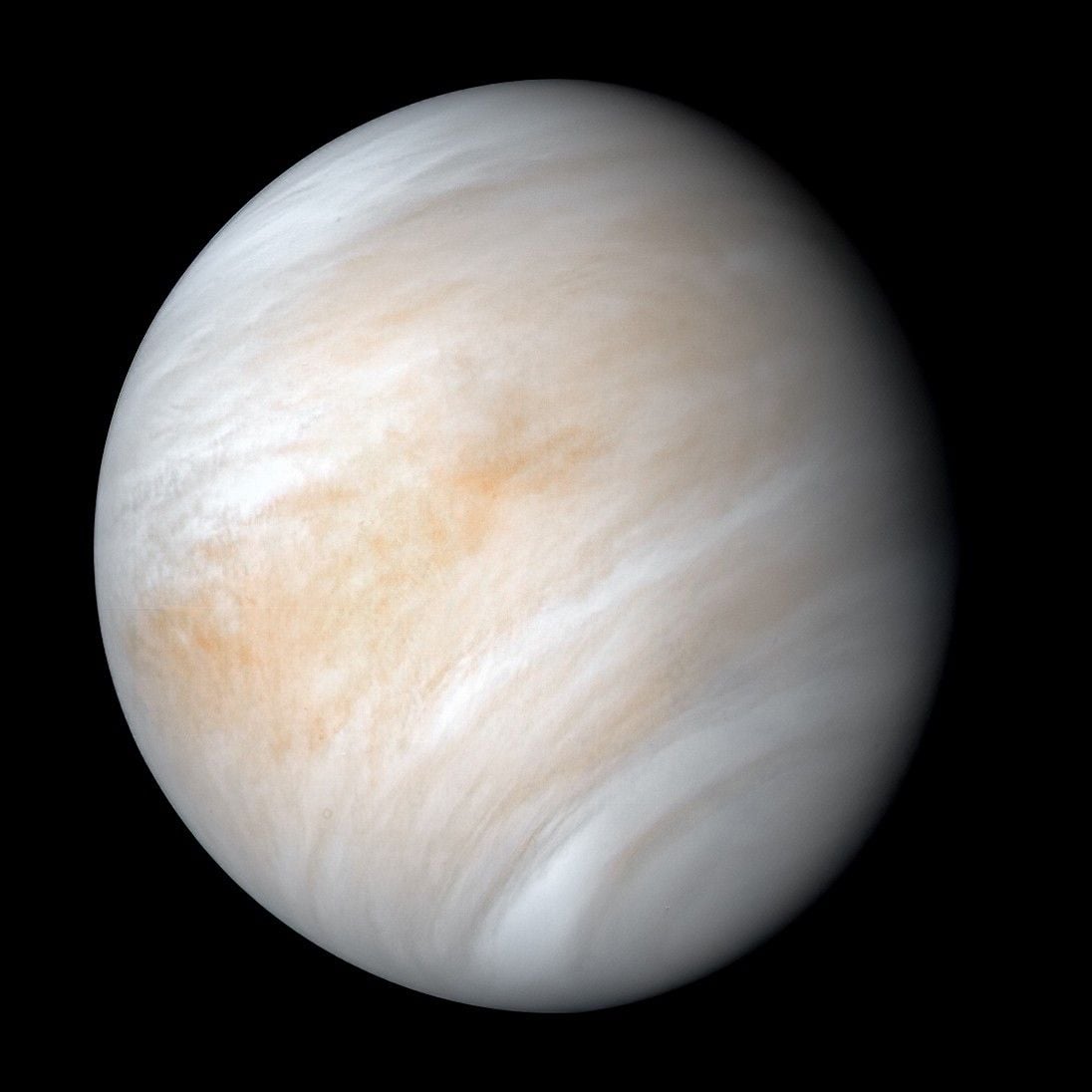
Venus itself turns with extraordinary slowness, but its upper atmosphere does not. NASA notes that near the tops of Venus’ clouds, winds can reach 224 miles per hour, or about 360 kilometres per hour. The cloud layer can circle the planet far faster than the solid body beneath it.
This is one of Venus’ central contrasts. The surface rotates over months. The atmosphere races around it. Spacecraft see a planet wrapped in bright clouds that seem smooth from afar, but those clouds sit above a world with crushing pressure, extreme heat and a circulation system unlike Earth’s.
That difference between surface rotation and atmospheric motion is part of why Venus remains scientifically useful. It is similar to Earth in size and structure, but its climate history went in another direction. Its slow retrograde spin is one piece of a larger planetary puzzle: how a rocky world near Earth in size became the hottest planet in the solar system.
The year is short because Venus is close to the Sun
Venus’ year is shorter than Earth’s for a simple orbital reason. It is the second planet from the Sun, orbiting closer in than Earth does. NASA gives its average distance from the Sun as 67 million miles, or 108 million kilometres. A smaller orbit means Venus completes one trip around the Sun in less time.
That is why its 225-Earth-day year is not surprising on its own. Mercury’s year is shorter still. The strange part is the combination: a relatively quick orbit paired with one of the slowest rotations in the solar system.
Imagine a calendar pinned to a world where the seasons barely matter, the year passes in 225 Earth days, and the planet has still not completed one turn. On Earth, a year contains 365 familiar rotations. On Venus, the relationship is inverted. The orbit runs ahead of the spin.
What “sunrise in the west” really means
The westward sunrise is not a claim about Venus having Earth’s sort of sky. The planet’s surface is hidden beneath thick clouds, and any sunlight reaching the ground would be diffuse and heavily filtered. A human observer would also need impossible protection from the heat and pressure.
The statement is about direction. Because Venus spins backward compared with Earth, the apparent motion of the Sun across the sky is reversed. On Earth, the planet’s rotation makes the Sun appear to rise in the east and set in the west. On Venus, the opposite spin means the Sun would rise in the west and set in the east.
That reversal is one of the cleaner ways to see how much of daily experience is a local accident. East and west feel fixed because we live on Earth. Morning feels quick because Earth rotates in 24 hours. A year feels long because our orbit takes 365 days. None of those relationships is universal.
Venus shows that a rocky planet can keep a familiar size while rearranging the clock almost completely.
A close world that is not Earthlike in time
Venus is often called Earth’s twin because the two planets are close in size and bulk composition. That comparison is useful only up to a point. In timekeeping, climate and surface conditions, Venus is not Earth’s twin so much as a warning that similar starting points can lead to very different worlds.
Its day is longer than its year. Its Sun rises in the west. Its noon-to-noon cycle stretches across months. Its air moves around the planet far faster than the ground turns beneath it. These are not small curiosities. They are part of why Venus is one of the most important laboratories for understanding rocky planets.
For exoplanet science, the lesson is even broader. Telescopes now find rocky worlds orbiting close to other stars, many of them likely rotating slowly or locked into unusual patterns by gravity. Venus is nearby evidence that a planet’s spin can be as important as its size or distance from the star.
The old classroom fact is still true: Venus has a day longer than its year. But the deeper point is that Venus forces the words day and year apart. On Earth they fit into a familiar rhythm. On Venus, the calendar moves on while the planet is still slowly turning, backwards, beneath a cloud-bright sky.