

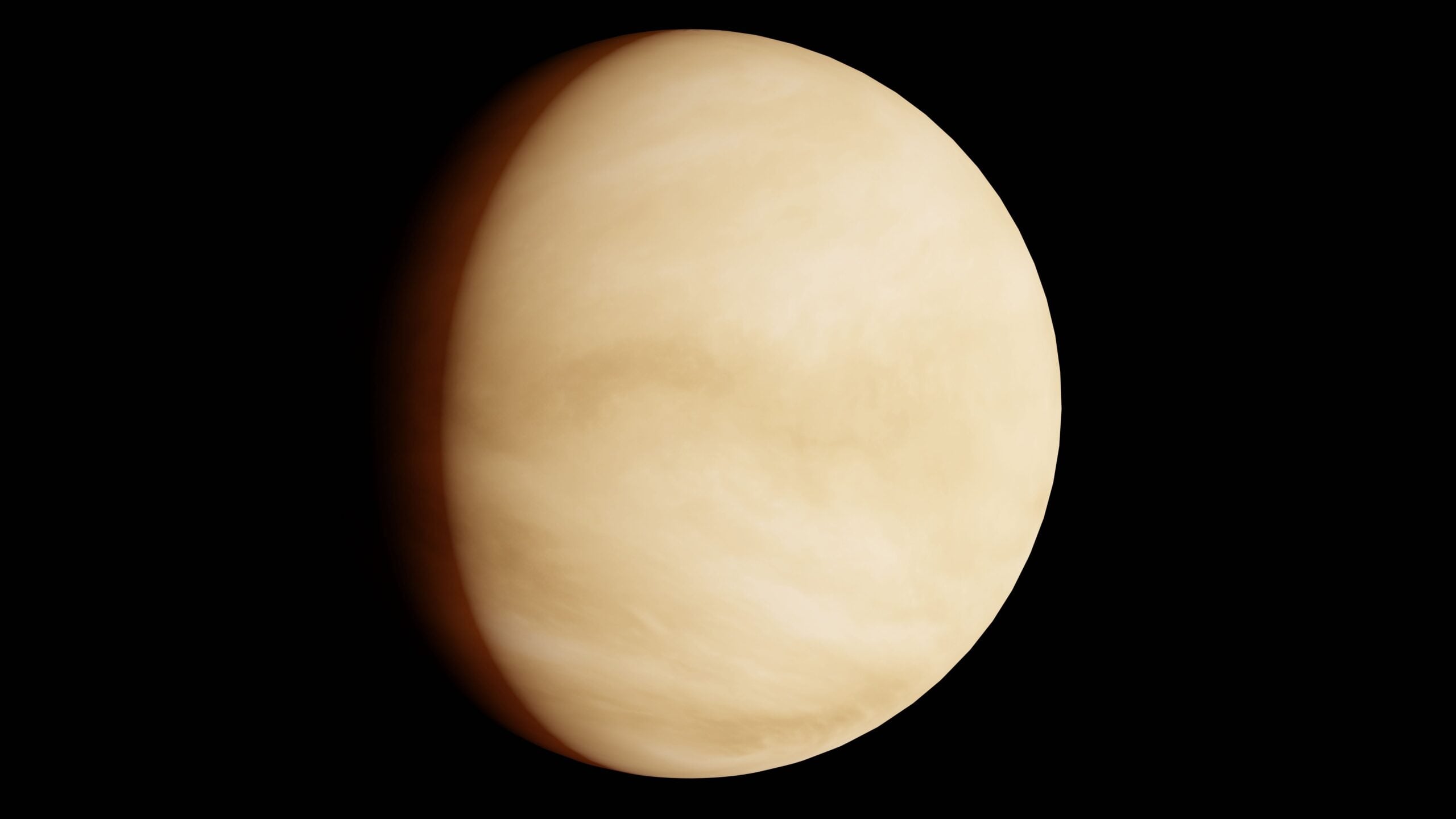
Venus earns the familiar description “Earth’s twin” from a genuine family resemblance. It is a rocky planet only slightly smaller than Earth, with comparable mass, density and surface gravity. Place the two worlds side by side without their atmospheres and the kinship would be obvious.
At ground level, however, the comparison becomes almost perverse. NASA gives Venus a surface temperature of about 467°C and pressure roughly 93 times that at Earth’s sea level. The Soviet probes that reached the ground returned data for between 23 and 127 minutes. They were not flimsy machines. They were pressure vessels built for one of the most hostile places ever explored.
Those short lifetimes are often described as if every lander was immediately crushed or melted. The real engineering story is subtler. Soviet designers largely solved the crushing-pressure problem. What they could not stop indefinitely was heat passing through the shell and turning the protected interior into part of Venus’s environment.
A twin in dimensions, not in living conditions
Venus has an equatorial diameter of about 12,104 kilometres, compared with Earth’s 12,756 kilometres. Its mass is about 82 per cent of Earth’s, and a person standing on a solid platform there would feel about 90 per cent of Earth’s surface gravity. Both planets are differentiated rocky worlds with metal-rich cores, mantles and crusts.
The apparent similarity once encouraged visions of a warm, wet planet beneath the clouds. Radar mapping and direct measurements replaced that picture with volcanic plains, deformed highlands and an atmosphere composed mostly of carbon dioxide. Thick clouds reflect much of the sunlight that reaches Venus, but the immense atmosphere prevents heat from escaping efficiently to space.
The result is a surface hotter than Mercury’s, even though Mercury is closer to the Sun. The quoted 467°C is a representative planetary value, not the temperature of every slope and summit. Elevation and location produce differences. None provides anything like an Earthly refuge, and Venus’s slow night brings no major cooling at the ground.
The word “twin” therefore describes starting materials and scale, not present climate. The contrast is the reason Venus matters. Two similar-sized neighbours reached radically different states, making their divergence a test of how rocky planets evolve.
What 93 Earth atmospheres does to a spacecraft
Ninety-three times Earth’s sea-level pressure is roughly 9.4 megapascals. In familiar terms, it is comparable to the pressure about 900 metres beneath Earth’s ocean. That analogy concerns the load on an object, not the character of its surroundings. Venus’s lower atmosphere is far less dense than seawater, even though it is extraordinarily dense for a planetary atmosphere.
Pressure acts across the whole exterior of a vehicle. A cabin kept near one atmosphere must resist the difference between its interior and the carbon-dioxide fluid outside. Flat panels are vulnerable to buckling, so the Soviet landers placed sensitive equipment inside strong, rounded pressure vessels.
Paradoxically, the dense atmosphere also helped them arrive. After surviving the high-speed entry, a probe could use parachutes and broad aerodynamic surfaces to shed velocity. In the thick lower atmosphere, the lander did not need a large rocket engine to make a soft landing.
Touchdown proved that the capsule could carry the structural load. Pressure was not a countdown that automatically crushed it after a fixed number of minutes. The endurance clock was set mainly by the relentless transfer of heat into the protected interior.
The first 23 minutes came from a signal almost missed
Venera 7 entered Venus’s atmosphere on 15 December 1970. Its parachute appears to have torn or collapsed during descent, and the signal weakened sharply at impact. Controllers initially thought the mission had ended. Careful analysis later found a faint carrier continuing for another 23 minutes from the surface.
That recovery changed the history of planetary exploration. As SpaceDaily’s earlier account of Venera 7 described, the probe became the first spacecraft to transmit data from the surface of another planet. The weak signal may have resulted from the capsule coming to rest on its side and pointing its antenna poorly, rather than from an immediate systems failure.
NASA’s Venus mission history gives Venera 7’s surface return as 23 minutes. The data were modest by later standards, but they established that the surface temperature was around 475°C and showed that a pressure vessel could survive touchdown.
Later Soviet spacecraft extended the record while adding cameras and chemical instruments. Venera 8 transmitted from the ground for about 50 minutes. Venera 9 operated for 53 minutes and returned the first photograph from the surface of another planet. Venera 11 and 12 lasted 95 and 110 minutes respectively.
Venera 13 stretched a 32-minute plan to 127
Venera 13 landed on 1 March 1982 with a planned surface lifetime of 32 minutes. It continued sending data for 127 minutes, still the longest confirmed operation by a spacecraft on Venus. During that window it scanned colour panoramas, measured the local environment, drilled into the ground and transferred a sample to an onboard analysis chamber.
The achievement deserves its careful wording. The 127 minutes records confirmed operation and communication. It is not an observed instant when the spacecraft visibly melted, collapsed or otherwise died. The carrier receiving the transmission was moving away from Venus, while the temperature inside the lander was rising. The record establishes how long useful data arrived, not the precise final condition of every component.
A previous SpaceDaily feature examined how Venera 13 turned its thermal margin into a first colour photographic record and a drilled-sample analysis. Its longevity was partly the result of robust construction and partly a reminder that a design lifetime is a requirement, not a self-destruct setting. Hardware can outperform it when real conditions and component margins are favourable.
The later Venera 14 operated for 57 minutes. The Vega 1 and Vega 2 descent craft reached Venus in 1985 and remained active on the surface for less than an hour, while balloons released higher in the atmosphere continued separately. No mission has transmitted from the Venusian ground since, so the 1982 record still stands.
Why heat won even when the hull held
The landers began their descents with cool interiors, thermal insulation and enough mass to absorb heat for a while. This created a limited reservoir of time. Every minute in the atmosphere and on the surface moved energy through the outer structure, along cables, through joints and toward the electronics.
On Earth, a refrigerator cools its interior by moving heat into a cooler surrounding environment. A Venus lander trying to protect conventional electronics faces an outside temperature hundreds of degrees above the desired internal temperature. Active cooling is possible in principle, but rejecting the accumulated heat becomes heavy, power-hungry and difficult.
Different parts also have different limits. A titanium pressure shell does not fail merely because lead would melt outside. Batteries, semiconductor junctions, insulation, solder, seals, sensors and lubricants can degrade much earlier than the main structure. A lander can remain visibly intact long after it loses the ability to measure, process or transmit data.
This is why NASA’s work on long-lived Venus concepts describes the electrical systems as succumbing to the extreme environment. “Crushed by the pressure” is a vivid simplification, but it does not explain why carefully designed capsules transmitted after landing or why their endurance varied so widely.
Future Venus machines may have to live hot
Insulating a room-temperature computer remains useful for a descent probe intended to work for an hour or two. It is a poor foundation for a station expected to last months. The more durable approach is to reduce the difference between the machine and the planet by building components that function while hot.
Silicon carbide is central to that effort. Its wide band gap allows electronic devices to operate at temperatures that disable ordinary silicon chips. High-temperature batteries, sensors, memory, wiring, seals and actuators must advance alongside the processors. A single resilient chip does not make a complete lander.
NASA-supported tests have run prototype silicon-carbide circuits in simulated Venus conditions for weeks, a substantial change from carrying a cold electronic core toward inevitable overheating. Mechanical or partly mechanical concepts offer another route for basic mobility and communication with fewer temperature-sensitive parts.
Laboratory endurance is not yet a long-lived operating station on Venus. A flight system must survive launch, the cruise from Earth, atmospheric entry, landing shocks and years of storage before its electronics ever face the surface. It must then generate power, collect useful measurements and send them through the dense atmosphere.
The failed twin is the comparison worth keeping
Earth and Venus are close enough in size that their differences cannot be dismissed as a comparison between fundamentally different classes of world. Something in their histories separated them. The timing of water loss, the role of volcanism, the recycling of carbon and the development of the present atmosphere remain active questions.
The Soviet landers supplied direct evidence from beneath clouds that otherwise conceal the ground in visible light. Their minutes of operation measured temperatures and pressures, photographed rocks and analysed surface material. Short survival did not make them failed missions. It defined the environment with an authority that remote sensing alone could not provide.
Venus is Earth’s twin in the useful planetary-science sense: not a duplicate, but a closely related world whose history became profoundly different. The 23-to-127-minute record is part of that lesson. Reaching the surface was possible with twentieth-century engineering. Staying alive there will require machines designed not merely to resist Venus, but to function as hot as Venus itself.